Mozambique has 2 UNESCO World Heritage Sites — one cultural, one natural and transnational — spread across a coastline that once anchored the Indian Ocean trade world and a wilderness ecosystem shared with South Africa. The country’s list is compact but spans an extraordinary range: a coral-island city layered with five centuries of Swahili, Portuguese, and Arab architecture; and a chain of coastal wetlands and savanna parkland that shelters elephants, humpback whales, and leatherback turtles in the same landscape. From Cultural Heritage Online.
Why Mozambique’s list looks the way it does
Mozambique’s engagement with the World Heritage Convention reflects both the richness of its heritage and the practical constraints of a country still consolidating post-conflict institutions. The World Heritage Committee inscribed the Island of Mozambique in 1991 — relatively early for sub-Saharan Africa — recognising a site that had already drawn the attention of historians, architects, and conservationists for decades. The natural site followed more than thirty years later, in 2025, when an expansion of South Africa’s iSimangaliso Wetland Park formally incorporated Mozambique’s Maputo National Park as a transnational property.
Three further sites remain on Mozambique’s tentative list, submitted between 1997 and 2008. None has yet progressed to nomination, partly because transnational and serial dossiers demand sustained coordination across ministries and borders. The tentative list nonetheless signals where future inscriptions may come: archaeological trading sites along the Indian Ocean coast, and island and mountain landscapes in the north and west of the country.
The first inscriptions
Mozambique’s first — and for three decades, its only — World Heritage inscription came in 1991. The committee recognised a single site meeting criteria iv and vi for outstanding universal value in terms of architectural typology and direct association with living traditions and historical events of global significance.
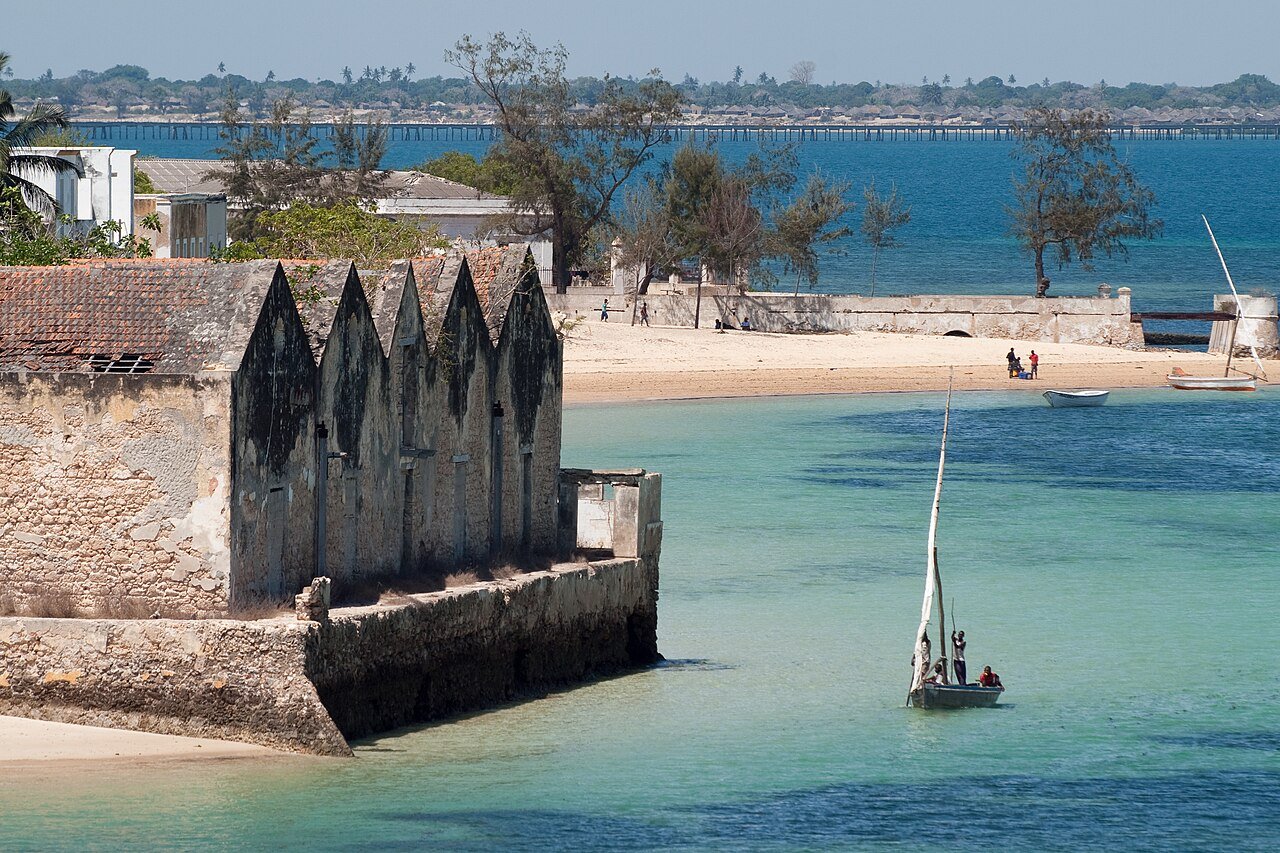
- Island of Mozambique (1991) — a small coral island in Nampula Province that served as the principal Portuguese base in the Indian Ocean from the sixteenth century. The island retains a coherent urban fabric of fortified architecture, mosques, Hindu temples, and vernacular Swahili housing, all compressed into less than two square kilometres.
No second inscription followed until 2025. During that interval, the country submitted tentative sites and engaged in early-stage work on transnational dossiers, but formal nominations did not advance — a pattern common across the region, where World Heritage candidature requires sustained technical and financial capacity that many states are still developing.
The most visited — and the alternatives
The Island of Mozambique carries most of the international attention. The Fortaleza de São Sebastião, built in the 1550s and one of the oldest intact European fortifications south of the Sahara, draws the majority of heritage visitors who reach the island, and the Church of Nossa Senhora de Baluarte — constructed in 1522 — is often cited as the oldest European building in the southern hemisphere still standing. The island is a working community as well as a monument, which gives it a social texture that purely archaeological sites rarely possess.
Beyond the headline structure, the island rewards slower attention. The Stone Town quarter contains a sequence of nineteenth-century merchant houses whose carved wooden doors and interior courtyards reflect mercantile connections reaching from Oman to Gujarat. The Macuti Town district to the south — built largely from coral block and thatch, and often overlooked by day-trippers — represents the domestic architecture of the island’s longer-resident population. On the tentative list, Manyikeni and Chibuene offer an entirely different register: two inland and coastal archaeological sites where excavated finds of Chinese porcelain, gold, and glass beads document Mozambique’s role in pre-colonial Indian Ocean commerce dating to the second millennium AD. The Quirimbas Archipelago, a string of coral islands in the far north of Cabo Delgado Province, has been on the tentative list since 2008 and combines marine biodiversity with Swahili-era settlement remains.
Natural and shared sites
Mozambique’s natural World Heritage presence arrived through a transnational extension rather than a standalone nomination. In 2025, the iSimangaliso Wetland Park — already inscribed on the World Heritage List as a South African natural site in 1999 — was formally extended to include Mozambique’s Maputo National Park, recognising the ecological continuity of the two protected areas across the border. The expanded property meets criteria vii, ix, and x, covering outstanding natural beauty, ongoing ecological processes, and biodiversity of global significance, including marine turtle nesting beaches, coral reef systems, and large mammal corridors used by elephant and hippopotamus populations moving between the two countries.
The transnational format reflects a broader trend in African conservation: serial and cross-border nominations that acknowledge how ecosystems and migratory species do not respect national boundaries. For Mozambique, the Maputo National Park inscription also represents a formal international recognition of conservation progress in a coastal wilderness area that suffered significant wildlife losses during the civil war period and has undergone sustained recovery since the late 1990s.
How to find them
Both of Mozambique’s inscribed sites are accessible by organised visit, though they require advance planning. The Island of Mozambique is reached by road bridge from the mainland near Nampula and receives international visitors through a small guesthouse and hotel infrastructure that has grown steadily since the 1990s. The transnational iSimangaliso–Maputo National Park property is accessible from the South African side via the well-developed iSimangaliso Wetland Park infrastructure, or from Mozambique through Maputo National Park’s northern gate, roughly 90 kilometres from the capital Maputo.
Mozambique’s World Heritage sites sit alongside thousands of other places on CHO’s interactive map, with GPS and sourced editorial history for each. See also our guides to Italy’s and France’s UNESCO sites, and our piece on cultural travel beyond mass tourism.
Frequently Asked Questions
How many UNESCO World Heritage Sites does Mozambique have?
Mozambique has 2 UNESCO World Heritage Sites as of 2025: the Island of Mozambique (cultural, inscribed 1991) and the transnational iSimangaliso Wetland Park extension including Maputo National Park (natural, inscribed 2025). Three additional sites remain on the country’s tentative list awaiting formal nomination.
What was Mozambique’s first UNESCO World Heritage Site?
The Island of Mozambique was the country’s first inscription, added to the World Heritage List in 1991. A small coral island in Nampula Province, it was recognised for its exceptional concentration of Portuguese colonial-era fortifications, Swahili merchant architecture, mosques, and Hindu temples dating from the sixteenth century onward.
What is the most recently inscribed World Heritage Site in Mozambique?
The most recent inscription is the transnational extension of iSimangaliso Wetland Park to include Mozambique’s Maputo National Park, which achieved World Heritage status in 2025. The property spans the South Africa–Mozambique border and protects a coastal ecosystem supporting marine turtles, elephants, and coral reef systems meeting three natural criteria.
Does Mozambique have any natural UNESCO World Heritage Sites?
Yes — the iSimangaliso Wetland Park (including Mozambique’s Maputo National Park) is Mozambique’s sole natural World Heritage Site, inscribed as a transnational property shared with South Africa in 2025. The site meets criteria vii, ix, and x for its outstanding scenery, ecological processes, and globally significant biodiversity along the Indian Ocean coast.
Sources used in this article
- UNESCO — State Party Mozambique — World Heritage list.
- UNESCO — Mozambique: World Heritage Sites.
- CHO magazine — What is a World Heritage Site?
- CHO — Interactive map of heritage sites.
Sources
- S1 — Newitt, Malyn. A History of Mozambique. Indiana University Press, 1995. ISBN 978-0-253-34006-1.
- S2 — Sinclair, Paul J. J. Space, Time and Social Formation: A Territorial Approach to the Archaeology and Anthropology of Zimbabwe and Mozambique. Societas Archaeologica Upsaliensis, 1987. ISBN 978-91-506-0640-9.
Spotted an error? Write to editorial@culturalheritageonline.com and we correct it the same day.