Cairo sits at the threshold of an extraordinary concentration of world heritage. Within the city itself, the medieval fabric of Historic Cairo preserves one of the densest accumulations of Islamic architecture anywhere on earth. Twenty-five kilometres to the southwest, the Giza Plateau holds the last standing Wonder of the Ancient World. Four hours further into the Western Desert, the silences of Wadi Al-Hitan shelter whale skeletons that rewrote the textbooks on vertebrate evolution. These four UNESCO inscriptions — spanning some 40 million years of natural and human history — are the reason Cairo remains one of the world’s great destinations for heritage travel. From Cultural Heritage Online.
Memphis and its Necropolis — the Great Pyramids of Giza 40 min from Tahrir Square
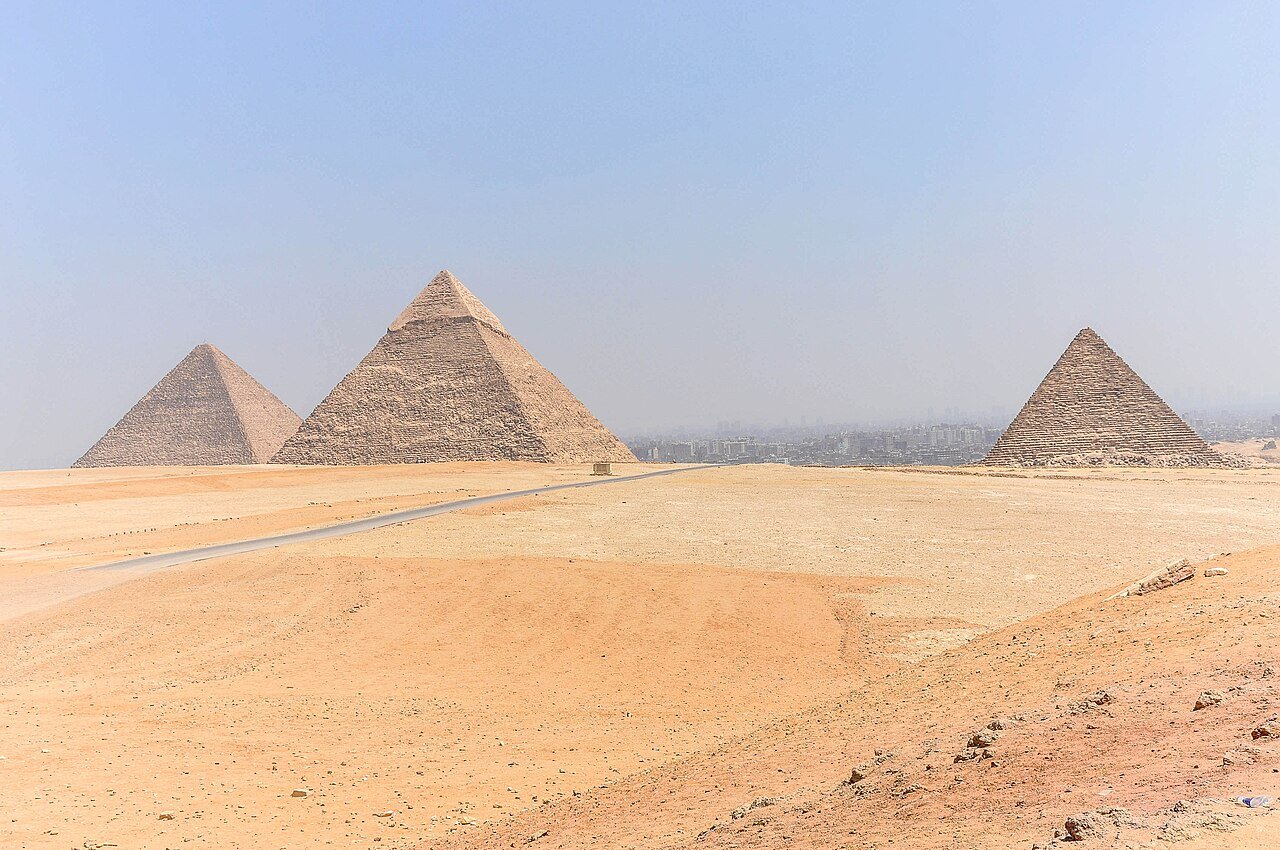
UNESCO inscribed Memphis and its Necropolis — the Pyramid Fields from Giza to Dahshur in 1979, among the very first sites placed on the World Heritage List. The site spans more than 30 kilometres of desert plateau on the Nile’s west bank and encompasses the necropolises of Giza, Saqqara, Abusir, and Dahshur. At its northern end, the Great Pyramid of Khufu (Cheops) stands 138.5 metres tall today — reduced from its original 146.6 metres after the smooth Tura limestone casing was stripped for medieval Cairo’s construction. Pharaoh Khufu, ruling during the Fourth Dynasty around 2600 BCE, directed the assembly of some 2.3 million stone blocks weighing 6 million tonnes in total. The mass is staggering in person: the base of each side measures roughly 230 metres, and the shadow the structure casts across the plateau at sunrise covers ground the size of several city blocks. The adjacent pyramids of Khafra and Menkaura complete the triad visible from the plateau’s rim.
Getting there: 25 km from Cairo centre — approximately 40 minutes by taxi or Uber from Tahrir Square; alternatively take Metro Line 2 to Giza station, then a short taxi onward to the plateau entrance. Allow: Half a day minimum; a full day if combining with Saqqara. Best for: Anyone seeking to stand before the only ancient Wonder still intact — the scale is impossible to appreciate from photographs alone.
Great Sphinx of Giza On the Giza Plateau
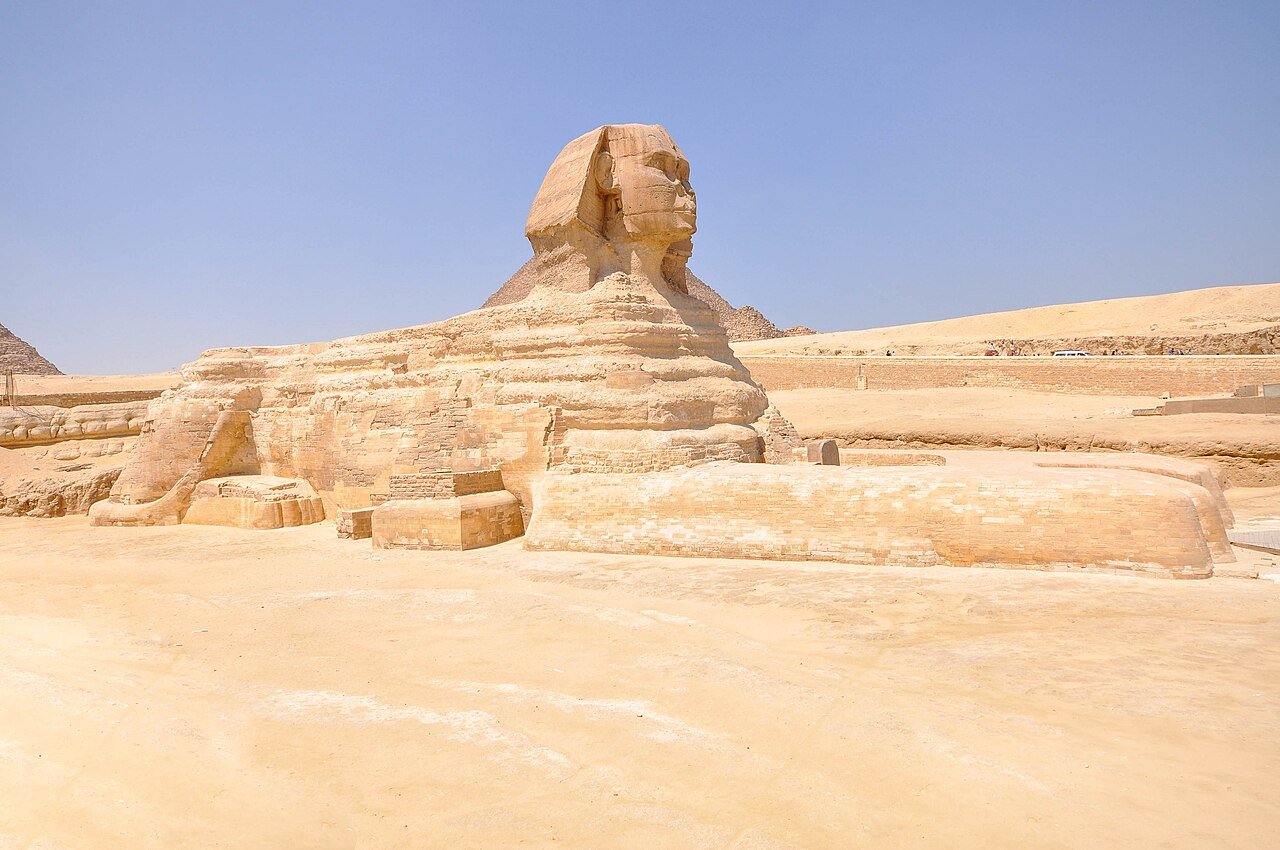
The Great Sphinx occupies a hollow in the Giza Plateau just east of the pyramid of Khafra, carved from a single outcrop of Eocene-aged Mokattam Formation limestone during the reign of Pharaoh Khafra (c. 2558–2532 BCE). It is the oldest known monumental sculpture in Egypt. The statue’s dimensions are formidable: 73.5 metres long, 19.3 metres wide, and 20.22 metres high — roughly equivalent to a six-storey building. The human face, wearing the nemes royal headdress, surveys the eastern horizon and greets the sunrise each morning. Up close, the weathered limestone surface reveals centuries of erosion, repairs with smaller blocks, and the stump of what was once a pharaonic beard, fragments of which now sit in the British Museum and the Egyptian Museum in Cairo. The Sphinx forms part of the same UNESCO inscription as the pyramids — Memphis and its Necropolis, 1979 — and is included in the same site ticket.
Getting there: The Sphinx is within the Giza Plateau complex, a short walk southeast of the Great Pyramid. No separate transport is required; it is accessed through the same ticketed enclosure. Allow: 30 minutes combined with the pyramid visit — the Sphinx viewpoint is a distinct stop within the site. Best for: Understanding the scale of Fourth Dynasty royal ambition; the panoramic view of Sphinx and pyramid together from the eastern approach is the definitive image of ancient Egypt.
Historic Cairo — Citadel and Mosque of Muhammad Ali 30 min from Tahrir Square
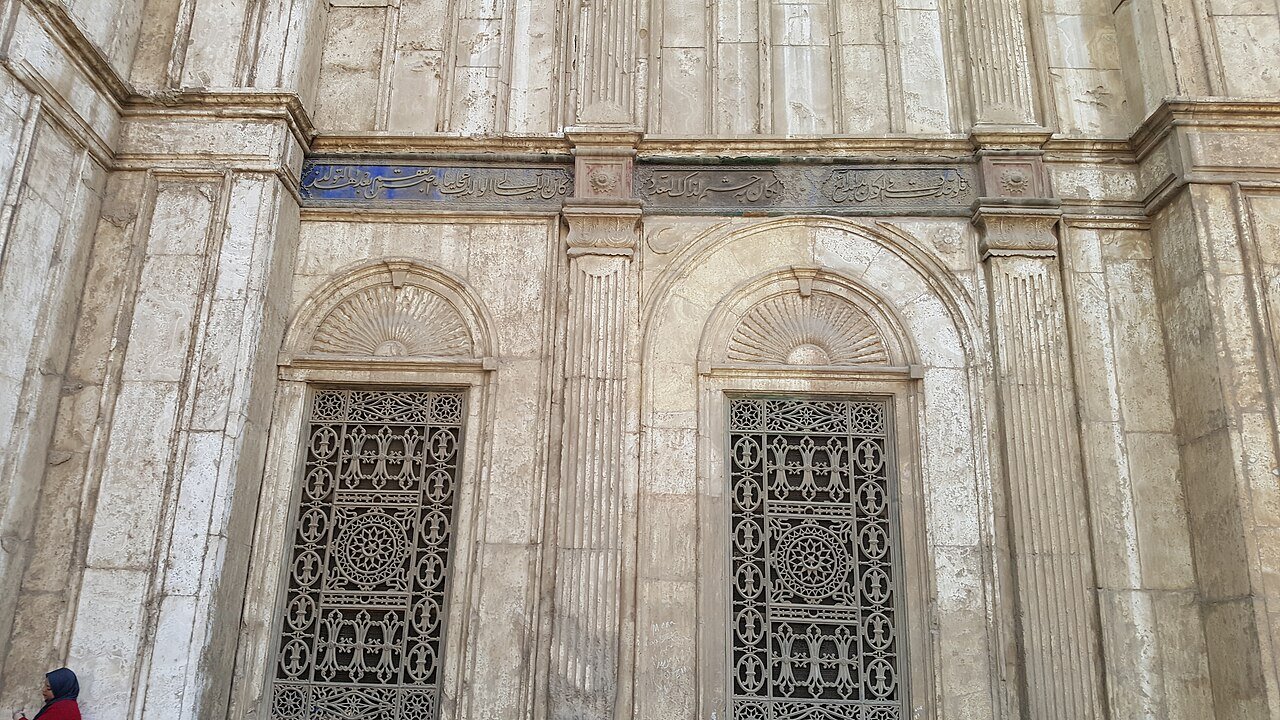
UNESCO inscribed Historic Cairo in 1979, recognising it as one of the world’s oldest Islamic cities, covering 523 hectares of medieval urban fabric that reached its peak during the Mamluk period. At its centre stands the Citadel, begun by Saladin (Salah ad-Din) in 1176 CE on a spur of the Mokattam hills; it served as Egypt’s seat of government and royal residence for roughly 700 years. Dominating the Citadel’s skyline is the Mosque of Muhammad Ali Pasha, constructed between 1832 and 1857 in an Ottoman and European-influenced style that departs sharply from the Mamluk tradition of the surrounding city. The architect — likely Greek or Armenian — modelled it on Istanbul’s great imperial mosques, giving it a central dome 21 metres in diameter rising to 52 metres at its apex. The interior walls are clad in alabaster — Muhammad Ali’s deliberate revival of a local quarrying industry — giving the prayer hall a cool, pale luminosity that contrasts with Cairo’s dusty light outside. From the Citadel’s walls, the view across the city toward the Giza Plateau on a clear day is exceptional.
Getting there: Approximately 30 minutes from Tahrir Square by Metro or Uber; exit at Al-Malik al-Saleh or take a taxi directly to the Citadel gate on Salah Salem Street. Allow: 3–4 hours to see the Citadel complex, including the Military Museum and the views from the ramparts. Best for: The full sweep of Cairo’s Islamic heritage in a single visit — the Citadel commands both the history and the panorama.
Wadi Al-Hitan — Whale Valley 4 hrs 30 min by 4WD from Cairo
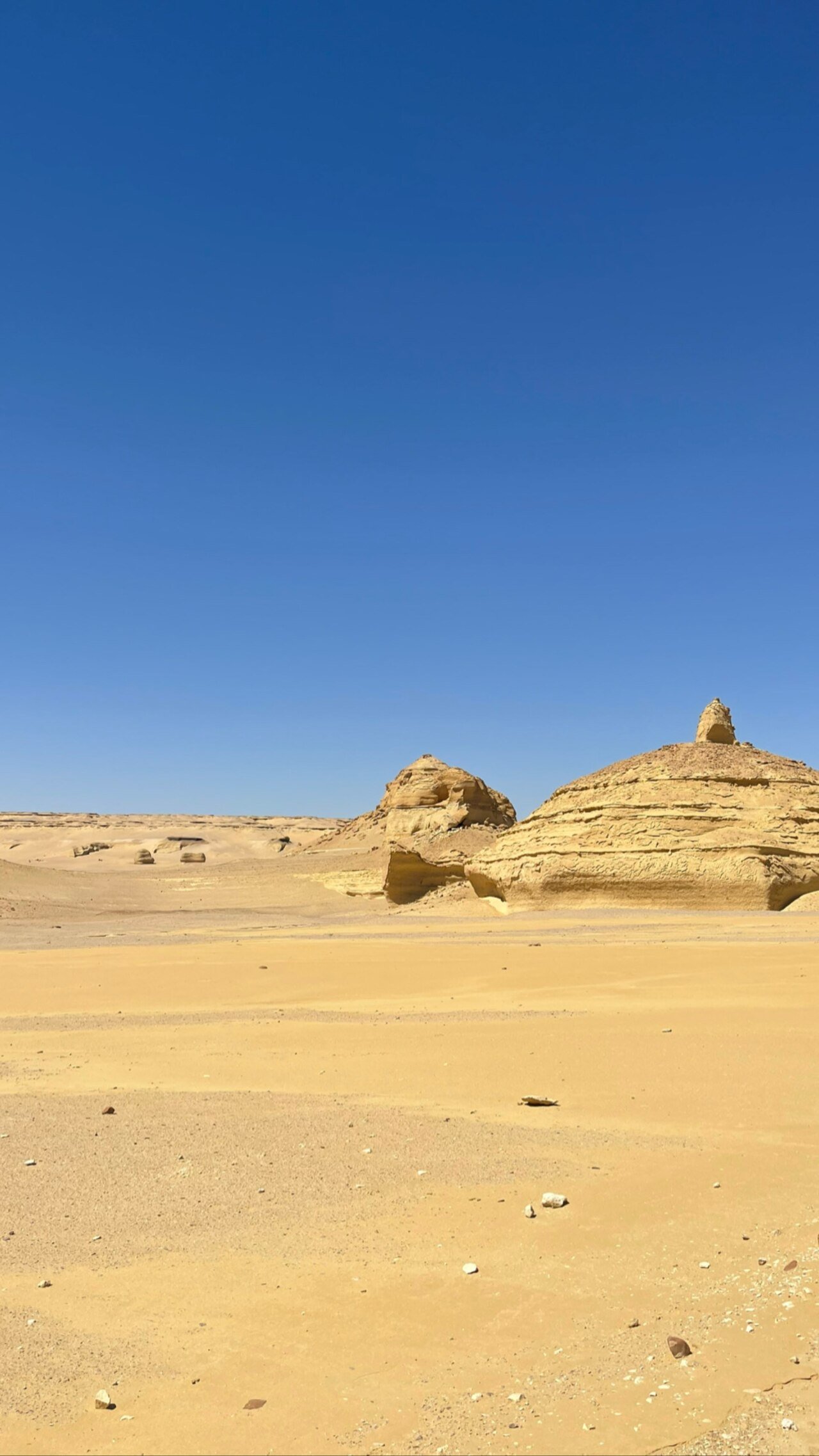
UNESCO inscribed Wadi Al-Hitan — Whale Valley — in 2005, recognising it as the finest site on earth for understanding one of palaeontology’s great questions: how did whales transition from land-dwelling mammals to ocean creatures? The 200 km² site in the Faiyum Governorate, approximately 150 kilometres southwest of Cairo, contains around 1,500 documented marine vertebrate fossil skeletons dating to the Middle Eocene, roughly 40–41 million years ago. Two species dominate: Basilosaurus, reaching up to 21 metres in length, and the smaller Dorudon, measuring 3–5 metres. Both retained functional hind legs, feet, and toes — the anatomical evidence that settled decades of scientific debate. Exposed by wind erosion in the Western Desert’s sculpted badlands, the fossils lie in open air along walkways, with stratified sandstone cliffs as a backdrop. The silence and the scale of the landscape are part of the experience. This site requires genuine logistical commitment: an overnight stay at the on-site campsite is strongly recommended, as the round-trip drive from Cairo is nearly nine hours.
Getting there: A private car or 4WD is essential — there is no public transport to Wadi Al-Hitan. The drive from Cairo takes approximately 4 hours 30 minutes via the Faiyum Desert Road. Entry requires a permit from the Wadi El Rayan Protected Area authorities; guided trails are mandatory within the site. Allow: 2–3 hours on site, but plan for a full day or overnight given the drive. Best for: Palaeontology enthusiasts and desert travellers who want a UNESCO site seen by fewer than 1,000 visitors per year.
Frequently Asked Questions
How many UNESCO World Heritage Sites are near Cairo?
Cairo is the access point for four UNESCO World Heritage Sites. Two were inscribed in 1979 — Memphis and its Necropolis (which includes the Giza Pyramids and Sphinx) and Historic Cairo — and one in 2005: Wadi Al-Hitan (Whale Valley). The Giza sites and Historic Cairo are within the city or its immediate periphery; Wadi Al-Hitan requires a half-day drive into the Western Desert.
What is the closest UNESCO World Heritage Site to Cairo city centre?
Historic Cairo — inscribed in 1979 — is within the city itself and reachable from Tahrir Square in roughly 30 minutes by Metro or taxi. The Citadel and Mosque of Muhammad Ali are its most prominent landmarks. The Giza Pyramids, part of the Memphis and its Necropolis inscription, are 25 kilometres from the city centre and take about 40 minutes by taxi or Uber.
What is the best season to visit the Giza Pyramids and Wadi Al-Hitan?
October through April is the most comfortable period for both sites. Cairo’s summer temperatures regularly exceed 38°C (100°F), making open-air exploration of the Giza Plateau and the exposed desert badlands of Wadi Al-Hitan genuinely taxing. Winter mornings at Giza are cool and the light is excellent for photography; Wadi Al-Hitan is at its most tolerable in December and January, when daytime temperatures can remain below 20°C.
Do visitors to Egypt need a visa, and is it available on arrival?
Most nationalities — including citizens of the United States, the United Kingdom, the European Union, Canada, and Australia — can obtain a tourist visa on arrival at Cairo International Airport or purchase an e-Visa online before travel. The standard tourist visa allows stays of up to 30 days, extendable once in-country. Travellers should verify current requirements with the Egyptian consulate or official e-Visa portal before departure, as policies can change.
Sources
- S1 — Lehner, Mark. The Complete Pyramids. Thames & Hudson, 1997. ISBN 978-0-500-05084-2.
- S2 — Raymond, André. Cairo. Harvard University Press, 2000. ISBN 978-0-674-00316-3.
Spotted an error? Write to editorial@culturalheritageonline.com and we correct it the same day.