Bangladesh has three UNESCO World Heritage Sites: two cultural and one natural, inscribed across twelve years that trace the country’s journey from ancient Buddhist scholarship to the world’s largest mangrove delta. Small in number yet striking in range, the list spans a thirteenth-century mosque city, a monastic university complex that once drew students from across Asia, and a coastal wilderness shared with India where land and sea refuse to settle into fixed boundaries. From Cultural Heritage Online.
Why Bangladesh’s list looks the way it does
Bangladesh ratified the World Heritage Convention in 1983, moving quickly to submit nominations that reflected the country’s deepest archaeological layers rather than its more recent history. The result is a list weighted toward the pre-Mughal and early medieval periods — Buddhist viharas, sultanate mosques — rather than the Mughal and colonial fabric that dominates many neighbouring South Asian lists. This is partly a matter of survival: Dhaka’s Mughal monuments exist but remain on the tentative list, where several have waited for decades.
The country currently has seven sites on its tentative list, including the modernist architectural legacy of Muzharul Islam and a group of four Mughal brick fortifications in the Dhaka region. Neither has yet reached the inscription stage, which means Bangladesh’s formal count of three sites is likely to grow modestly in coming years if nominations advance through UNESCO’s evaluation cycle.
The first inscriptions
Both of Bangladesh’s inaugural inscriptions arrived together in 1985, an unusual double debut that placed the country immediately on the world heritage map with two sites of significant scholarly interest:
- Mosque City of Bagerhat — a sultanate-era city in the southwestern delta, built in the fifteenth century and containing dozens of mosques in a landscape now partly reclaimed by forest.
- Ruins of the Buddhist Vihara at Paharpur — the remains of a vast monastic university founded in the eighth century, once one of the most important centres of Buddhist learning in the subcontinent.
The simultaneity of these inscriptions was deliberate: both had been under study for years, and Bangladesh’s newly ratified commitment to the Convention gave momentum to push them through together. They remain the anchors of the national list.
The most visited — and the alternatives
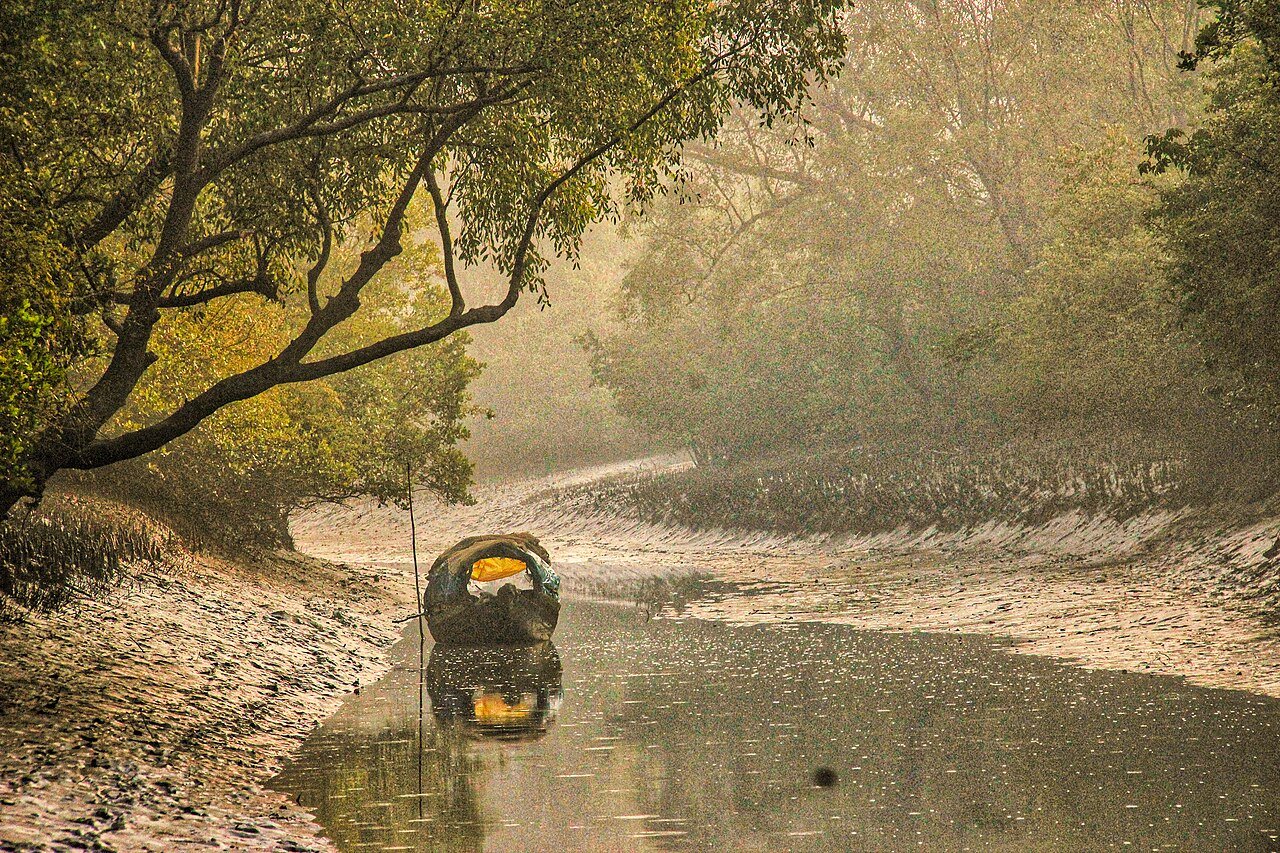
Among the three inscribed sites, the Sundarbans draws the widest international attention, partly because wildlife tourism has a broader market than archaeological tourism, and partly because the mangrove delta offers an experience — boat travel through tidal channels, glimpses of the Bengal tiger — that cannot be replicated elsewhere. The Mosque City of Bagerhat has a strong regional following and is accessible from Khulna, while Paharpur attracts scholars and Buddhist pilgrimage visitors from across Asia.
Three sites on Bangladesh’s tentative list deserve more attention than they typically receive. Mahasthangarh, along the Karatoya River in Rajshahi division, contains city ruins dating to at least the third century BCE, making it among the oldest known urban sites in the subcontinent. Mainamati, near Comilla, holds roughly fifty Buddhist settlement ruins spanning several centuries of continuous occupation. Halud Vihara, also in Rajshahi, is a Buddhist monastery site where excavations have yielded terracotta plaques and metal artefacts that suggest a sophisticated artistic tradition largely unknown outside specialist circles.
Natural and shared sites
The Sundarbans, inscribed in 1997, is Bangladesh’s only natural World Heritage Site and one of the most ecologically significant landscapes in South Asia. The site covers the Bangladesh portion of the world’s largest tidal mangrove forest — a network of islands, mudflats, and waterways at the mouths of the Ganges, Brahmaputra, and Meghna rivers. It is home to the Bengal tiger, Irrawaddy dolphin, estuarine crocodile, and an extensive bird community adapted to brackish conditions.
The Sundarbans is a transnational inscription in all but formal structure: the adjacent Sundarbans National Park on the Indian side of the border was inscribed separately in 1987, and both sites share the same continuous ecosystem. They are managed independently by their respective governments but are understood by UNESCO as parts of a single ecological unit. Any serious engagement with the Bangladesh site benefits from consulting the broader transboundary context.
How to find them
All three inscribed sites are accessible by public transport, though the Sundarbans requires a boat journey from Khulna or Mongla that is best arranged through a licensed operator. Paharpur sits near the town of Joypurhat and is reachable by train and local transport from Rajshahi. Bagerhat is a short ride from Khulna and can be combined with a Sundarbans visit in a single itinerary.
Bangladesh’s World Heritage sites sit alongside thousands of other places on CHO’s interactive map, with GPS and sourced editorial history for each. See also our guides to Italy’s and France’s UNESCO sites, and our piece on cultural travel beyond mass tourism.
Frequently Asked Questions
How many UNESCO World Heritage Sites does Bangladesh have?
Bangladesh has three UNESCO World Heritage Sites: the Mosque City of Bagerhat, the Ruins of the Buddhist Vihara at Paharpur, and the Sundarbans. Two are classified as cultural sites and one as natural. The country also maintains seven sites on the UNESCO tentative list, which may yield future inscriptions.
What was Bangladesh’s first UNESCO World Heritage Site?
Bangladesh achieved two simultaneous first inscriptions in 1985: the Mosque City of Bagerhat and the Ruins of the Buddhist Vihara at Paharpur. Both were recognised in the same year, making it impossible to designate a single “first” — the country entered the World Heritage list with two sites at once.
Is the Sundarbans shared between Bangladesh and India?
The Sundarbans ecosystem spans both countries, but the inscriptions are separate. India’s Sundarbans National Park was inscribed in 1987, while Bangladesh’s portion was inscribed in 1997. UNESCO treats them as parts of a single ecological unit, though they are managed independently by each government.
When did Bangladesh join the UNESCO World Heritage Convention?
Bangladesh ratified the World Heritage Convention on 3 August 1983, just two years before its first sites were inscribed. This relatively swift transition from ratification to inscription reflects how thoroughly the country’s key archaeological sites had already been studied and documented by that point.
Sources used in this article
- UNESCO — State Party Bangladesh — World Heritage list.
- UNESCO — Bangladesh: World Heritage Sites.
- CHO magazine — What is a World Heritage Site?
- CHO — Interactive map of heritage sites.
Sources
- S1 — Eaton, Richard M. The Rise of Islam and the Bengal Frontier, 1204–1760. University of California Press, 1993. ISBN 978-0-520-20507-9.
- S2 — Seidensticker, John, et al. Riding the Tiger: Tiger Conservation in Human-Dominated Landscapes. Cambridge University Press, 1999. ISBN 978-0-521-64835-6.
Spotted an error? Write to editorial@culturalheritageonline.com and we correct it the same day.