Georgia has four UNESCO World Heritage Sites: a compact but strikingly varied list that ranges from early Christian church complexes rising above the confluence of two rivers to primeval forests surviving along what was once the ancient Colchis coast. Each inscription tells a different chapter of a country that sits at the crossroads of the Caucasus, where Silk Road trade routes, Byzantine influence, and Persian pressure shaped an architectural tradition unlike anything else in Europe or western Asia. From Cultural Heritage Online.
Why Georgia’s list looks the way it does
Georgia ratified the World Heritage Convention in 1992, two years after independence, and the pace of inscription since then has been measured rather than rapid. The country currently holds three cultural sites and one natural site, a ratio that reflects both the extraordinary density of medieval ecclesiastical architecture in the Caucasus and the recent international recognition of Georgia’s ancient forest ecosystems. The list remained at three entries for a quarter of a century before the Colchic Rainforests and Wetlands joined in 2021.
A notable complication shapes the history of the list. The 1994 inscription of Bagrati Cathedral and Gelati Monastery was later split: Bagrati Cathedral was removed from the designation in 2017 after reconstruction work was judged to have damaged the site’s integrity and authenticity. Gelati Monastery retained its inscription. That delisting, rare in World Heritage history, underlines how reconstruction decisions carry long-term institutional consequences for a country’s heritage standing.
The first inscriptions
Two nominations reached the World Heritage Committee simultaneously in 1994, establishing the foundation of Georgia’s list at a moment when the country was navigating post-Soviet transition. Both anchored themselves in the medieval Georgian kingdom at its most confident.
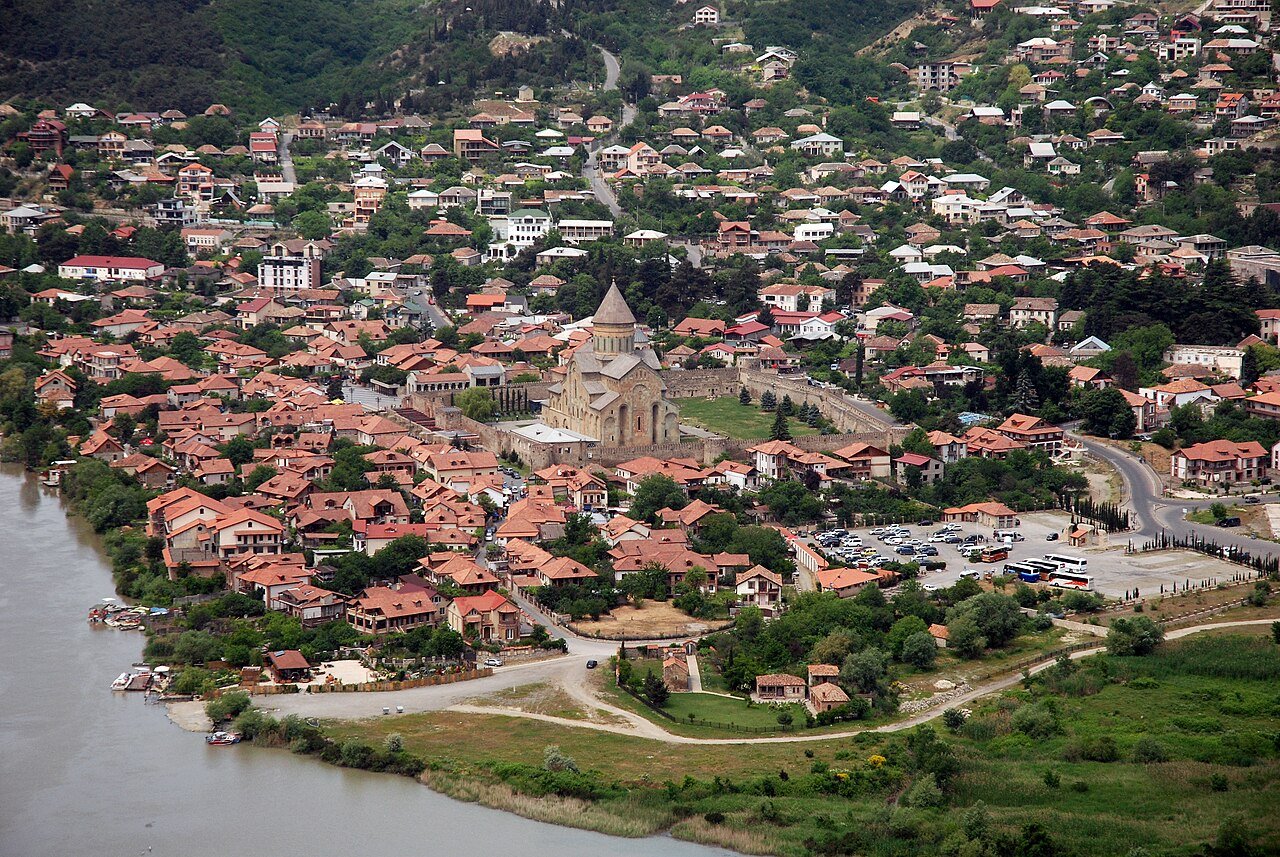
- Historical Monuments of Mtskheta (1994) — the ancient capital of Iberia, where Jvari Monastery, Svetitskhoveli Cathedral, and Samtavro Monastery form a concentration of early Christian architecture that has defined Georgian religious identity since the fourth century.
- Gelati Monastery (1994) — founded in 1106 by King David IV (“the Builder”) during Georgia’s Golden Age, the monastery complex outside Kutaisi was conceived as a centre of intellectual and spiritual life and contains some of the finest medieval Georgian mosaic work surviving anywhere.
Both sites were recognised for representing the development of medieval Georgian architectural forms — a tradition that absorbed Byzantine models and transformed them into something distinctly local, visible in the treatment of stone carving, fresco programmes, and the proportions of the cruciform church plan.
The most visited — and the alternatives
Mtskheta, situated just north of Tbilisi at the confluence of the Mtkvari and Aragvi rivers, receives the largest share of international visitors among Georgia’s World Heritage properties. The view from Jvari Monastery across the valley to Svetitskhoveli Cathedral below has become one of the most reproduced images in Caucasus travel photography. Gelati draws a smaller but growing audience of visitors arriving from Kutaisi, which has gained accessibility through low-cost air routes in recent years.
Upper Svaneti, inscribed in 1996, offers a different kind of encounter. The high mountain valley in northwestern Georgia preserves more than two hundred medieval defensive towers — built by local families as combined refuges and status markers from the ninth century onward — alongside frescoed village churches that remained largely inaccessible to outside scholarship until the late twentieth century. The road into the valley from Zugdidi, now partly improved, still passes through landscapes where the towers appear to grow directly from the village fabric. Among Georgia’s tentative nominees, the David Gareji monastery complex — a network of cave monasteries cut into a semi-desert landscape on the border with Azerbaijan — and the ancient rock-cut settlement of Uplistsikhe, occupied from the second millennium BCE, represent the range of heritage that has not yet reached formal inscription.
Natural and shared sites
The Colchic Rainforests and Wetlands, inscribed in 2021, is Georgia’s only natural World Heritage Site and its most recent inscription overall. The designation covers seven distinct properties across three regions of western Georgia, encompassing ancient temperate rainforests — part of the broader Colchic refuge that survived the last ice age — alongside peat bogs and wetlands that support internationally significant populations of migratory birds. The Colchic zone is one of the few areas in the world where the forest composition of the Tertiary period can still be observed, making it of considerable interest to biogeographers alongside ecotourists.
Georgia does not currently hold any jointly inscribed transnational World Heritage properties, though the David Gareji monasteries on its tentative list sit along a border where the question of shared stewardship with Azerbaijan has at times been diplomatically sensitive. The Colchic Rainforests inscription, developed in coordination with international conservation bodies, suggests Georgia’s growing capacity to prepare technically complex natural nominations.
How to find them
All four inscribed sites are accessible by road, though Upper Svaneti requires the most planning: the main access route from Zugdidi climbs into the Greater Caucasus range, and the season for comfortable travel runs roughly from late May through October. Mtskheta is a half-day excursion from Tbilisi; Gelati sits close to Kutaisi and can be combined with the Sataplia Nature Reserve. The Colchic Rainforests properties are distributed across the Adjara, Guria, and Samegrelo-Zemo Svaneti regions, several of them within or adjacent to existing protected areas.
Georgia’s World Heritage sites sit alongside thousands of other places on CHO’s interactive map, with GPS and sourced editorial history for each. See also our guides to Italy’s and France’s UNESCO sites, and our piece on cultural travel beyond mass tourism.
Frequently Asked Questions
How many UNESCO World Heritage Sites does Georgia have?
Georgia has four UNESCO World Heritage Sites as of 2021: three cultural (Historical Monuments of Mtskheta, Gelati Monastery, and Upper Svaneti) and one natural (Colchic Rainforests and Wetlands). The country also maintains fourteen properties on its tentative list awaiting future nomination.
What was Georgia’s first UNESCO World Heritage Site?
Georgia received its first two inscriptions simultaneously in 1994: the Historical Monuments of Mtskheta and the Gelati Monastery complex (originally inscribed together with Bagrati Cathedral). Both nominations were submitted shortly after Georgia ratified the World Heritage Convention following independence.
What happened to Bagrati Cathedral’s World Heritage status?
Bagrati Cathedral in Kutaisi was inscribed alongside Gelati Monastery in 1994 but placed on the List of World Heritage in Danger in 2010 after reconstruction works raised concerns about its authenticity. In 2017 the World Heritage Committee removed it from the inscribed list — one of the relatively rare cases of a formal delisting in the Convention’s history.
What is the Colchic Rainforests and Wetlands site?
The Colchic Rainforests and Wetlands, inscribed in 2021, is Georgia’s only natural World Heritage property. It covers seven distinct areas across western Georgia encompassing ancient temperate rainforests that survived the last ice age, alongside peat bogs and wetlands of international importance for migratory birds.
Sources used in this article
- UNESCO — State Party Georgia — World Heritage list.
- UNESCO — Georgia: World Heritage Sites.
- CHO magazine — What is a World Heritage Site?
- CHO — Interactive map of heritage sites.
Sources
- S1 — Rayfield, Donald. Edge of Empires: A History of Georgia. Reaktion Books, 2012. ISBN 978-1-78023-030-6.
- S2 — Suny, Ronald Grigor. The Making of the Georgian Nation. Indiana University Press, 1994. ISBN 978-0-253-20915-3.
Spotted an error? Write to editorial@culturalheritageonline.com and we correct it the same day.