South Africa has 12 UNESCO World Heritage Sites, a collection that spans ancient human origins, extraordinary biodiversity, the geological record of a primordial asteroid impact, and the living memory of political struggle. No other country on the continent combines all four of those registers in a single list. From Cultural Heritage Online.
Why South Africa’s list looks the way it does
South Africa’s inscriptions reflect two overlapping roles the country plays in global heritage scholarship. It sits at one of the oldest continuously occupied regions on Earth, where the deep record of human evolution and early behavioural modernity is preserved in its caves and rock shelters. At the same time, the post-apartheid democratic transition produced sites of recent political history whose significance was recognised unusually quickly by UNESCO standards.
The result is a list weighted toward cultural designations — seven of the twelve sites carry that classification — alongside four natural properties and one mixed site. Two inscriptions in 2024 brought the total to its current figure, and both addressed different ends of the human timeline: one reaching back into the Pleistocene, the other anchored in the twentieth century.
The first inscriptions
South Africa received its first three inscriptions simultaneously in 1999, a cohort that set the tone for everything that followed. Each of the three represents a distinct dimension of the country’s heritage:
- Fossil Hominid Sites of South Africa — a serial property encompassing cave systems including the Cradle of Humankind, where fossils of early hominins have been recovered in significant numbers since the 1930s.
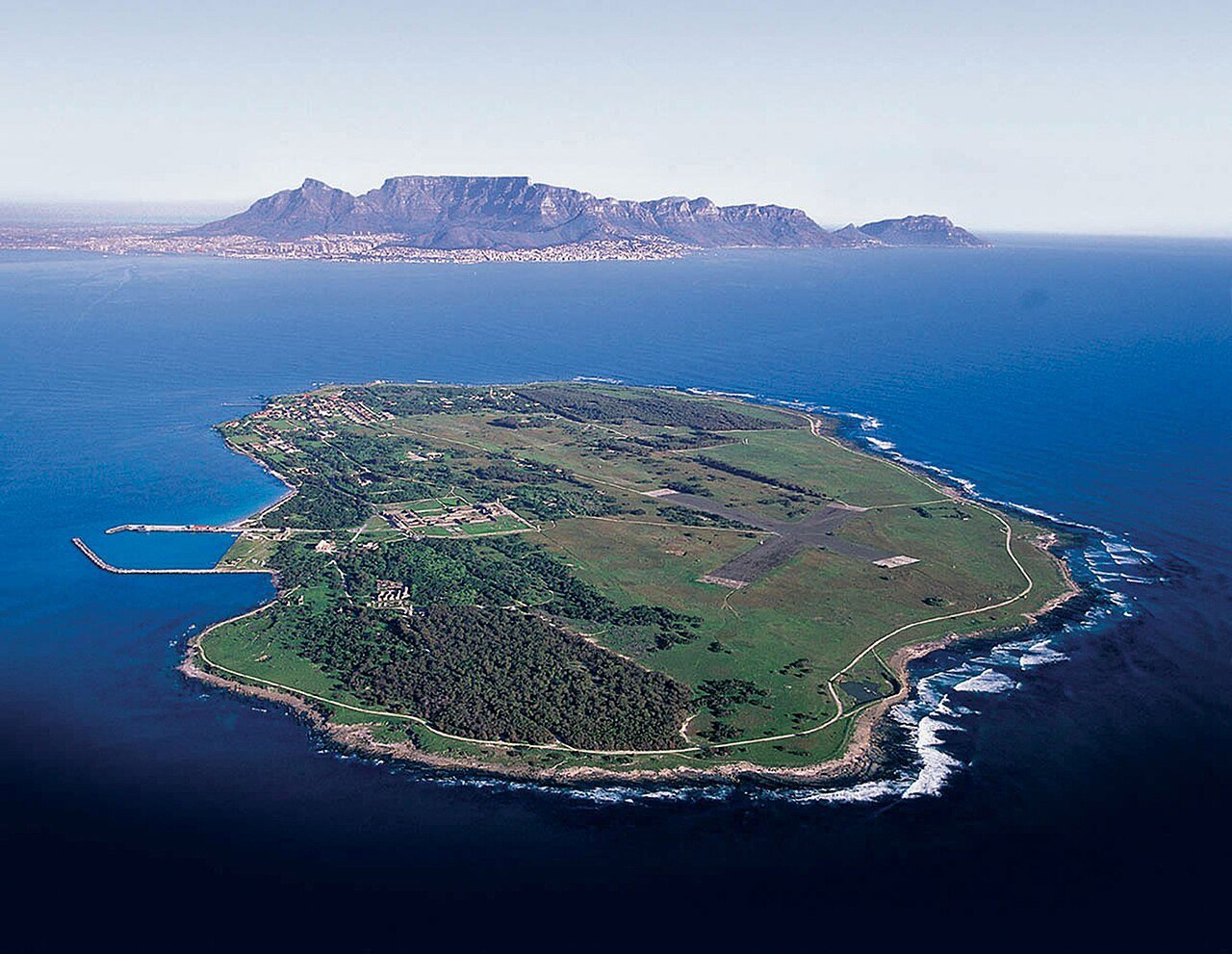
- Robben Island — the island off Cape Town where Nelson Mandela and other anti-apartheid political prisoners were held; inscribed as a symbol of the triumph of human dignity over oppression.
- iSimangaliso Wetland Park — a coastal mosaic of lakes, wetlands, coral reefs, and beach forest on the KwaZulu-Natal coast, recognised for its exceptional natural diversity.
That 1999 intake — a palaeontological serial property, a site of political memory, and a coastal ecosystem — established the breadth the list has maintained ever since.
The most visited — and the alternatives
Robben Island draws the largest share of international visitors, partly because it is accessible by ferry from the V&A Waterfront in Cape Town and partly because its political history is well-documented in English. The Cradle of Humankind, northwest of Johannesburg, attracts a steady academic and educational audience through its visitor centre at Maropeng. Both sites have the infrastructure to handle volume.
Less travelled but no less significant are several properties that reward deliberate planning. The Mapungubwe Cultural Landscape in Limpopo preserves the remains of the first large kingdom in southern Africa, which flourished between roughly 900 and 1300 CE and conducted trade as far as China and India before its decline. The ǂKhomani Cultural Landscape in the Northern Cape documents the San people’s intimate knowledge of the Kalahari Desert environment — an intangible cultural record tied to a specific terrain in ways that are not easily replicated elsewhere. Further north, the Richtersveld Cultural and Botanical Landscape is the only site in the world where the semi-nomadic Nama people still practise traditional pastoralism and occupy portable mat-roofed houses known as haru oms, a form of vernacular architecture adapted to seasonal movement across arid land.
Natural and shared sites
South Africa’s natural properties cover a striking range of environments. The Cape Floral Region Protected Areas — a serial property encompassing several protected areas in the Western and Eastern Cape — is one of the world’s six floral kingdoms and among the most botanically diverse regions on Earth relative to its size. The Vredefort Dome, southwest of Johannesburg, is the eroded remnant of the largest verified meteorite impact structure on the planet, formed roughly two billion years ago. The Barberton Makhonjwa Mountains in Mpumalanga contain some of the oldest and best-preserved volcanic and sedimentary rocks on Earth, dating back 3.2 to 3.6 billion years.
Two of the twelve sites cross international borders. The Maloti-Drakensberg Park is a mixed property shared with Lesotho, combining the Drakensberg’s dramatic basalt escarpment with one of the largest concentrations of San rock art in Africa. The iSimangaliso Wetland Park was expanded in 2025 to incorporate Mozambique’s Maputo National Park, extending the listed area across the border to form a single transnational coastal ecosystem. South Africa’s two 2024 inscriptions — the Nelson Mandela Legacy Sites and the Pleistocene Occupation Sites of South Africa — are both serial cultural properties, the former spanning multiple locations connected to Mandela’s life and the anti-apartheid movement, the latter documenting the archaeological evidence for the emergence of modern human behaviour.
How to find them
South Africa’s twelve World Heritage properties are geographically dispersed across the country, from the Northern Cape desert to the KwaZulu-Natal coast and the Limpopo bushveld. Planning visits to more than one or two in a single trip requires careful routing, particularly for the sites in more remote areas where access infrastructure is limited.
South Africa’s World Heritage sites sit alongside thousands of other places on CHO’s interactive map, with GPS and sourced editorial history for each. See also our guides to Italy’s and France’s UNESCO sites, and our piece on cultural travel beyond mass tourism.
Frequently Asked Questions
How many UNESCO World Heritage Sites does South Africa have?
South Africa has 12 UNESCO World Heritage Sites as of 2024, when two new inscriptions were added. The list includes seven cultural sites, four natural sites, and one mixed property combining cultural and natural values.
What was South Africa’s first UNESCO World Heritage Site?
South Africa received its first three inscriptions in the same year, 1999: the Fossil Hominid Sites of South Africa (including the Cradle of Humankind), Robben Island, and iSimangaliso Wetland Park. No single site can claim precedence over the others, as all three were inscribed simultaneously.
Does South Africa have any transnational World Heritage Sites?
Yes, two of South Africa’s twelve sites are shared with neighbouring countries. The Maloti-Drakensberg Park is a mixed property co-inscribed with Lesotho, while iSimangaliso Wetland Park was extended in 2025 to include Mozambique’s Maputo National Park as a single transnational natural site.
What is the most recently inscribed UNESCO site in South Africa?
Two sites were inscribed in 2024, the most recent additions to the list. The Human Rights, Liberation and Reconciliation: Nelson Mandela Legacy Sites recognises places central to Mandela’s life and the anti-apartheid movement, while the Pleistocene Occupation Sites of South Africa documents archaeological evidence for the emergence of modern human behaviour.
Sources used in this article
- UNESCO — State Party South Africa — World Heritage list.
- UNESCO — South Africa: World Heritage Sites.
- CHO magazine — What is a World Heritage Site?
- CHO — Interactive map of heritage sites.
Sources
- S1 — Lewis-Williams, J. David, and David G. Pearce. San Spirituality: Roots, Expressions, and Social Consequences. AltaMira Press, 2004. ISBN 978-0-7591-0432-7.
- S2 — Deacon, Hilary J., and Janette Deacon. Human Beginnings in South Africa: Uncovering the Stone Age. AltaMira Press, 1999. ISBN 978-0-7619-9086-4.
Spotted an error? Write to editorial@culturalheritageonline.com and we correct it the same day.