
Curated Itinerary
Art Nouveau Brussels: The Complete Walk in Twenty Stops (1893–1911)
Art Nouveau did not begin in Paris or Vienna. It began here in 1893, on two quiet Brussels streets, in the iron and glass of a young engineer-architect named Victor Horta. This is two days spent walking the city that invented it — twenty stops and about twenty kilometres, from the first Art Nouveau house to the last.
Twenty stops through the city where Art Nouveau began, arranged as a two-day walk from Saint-Gilles east to the Palais Stoclet — where the story that started on rue Paul-Émile Janson in 1893 comes to its end. Every stop is a documented entry in this archive, with its architect, its date and its sources. Most of these houses are private and the facade is the visit; the few you can enter are marked in the notes.
In 1893 a thirty-two-year-old Belgian called Victor Horta finished a townhouse for a professor named Tassel and, without quite meaning to, started a movement. Its curling iron, its light wells, its refusal of the straight line spread across Europe within a decade as Art Nouveau, Jugendstil, Stile Liberty, Modernisme. Brussels has more of it, and better, than anywhere — four of Horta’s houses are UNESCO World Heritage.
This route runs roughly south to north across the city, from Horta’s own home through the streets where he and his rivals built, into the centre, and out to the eastern squares. Many of these houses are private and best read from the pavement; a few you can enter. Go slowly, look up, and bring a friend who likes to argue about beauty.
Read the full story behind this walk: Brussels 1893: the Birthplace of Art Nouveau.
Read the full story behind this walk: Brussels 1893: the Birthplace of Art Nouveau.
Read the full story behind this walk: Brussels 1893: the Birthplace of Art Nouveau.
Get this route — explore at your own pace
The walk and the notes are open to everyone, right here. To take the route with you — the GPX and KML tracks for your phone — you need a CHO account, and a free one is enough. We do not sell these routes: we build them ourselves and give them to the people who read us.
Create a free accountAlready have one? Log in.
This route was built with the tools we give operators.
Guides, associations and cultural operators build their own routes here: pick the stops from the archive, add your notes, and the map, the GPX and the printable version come out on their own. Your programme gets a permanent page, your events go on the city pages people read while planning — and if you sell your route as a road-book or a virtual tour, you receive 80% of the price net of tax.
See how an operator account worksBefore you go
A word from your host
A warning from your host: most of these houses are private homes, not museums, so this is largely a walk of façades — and that is the point, because Art Nouveau was meant to be lived in, not visited. Read the streets slowly and you will start to see it everywhere in Brussels, in a doorway or a number plate. The two interiors you can enter, the Horta Museum and the Hôtel Hannon, both keep museum hours and reward booking ahead. And eat as the locals do between stops: frites from a stand, a waffle, a beer chosen by the waiter — the food here is as much heritage as the ironwork.
Getting around
Brussels is more spread out than its Art Nouveau reputation suggests, so this route mixes walking with a tram and a metro hop, all covered by one STIB day ticket bought from any machine or the app. The southern cluster in Saint-Gilles and Ixelles is walkable end to end; save the tram and metro for the jumps into the centre and out to the eastern Squares. Villo! city bikes and dockless e-scooters are widely available if you would rather ride between the Horta houses — use the cycle lanes and park them tidily. Belgian weather is changeable; carry a light raincoat whatever the forecast.
Step by step

Rue Vanderschrick (Blerot Ensemble), Brussels
One architect built a whole street: Ernest Blerot signed this row on rue Vanderschrick between 1900 and 1902. Walk the pavement slowly — the facades are variations on a single theme.

Hôtel Winssinger, Brussels
Horta in 1894, still editing himself. Compare the restraint here with what he does three streets on.
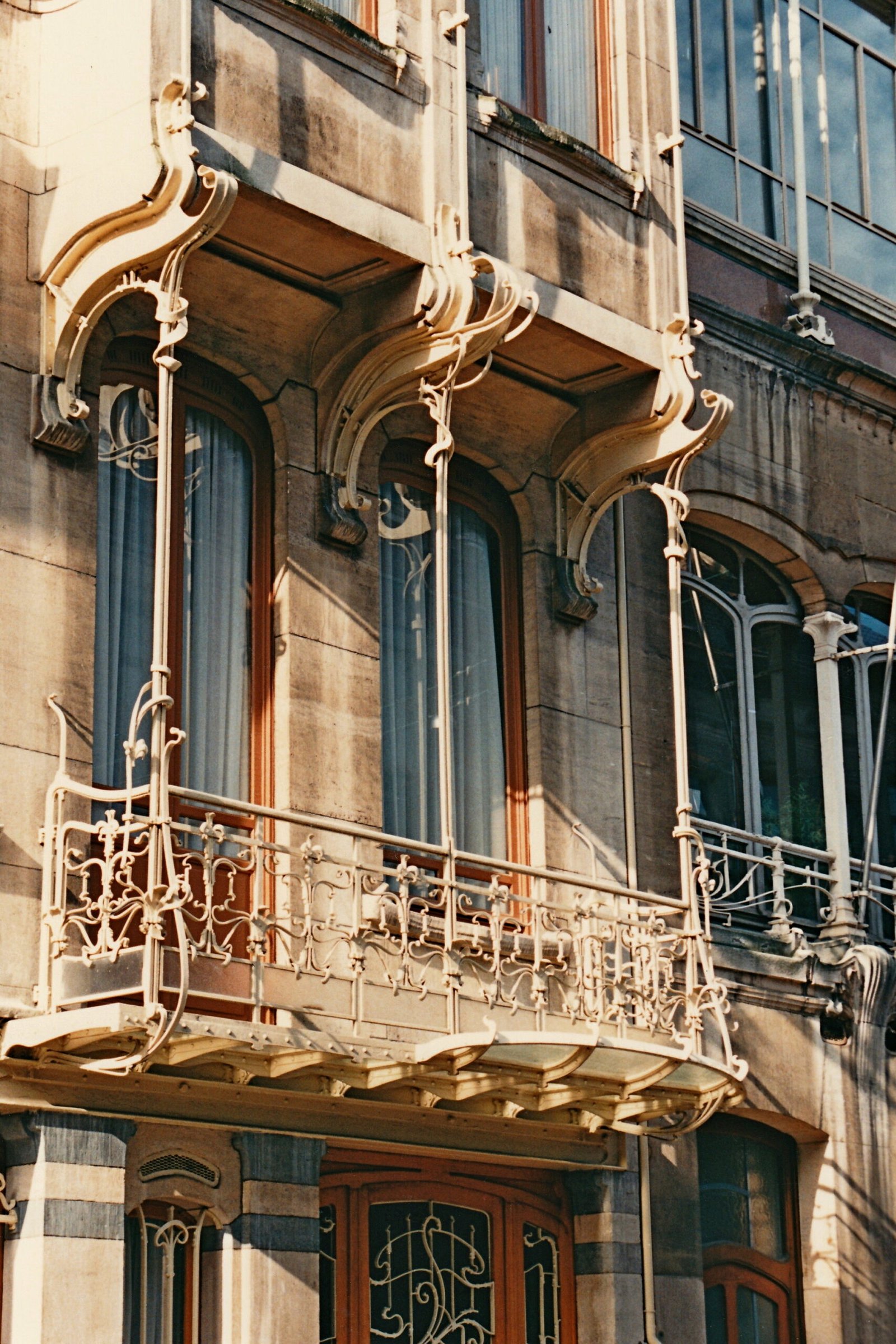
Musée Horta
Begin in Horta’s own house and studio, the one Art Nouveau interior in Brussels you can fully walk through — every banister, mosaic and lamp designed by the same hand.
The storyHorta built this as his home and workplace between 1898 and 1901, at the height of his fame. The two buildings, house and atelier, are now the Horta Museum, and the top-lit stairwell is the clearest lesson anywhere in what he was trying to do: turn a staircase into a living thing of light, iron and curve.
Insider tipThis is the only Horta interior on the walk you can properly visit, so give it real time. It is small and popular — book online, and go early. Photography rules vary, so check at the desk.
A fitting stopYou are in Saint-Gilles, Art Nouveau heartland: La Porteuse d’Eau, an Art Nouveau brasserie a few minutes away on Avenue Jean Volders, is a fitting first coffee.

Hankar House (Maison Hankar), Brussels
Paul Hankar’s own house of 1893 — built the same year as Horta’s Tassel, by the man usually named as Art Nouveau’s other founder.
The storyHorta gets the fame, but Paul Hankar was working in parallel, and historians still argue about who was first. His house on rue Defacqz uses exposed iron and sgraffito — scratched coloured plaster — instead of Horta’s flowing stone. A few doors down, the Hôtel Ciamberlani carries Hankar’s great sgraffito frieze across its whole front.
Insider tipThese are private homes; read them from the opposite pavement. Look for the bird and butterfly sgraffito under the Ciamberlani cornice — it is easy to miss and one of the finest in Brussels.

Hôtel Ciamberlani, Brussels
Paul Hankar built this for a painter in 1897: the front wall is treated as a surface to decorate, not a wall to hide behind.

Hôtel Otlet, Brussels
The town house of Paul Otlet, the man who tried to index all the world's knowledge. Van Rysselberghe, 1894–98.
Hotel Tassel
The Hôtel Tassel of 1893: by common agreement the first Art Nouveau building in the world, and the reason the rest of this walk exists.
The storyHorta built it for the scientist Émile Tassel, and inside hid an iron column that flowers into tendrils across the walls — the “Horta whiplash” that every Art Nouveau city would soon copy. From the street it looks almost restrained; the revolution was in how it bent light and space inside.
Insider tipIt is a private house and not open, so this is a pilgrimage to a façade — but stand here knowing this is ground zero. The curved stone bay and the ironwork of the door are pure 1893.
A fitting stopTime for lunch: this is Belgium, so a proper friterie cone of double-fried frites with mayonnaise is the honest local choice, or a café with a long list of Trappist and lambic beers.

Hôtel Solvay — Brussels – Virtual Tour 360°
Horta’s grandest townhouse, built for the chemical-fortune Solvay family, where he was given an unlimited budget and used it on every door handle.

Hôtel Max Hallet, Brussels
By 1902 Horta had nothing left to prove; this is the same language spoken quietly.

Maison Les Hiboux, Brussels
Two stylised owls sit in the sgraffito. Édouard Pelseneer, 1899 — look up before you walk on.

Maison Hannon, Brussels
A 1904 corner house famous for its light: stained glass, a sweeping painted staircase and one of the most photographed Art Nouveau interiors in the city.
The storyThe Hôtel Hannon was built by the architect Jules Brunfaut for Édouard Hannon, an engineer and keen photographer, with stained glass and a monumental mural staircase. After decades as a photography gallery it reopened as a house museum, so the interior is once again open to see.
Insider tipCheck the opening days before you come — it keeps museum hours, not shop hours. The stained-glass window over the stair is the thing to wait for when the light is behind it.
A fitting stopThis stretch of Saint-Gilles is full of small neighbourhood cafés where locals actually sit; pick one with a terrace and watch the corner.

Maison du Peuple, Brussels
What Horta built for the Belgian Workers' Party, 1896–99. The card tells you what became of it: read it here, on the spot.

Maison Frison, Brussels
Horta on rue Lebeau, 1894. The card carries a period plate from the Wasmuth portfolio — worth reading before you look up.

Old England Building (Musical Instruments Museum), Brussels
A black steel-and-glass former department store of 1899, hung on the hillside of the Mont des Arts, now the Musical Instruments Museum.
The storyPaul Saintenoy built the Old England store in 1899 in iron and glass painted black, a daring shop window onto the city. It now holds the Musical Instruments Museum — thousands of instruments — and a rooftop café-restaurant with one of the best free-with-a-coffee views over Brussels.
Insider tipEven if you skip the collection, ride up for the rooftop terrace: the view over the lower town and the distant Atomium is the reward. The museum gives you headphones that play each instrument as you stand before it.
A fitting stopThe rooftop café here is the stop itself — a coffee with the whole city laid out below.

Belgian Comic Strip Center (Former Magasins Waucquez), Brussels
Horta’s Magasins Waucquez of 1906, a luminous former textile warehouse, now the museum of the art form Belgium made its own: the comic strip.
The storyHorta designed this iron-and-glass warehouse in 1906; saved from demolition, it reopened in 1989 as the Belgian Comic Strip Center. The pairing is perfectly Belgian — Horta’s daylight architecture housing the home country of Tintin, the Smurfs and Spirou.
Insider tipGo in even for the entrance hall, where Horta’s glass roof floods the grand staircase. The shop has the best comic-art selection in the city if you read French or Flemish.
A fitting stopThe building’s own brasserie sits under the glazed roof; or walk to Le Falstaff (1903) near the Bourse, an Art Nouveau brasserie that has been pouring beer for over a century.
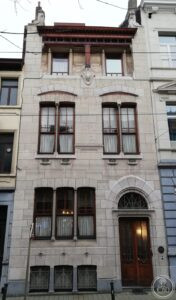
Maison Autrique
Maison Autrique, Horta 1893 — his first town house, and one of the few you can go inside. Wednesday to Sunday, midday to six.

Hôtel van Eetvelde, Brussels
Horta at his most experimental: a 1898 mansion built around a glass-domed octagonal hall, its façade carried on a frankly exposed iron frame.
The storyBuilt for Edmond van Eetvelde, the administrator of the Congo Free State, this is the most structurally radical of the UNESCO Horta houses — the iron is not hidden but celebrated, and the central hall glows under a stained-glass dome. The Congo money behind it is part of the harder story Brussels is still reckoning with.
Insider tipA private house, read from the street; the iron-and-glass bay is unlike anything else on the walk. The surrounding Squares district is full of Art Nouveau, so wander the side streets here.

Saint-Cyr House, Brussels
End on the most extravagant façade in Brussels: a house barely four metres wide, fronted top to bottom in curling wrought iron.
The storyThe Saint-Cyr House was built around 1903 by Gustave Strauven, who had trained in Horta’s office and was only in his twenties. On a tiny plot he went further than his master ever did, covering the whole narrow front in ironwork that erupts into a great circular window at the top — Art Nouveau pushed to the edge of excess, and a fitting place to stop.
Insider tipStand back across Square Ambiorix to see the whole height at once. Late afternoon light catches the ironwork best. From here the leafy square has cafés to end the day.
A fitting stopSquare Ambiorix and the nearby Square Marie-Louise are residential and calm — find a terrace, order a Belgian beer, and toast the city that started it all.

Cauchie House, Brussels
A house that advertises itself: Cauchie painted his own trade across the front in sgraffito, 1905.
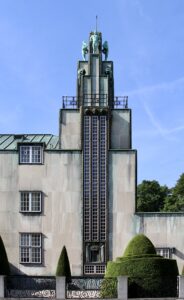
Palais Stoclet
Josef Hoffmann and the Wiener Werkstätte, 1911: white marble and gold, and the end of the line this walk began. UNESCO, and private.
Download for tour navigation
PDF is the stop list with GPS, to print or keep on the phone. GPX for Garmin / Komoot / OsmAnd. KML for Google Earth and Maps.