

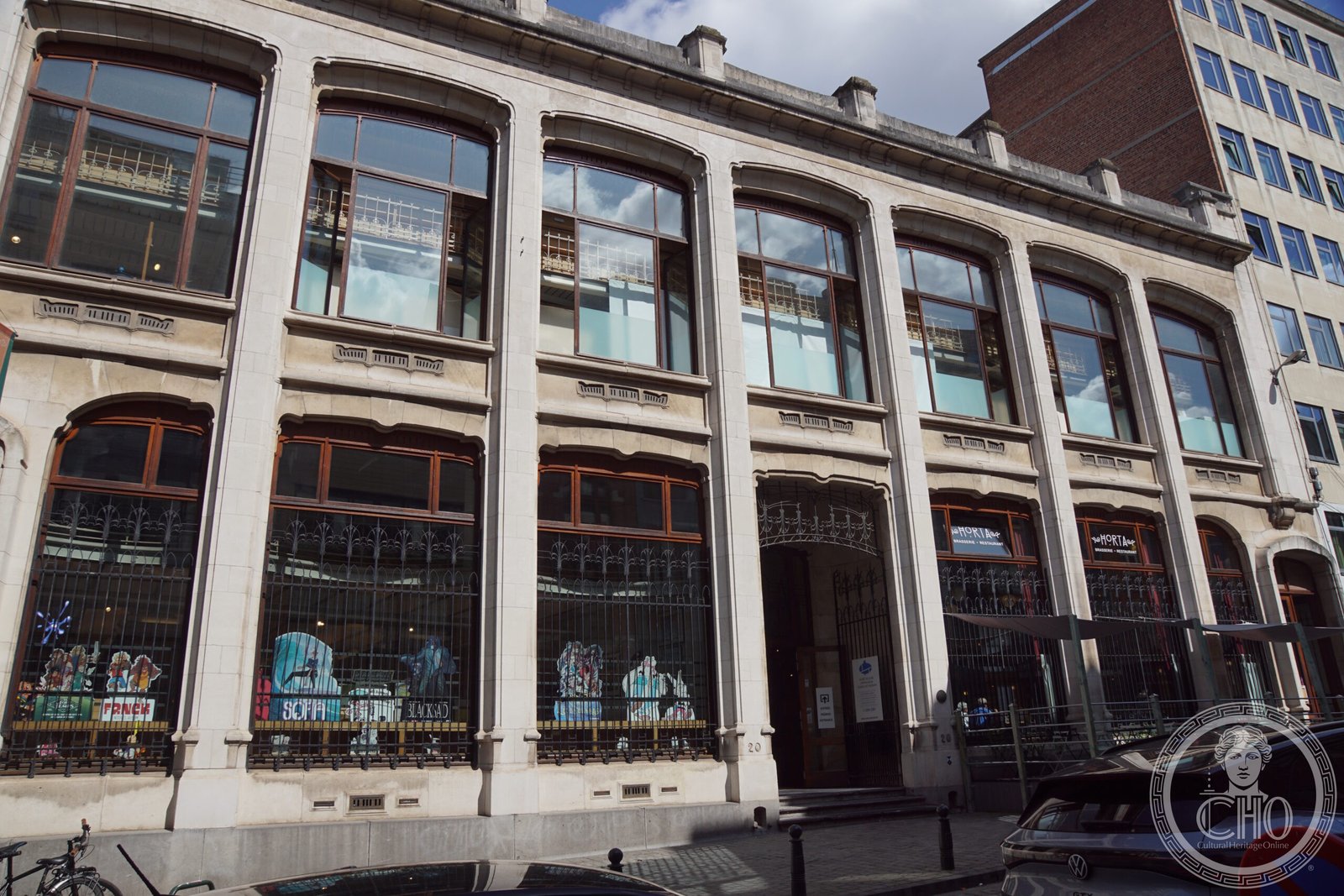
Horta built a temple to fabric. A century later it became a temple to Tintin, and the iron still holds the light.
At a glance
The Belgian Comic Strip Center occupies a Victor Horta building at 20, rue des Sables in central Brussels. Horta designed it in Art Nouveau style as the Magasins Waucquez, a large fabric store for the textile baron Charles Waucquez, and it opened in 1906. After decades of decline and a brush with demolition, it was rescued for its architectural value and reopened in 1989 as a museum dedicated to Belgian comics — the home country of Tintin, the Smurfs, and Lucky Luke. The building marries Horta’s iron-and-glass interior to one of Europe’s great popular art forms.
Key facts
- Architect: Victor Horta
- Built: opened 1906 as the Magasins Waucquez
- Original client: Charles Waucquez, textile merchant
- Style: Art Nouveau
- Address: 20, rue des Sables, central Brussels
- Listed: historic monument since 1975
- Reopened: 1989, as the Belgian Comic Strip Center
History
Horta designed the Magasins Waucquez at the height of his career, and the store opened in 1906 to sell luxury textiles. Its commercial life was short. After Charles Waucquez died in 1920 the business faded, and the firm finally closed its doors in 1970, leaving the building empty.
It was Jean Delhaye — a former student and aide of Horta who repeatedly defended his master’s work — who brought the endangered building to the attention of the state. On 16 October 1975 it was designated a historic monument because of its link to Horta, though it remained derelict and vandalised.
In 1980 the architect Jean Breydel, together with comics artists including François Schuiten, Bob de Moor, and Hergé, proposed restoring the building as a museum of Belgian comics. The Belgian state bought it in 1983, and the centre opened in 1989, giving a Horta monument a second life as a cultural institution.
What you see
The interior is the revelation. Horta opened the store around a central hall lit from above, carrying the floors on slender exposed iron columns and beams so the space reads as light and structure rather than mass. It is the department-store version of the ideas he worked out in his private houses.
That iron framework now frames original artwork, scripts, and full-scale figures from the Belgian comics tradition. The pairing is deliberate: an Art Nouveau landmark housing the medium that became Belgium’s most exported popular art, two chapters of the country’s visual culture under one glass roof.
Practical information
- The centre is a fully operating museum with regular opening hours and an admission charge.
- Check the current timetable and any closing days before visiting.
- Allow time for the building itself, not only the collection.
- Time needed: 1.5–2 hours.
Getting there
The centre sits on the rue des Sables in central Brussels, between the upper and lower town. It is within walking distance of Brussels-Central station and Brussels-Congress station, and close to the Botanique and De Brouckère areas.
Nearby
- Brussels city centre, Grand-Place, and the comic-strip murals trail.
- The Botanique cultural centre and gardens.
- Other Horta works across the city, from the Horta Museum to the Hôtel van Eetvelde.
Sources
- Wikipedia, “Belgian Comic Strip Center”.
- Belgian Comic Strip Center, official institutional history.
- Brussels regional monument designation (1975).
Find it on the map
See this place and what’s around it →Record researched and written by Luigi De Marchi for Cultural Heritage Online, 2026.
📷 Become a Cultural Heritage Online photographer
Share your photos of places: they stay published under your name as the author. The more they're seen, the more you get noticed — and soon a contest will reward the most appreciated photos.
Log in or sign up free to add a photoIs this page about you?
This page is read by travellers and heritage enthusiasts who find it on Google. Tell us how you are connected to this place and we will take it from there.