

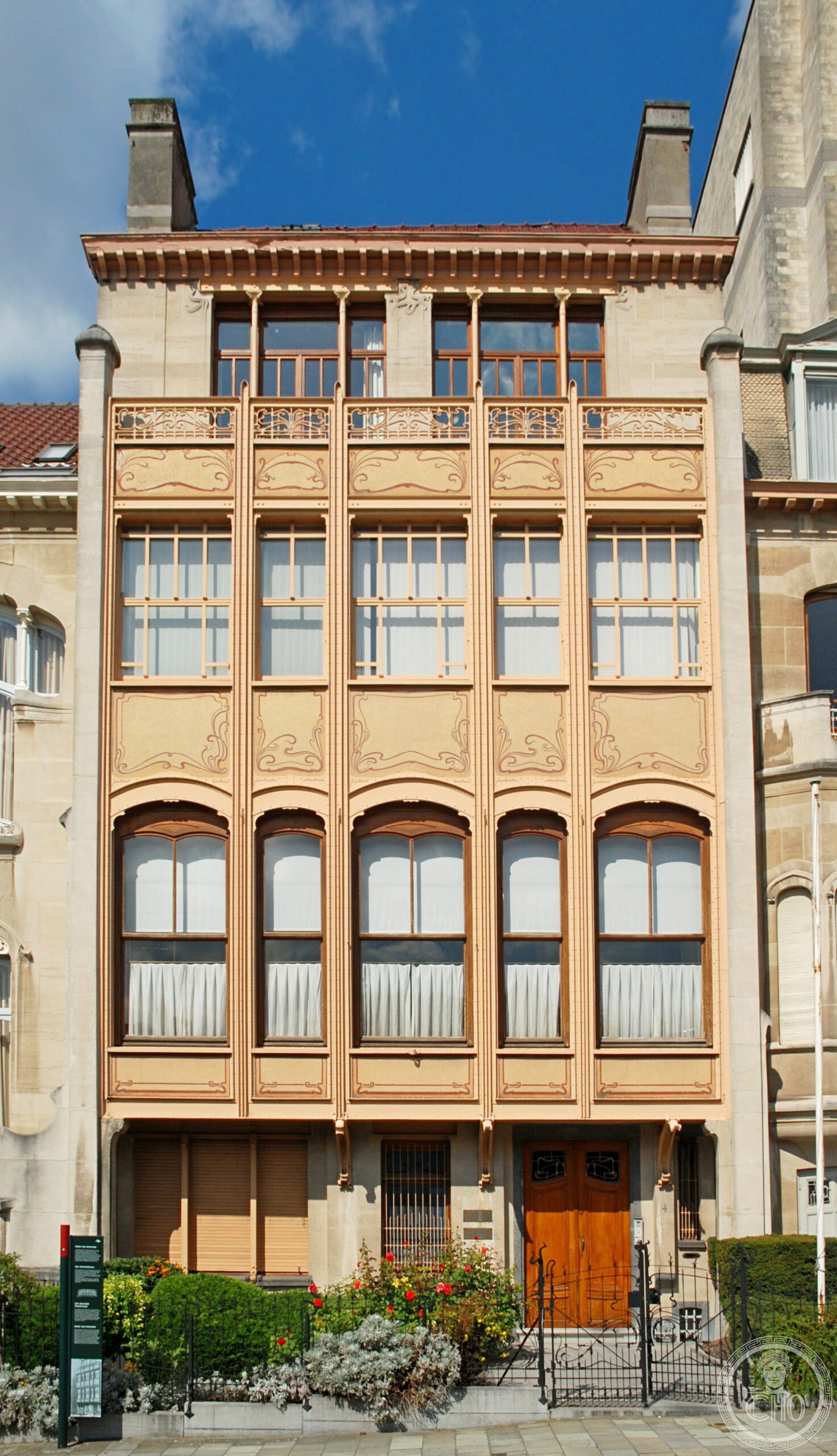
Horta did not hide the steel here. He hung the facade from it, then lit the rooms behind through a glass dome.
At a glance
The Hôtel van Eetvelde is a town house Victor Horta designed for Edmond van Eetvelde, a senior administrator of the Congo Free State, on the avenue Palmerston in the Squares Quarter of Brussels. Built between 1895 and 1898, with two later extensions also by Horta, it pushed industrial materials into a prestige private home: steel and glass that most architects of the day kept out of sight. The plan turns inward around an octagonal rotunda crowned by a stained-glass skylight. In 2000 it joined three other Horta houses on the UNESCO World Heritage list.
Key facts
- Architect: Victor Horta
- Built: 1895–1898; extensions 1898 and 1901
- Client: Edmond van Eetvelde
- Style: Art Nouveau
- Address: 4, avenue Palmerston, Squares Quarter, Brussels
- Recognition: UNESCO World Heritage (2000), part of the Major Town Houses of the Architect Victor Horta
- Signature: hanging steel facade construction; central glass cupola
History
Edmond van Eetvelde commissioned the house at the height of his career, and Horta delivered it between 1895 and 1898. By then Horta was the architect who took Art Nouveau most seriously as a structural language rather than a surface fashion. Where others applied the new style as ornament, he let the building’s iron skeleton shape the rooms.
Horta returned twice. A first extension, designed in 1899, presented a quieter sandstone facade and held a garage, an office for van Eetvelde, and apartments, with its own entrance at number 2. That wing later became the home of Jean Delhaye, a Horta collaborator who would defend the master’s legacy after his death. A second extension followed in 1901 on the other side of the plot.
The grouping of Horta town houses — van Eetvelde among them, alongside Horta’s own house and studio — was inscribed by UNESCO in 2000 as the core of the urban residences that reset domestic architecture in Europe before 1900.
What you see
The street front carries its structure openly. Horta used a hanging steel construction for the facade, so the metal that usually disappears behind stone becomes part of the composition. The bay reads as a frame and a screen at once, glass set into iron that curves rather than squares off.
Inside, the house revolves around an octagonal rotunda covered by a skylight, with a central reception room lit from above through a stained-glass cupola. Light falls down the stairwell instead of in from the windows, a move Horta repeated whenever a narrow city plot denied him a generous street frontage.
Practical information
- The building is an institutional residence and is not a regular museum; interiors open only on rare heritage occasions.
- The exterior can be seen from the public street at any time.
- Check current access through the Horta Museum or Brussels heritage listings before planning a visit.
- Time needed: 10–15 minutes for the facade and the square.
- In October 2026 the house is one of the venues of the Festival ARTONOV, which stages performances inside Brussels heritage interiors — one of the few chances to see the interior.
Getting there
The Hôtel van Eetvelde stands in the Squares Quarter on the eastern edge of central Brussels, close to the European institutions. The nearest metro stations are Maelbeek and Schuman, both a short walk away; the leafy Square Marie-Louise and Square Ambiorix are minutes on foot.
Nearby
- Saint-Cyr House — Gustave Strauven’s narrow facade on Square Ambiorix, in the same quarter.
- Hôtel Tassel and Hôtel Solvay — two more Horta UNESCO town houses across the city.
- Cinquantenaire park and museums.
Sources
- UNESCO World Heritage Centre — Major Town Houses of the Architect Victor Horta (Brussels).
- Horta Museum, Brussels.
- Wikipedia, “Hôtel van Eetvelde”.
Find it on the map
See this place and what’s around it →Record researched and written by Luigi De Marchi for Cultural Heritage Online, 2026.
📷 Become a Cultural Heritage Online photographer
Share your photos of places: they stay published under your name as the author. The more they're seen, the more you get noticed — and soon a contest will reward the most appreciated photos.
Log in or sign up free to add a photoIs this page about you?
This page is read by travellers and heritage enthusiasts who find it on Google. Tell us how you are connected to this place and we will take it from there.