
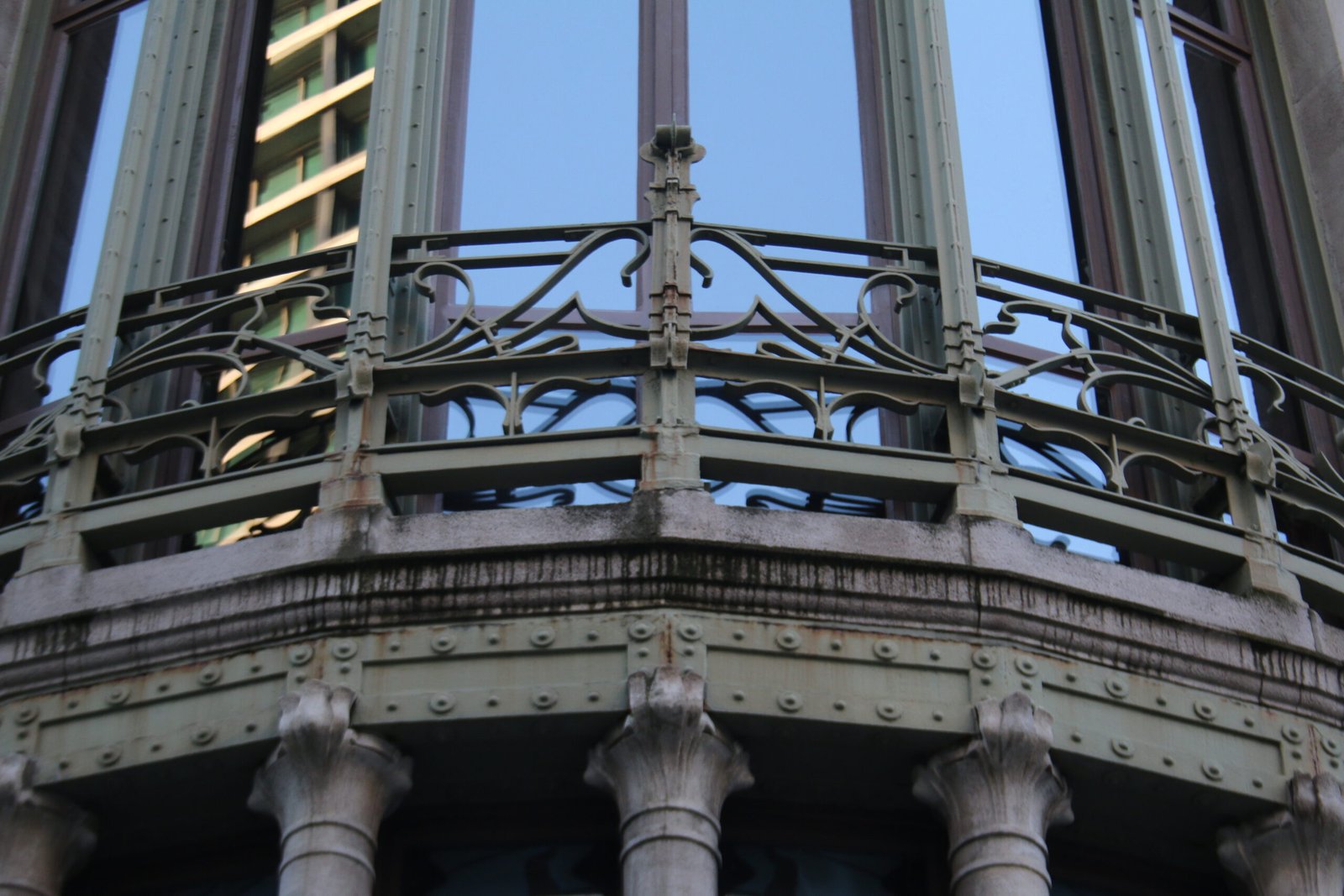

The house that launched Art Nouveau. Victor Horta completed this radical private townhouse in 1894, introducing an exposed iron skeleton and sinuous ornament that broke every rule of Brussels architecture.
At a glance
Victor Horta designed the Hotel Tassel in 1893 and 1894 for Emile Tassel, a professor of geometry and a personal friend. The result was a narrow urban townhouse that upended every convention of Brussels neo-Renaissance streetscapes. Horta exposed the iron structure instead of hiding it, shaped the staircase hall like a living organism, and covered every surface from walls to mosaic floors to wrought ironwork in tendrils and whiplash curves that became the grammar of Art Nouveau. UNESCO inscribed Tassel in 2000 as part of the Major Town Houses of Victor Horta.
Key facts
- Architect: Victor Horta (1861–1947)
- Built: 1893–1894
- Address: 6 rue Paul-Emile Janson, 1050 Ixelles, Brussels
- Style: Art Nouveau (Belgian school)
- Client: Emile Tassel, mathematician and professor
- Status: UNESCO World Heritage Site (2000), private property
- GPS: 50.827778, 4.362028 · Google Maps
History
Emile Tassel met Horta through circles of the Universite Libre de Bruxelles, where both men moved. The commission gave Horta a narrow lot and all the latitude in the world to reinvent. He had studied under Alphonse Balat, court architect to King Leopold II, and brought rigorous classical training to what became a full rupture with historicism.
Construction finished in 1894. The iron columns in the staircase hall were visible rather than clad in stone. The glass roof flooded the central volume with light. Every handrail, tile, and mosaic panel repeated the same sinuous botanical motif, making Tassel the first building in which structure, ornament, and space were treated as a single integrated system rather than a decorated shell.
Horta went on to design the Hotel Solvay, the Hotel van Eetvelde, and his own house and studio, all inscribed alongside Tassel by UNESCO in 2000. The house passed through several owners after the Tassel family and is now owned by Euroclear, a financial infrastructure company, which maintains it as a historic property closed to regular public visitors.
What you see
The facade reads modest from the street: three storeys of pale stone, a curved bow window at first-floor level, and thin iron columns that announce the structure behind the glass. Inside, the staircase hall unfolds in a single fluid volume. Iron columns branch at their capitals into arch-tendrils that merge with the ceiling vault. The mosaic floor continues the pattern upward onto the walls in glazed tiles of ochre and green.
Horta moved the load to the iron frame and freed the ground level from load-bearing partitions. The central void created by the glass roof carried daylight horizontally through the building via white-and-gold reflective surfaces rather than straight down through a courtyard. That logic, at once structural and spatial, is what subsequent Art Nouveau architects everywhere would imitate and elaborate.
Practical information
- Access: Private property. Exterior facade only; no public admission.
- Best view: From the pavement directly opposite; the facade faces east and reads best in morning light.
- Photography: Street photography freely permitted.
- Nearby interior: The Musee Horta (25 rue Americaine, 15 min walk) gives access to comparable interiors from the same period.
Getting there
From Brussels-Central take Metro line 2 or 6 to Louise, then walk seven minutes south on avenue Louise and turn right onto rue Paul-Emile Janson. By tram, line 94 stops at Ma Campagne, three minutes on foot. The Musee Horta is a 15-minute walk through the Ixelles residential streets to the west.
Nearby
- Musee Horta (25 rue Americaine) — Victor Horta own house and studio, now the definitive museum of Belgian Art Nouveau, 15 min walk
- Hotel Solvay (224 avenue Louise) — Horta grandest domestic commission, 10 min walk
- Brussels Art Nouveau guide — see city hub for the full neighbourhood walking route
Sources
- UNESCO World Heritage List, Major Town Houses of the Architect Victor Horta, Brussels (2000), whc.unesco.org/en/list/1005
- Musee Horta, building history, hortamuseum.be
- Borsi, Franco and Portoghesi, Paolo. Victor Horta. Academy Editions, 1991.
- Van Loo, Anne (ed.). Dictionnaire de l architecture en Belgique. Fonds Mercator, 2003.
Partner Ambassador
This is an independent editorial entry, compiled by Cultural Heritage Online from public, openly-licensed sources as part of our Founding Partner pilot. The institution shown has not joined, endorsed, or paid for the programme, and is under no obligation. Hôtel Tassel is welcome to claim, expand, correct, or request removal of it at any time. If you represent this institution, write to info@culturalheritageonline.com.
Find it on the map
See this place and what’s around it →Record researched and written by Luigi De Marchi for Cultural Heritage Online, 2026.
📷 Become a Cultural Heritage Online photographer
Share your photos of places: they stay published under your name as the author. The more they're seen, the more you get noticed — and soon a contest will reward the most appreciated photos.
Log in or sign up free to add a photoIs this page about you?
This page is read by travellers and heritage enthusiasts who find it on Google. Tell us how you are connected to this place and we will take it from there.