
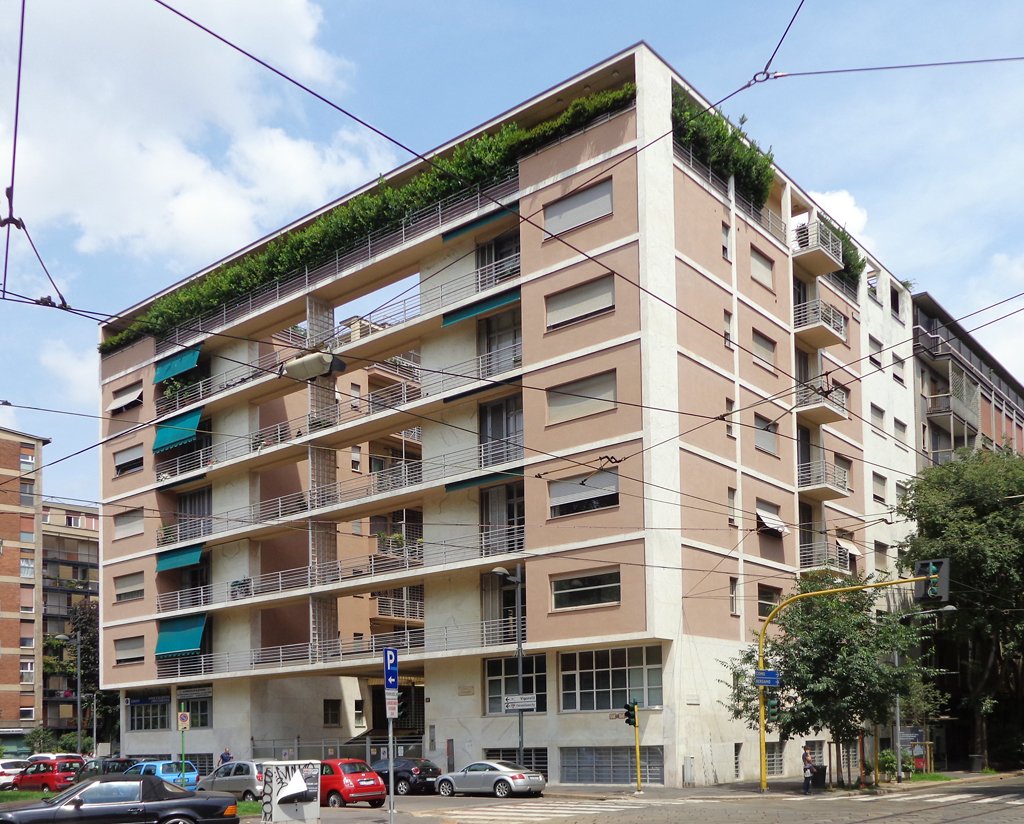
Milan is where Italian Rationalism met the real economy. Como gave the movement its purest manifestos, but Milan — industrial, ambitious, building fast between the wars — is where the new architecture had to prove it could house tenants, train students and run a courthouse. The result is a city you can read as an argument about modern life, written in concrete, marble and glass across a single restless decade.
The apartment as manifesto
The clearest place to start is a block of flats. Casa Rustici, built on Corso Sempione between 1933 and 1935 by Giuseppe Terragni and Pietro Lingeri, took an ordinary speculative brief — rental apartments for an engineer named Vittorio Rustici — and turned it into one of the movement’s defining images. Two parallel blocks face the boulevard, separated by an open courtyard and tied together at every floor by slender suspended walkways. The municipal commission reportedly rejected the design nine times before it was built. It has been protected heritage since 1988 and is still lived in, which is part of its quiet authority: it never stopped doing its job.
Terragni was a frequent visitor to Milan rather than a resident; his base remained Como, an hour north. But the partnership with Lingeri, a Milanese, gave him a foothold in the larger city, and the apartment houses they built together — Casa Rustici among them — brought the rigour of the Como manifestos into the everyday business of property development. That is the quiet radicalism of these buildings. They are not pavilions or monuments. They are places people paid rent to live in, designed as if every tenant deserved light on two sides and a facade that meant something.
Pagano and the Bocconi campus
If one figure organised Milanese Rationalism, it was Giuseppe Pagano. Born in 1896, Pagano was less a stylist than a conscience: as editor of the magazine Casabella he set the intellectual terms of the whole movement, championing honesty of structure and use over decoration. His campus for the Università Bocconi, designed with Gian Giacomo Predaval and built between 1937 and 1942, is the built version of that argument — long, sober, brick-faced volumes arranged for clarity rather than display, a modern university that looks like exactly what it is.
Pagano’s story did not end with the architecture. Once close to the regime, he broke with it, joined the anti-fascist Resistance, and was arrested and deported; he died at the Mauthausen concentration camp in the spring of 1945, weeks before the war in Europe ended. The Bocconi campus carries that weight. It is the work of a man who believed modern architecture was a moral project, and who paid for the rest of his convictions with his life.
The state takes the style monumental
The largest commissions came from the state, and they pushed the language toward sheer mass. Marcello Piacentini — the regime’s most powerful architect — designed Milan’s vast Palazzo di Giustizia, a courthouse of stripped stone whose corridors and halls run to a scale that no private client could ever have demanded. It belongs to the same years as Casa Rustici and stands only a few kilometres away, yet the two buildings argue for almost opposite ideas of what modern Italy should feel like: one light and tensile, the other grave and permanent. That tension — between Pagano’s lean modernism and Piacentini’s monumental authority — is the real subject of any walk through Rationalist Milan.
A short, decisive decade
What unites these buildings is compression. They were nearly all designed and built within ten years, by architects who knew and argued with one another through the pages of magazines like Pagano’s Casabella. The Second World War ended the experiment, and Allied bombing in 1943 damaged much of the historic city, taking some Rationalist work with it — but enough survives, scattered between the ring roads and the boulevards, to reconstruct the debate on foot today. Begin at Casa Rustici on Corso Sempione, move to the Bocconi campus, finish at the courthouse, and you will have crossed the full range of Italian Rationalism in an afternoon: from the lightest apartment house to the heaviest organ of the state.
Sources
- Wikipedia, Casa Rustici, Università Bocconi, Giuseppe Pagano (architetto), Palazzo di Giustizia (Milano), Marcello Piacentini — dates, attributions and biography.
- Lombardia Beni Culturali — twentieth-century architecture of Milan.


