
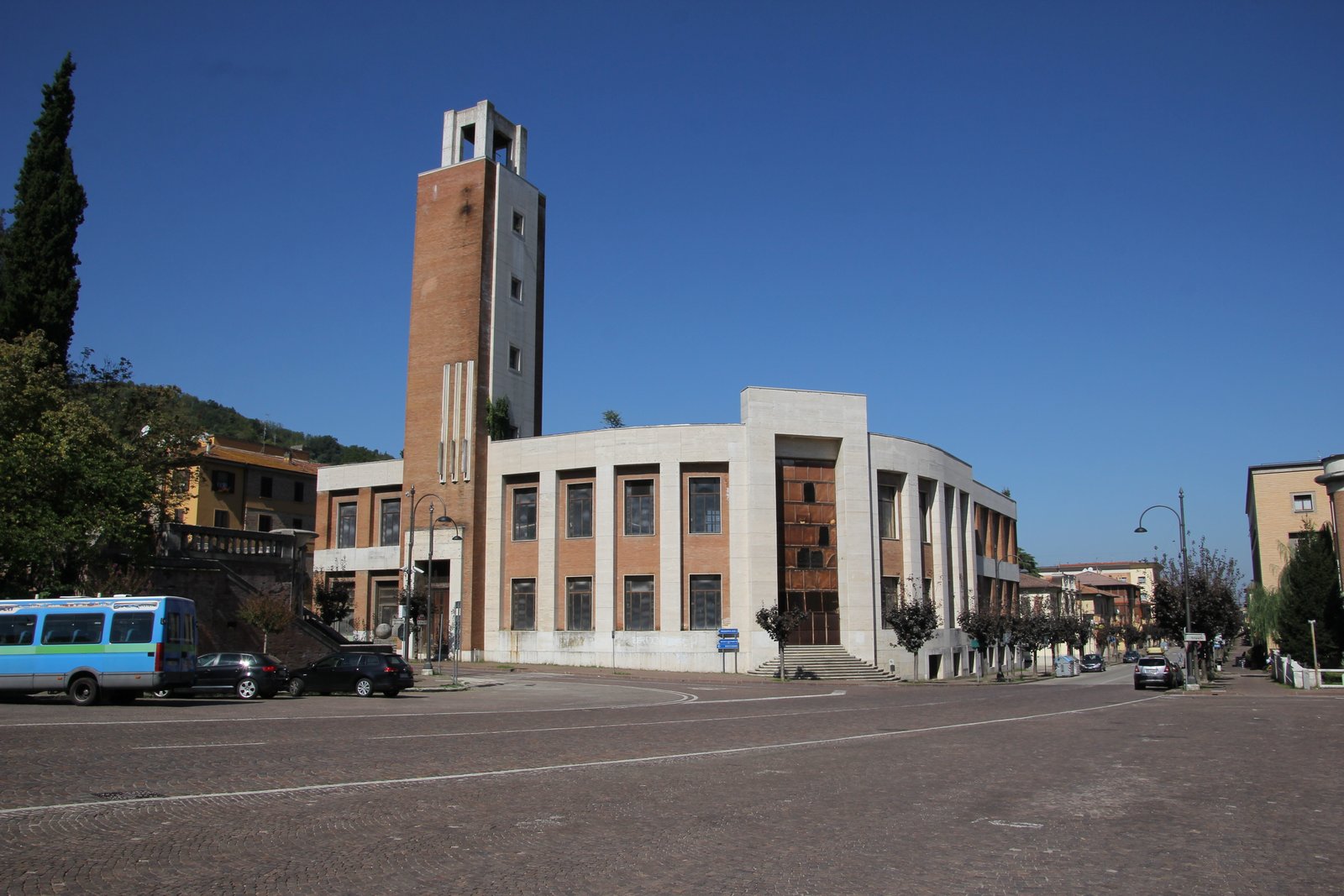
The former Casa del Fascio in Predappio is the largest party headquarters built in any small Italian town during the Fascist regime. Inaugurated in 1937 at the crossing of the two main streets of Predappio Nuova, it combines a heavy brick volume with Roman travertine cladding and a tall littorio tower. The building is now abandoned and at the centre of a long debate over its conversion into a documentation centre on twentieth-century totalitarianism, a project announced by the municipality in 2014 and still under negotiation.
- Address
- Via Guglielmo Oberdan, 47016 Predappio (FC), Emilia-Romagna, Italy
- Period
- 1934–1937 (inaugurated 1937)
- Architects
- Long attributed to Arnaldo Fuzzi (attribution debated; Florestano Di Fausto coordinated the broader urban plan of Predappio Nuova from 1925)
- Client
- Partito Nazionale Fascista, Forlì federation
- Style
- Italian Rationalism (Razionalismo italiano), monumental strand
- Function
- Original: Fascist party headquarters. Current: disused, partially opened for exhibitions
- Materials
- Brick masonry with Roman travertine facing; reinforced concrete frame
- Status
- State-owned, abandoned; included in the European cultural route ATRIUM (Architecture of Totalitarian Regimes of the 20th Century in Europe's Urban Memory)
- Reuse project
- Polo Museale del Fascismo / documentation centre on twentieth-century totalitarianism, announced 2014, repeatedly contested and delayed
- Coordinates
- 44.1027° N, 11.9814° E
Visit on the map
Via Guglielmo Oberdan, 47016 Predappio (FC) · 44.1027° N, 11.9814° E
Download for your navigator
A single waypoint, ready for GPS apps, navigators, and contacts.
Story
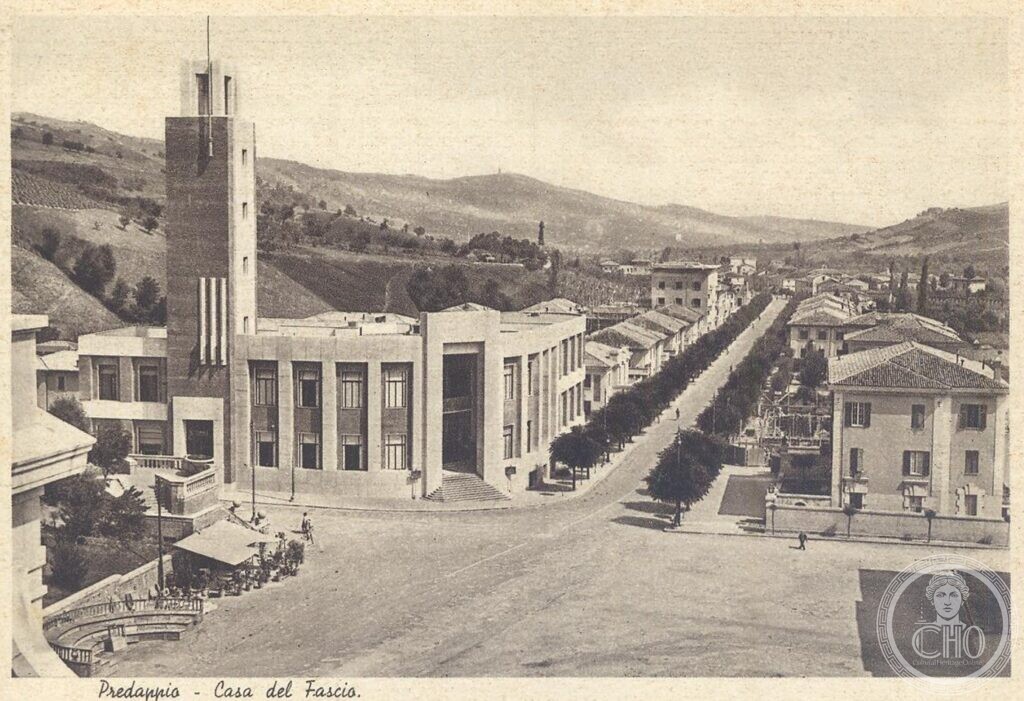
Predappio is the small Romagna town where Benito Mussolini was born in 1883, and from 1925 onward the regime reshaped it as a model settlement. Architect Florestano Di Fausto coordinated the master plan of Predappio Nuova, the new district laid out below the original hilltop village. Within this plan, the Casa del Fascio was conceived as the symbolic anchor of the entire town: a single building meant to assert the regime's presence at the crossing of the two main streets. Fundraising began in 1926, but the definitive project was approved only at the start of the 1930s, and construction did not begin until 1934. The building was inaugurated in 1937. The design is traditionally attributed to engineer-architect Arnaldo Fuzzi, although Italian-language sources are cautious on the point and link Fuzzi's documented Predappio work primarily to the nearby carabinieri barracks of the same year.
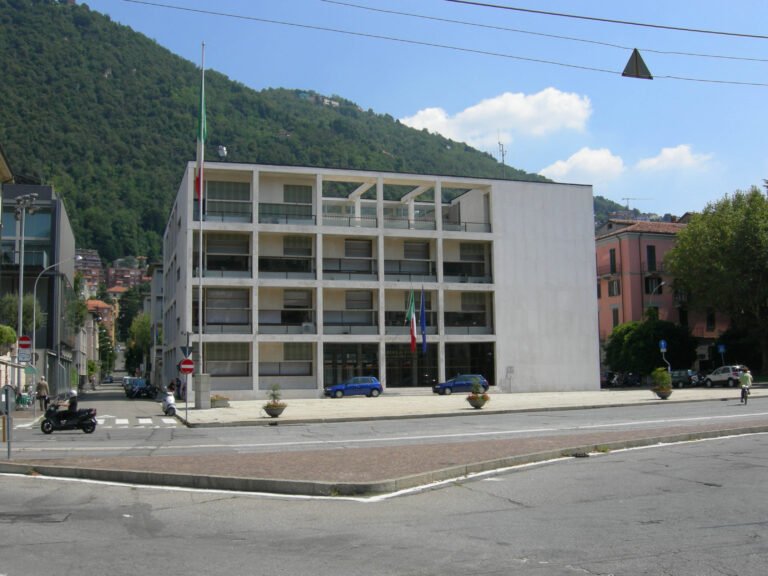
The Casa del Fascio sits on a long rectangular block, with a continuous portico at the ground floor, two upper storeys of regular windows in travertine surrounds, and a tall littorio tower rising at one end. The combination is typical of the monumental strand of Italian Rationalism, where the smooth volumes and flat surfaces of the modern movement are dressed with civic-Roman references: travertine cladding, geometric piers and a campanile-like tower that quotes medieval town halls while being detailed in stripped, abstract terms. Inside, a double-height assembly hall and a sequence of offices were organised along a central axis. Brick masonry, reinforced concrete and stone work together: the regime wanted a building that read as massive and durable, in contrast with the lighter Rationalism of Como or Lissone. At roughly seventy metres in length, the structure is one of the largest Case del Fascio ever built outside a regional capital, deliberately disproportionate to the size of the town.
After 1945 the building lost its function and entered a long period of partial use and progressive abandonment. It is owned by the State and managed locally, and for decades has stood empty along Via Oberdan. In 2014 the municipal administration of Predappio, then led by mayor Giorgio Frassineti, announced a project to convert the building into a documentation centre on twentieth-century totalitarianism, presented in the press as a Polo Museale del Fascismo. The initiative was supported by historians as a way to counter the use of Predappio for political pilgrimage to Mussolini's tomb, and contested by other commentators concerned about the risk of glorification.
Funding has been confirmed and withdrawn several times, partial restoration works have begun, and the building has hosted occasional temporary exhibitions, but as of the mid-2020s the centre is not yet open to the public on a stable basis. The Casa del Fascio is also included in ATRIUM, the European cultural route dedicated to the architecture of twentieth-century totalitarian regimes, which links sites of difficult heritage across Italy, Bulgaria, Albania, Slovakia and other countries that share an experience of twentieth-century authoritarian rule.
Resources & References
Editorial picks across Wikipedia, photo archives, and architectural databases.
Gallery
Find it on the map
See this place and what’s around it →Record researched and written by Stefano Vigolo for Cultural Heritage Online, 2026.

📷 Become a Cultural Heritage Online photographer
Share your photos of places: they stay published under your name as the author. The more they're seen, the more you get noticed — and soon a contest will reward the most appreciated photos.
Log in or sign up free to add a photoIs this page about you?
This page is read by travellers and heritage enthusiasts who find it on Google. Tell us how you are connected to this place and we will take it from there.