

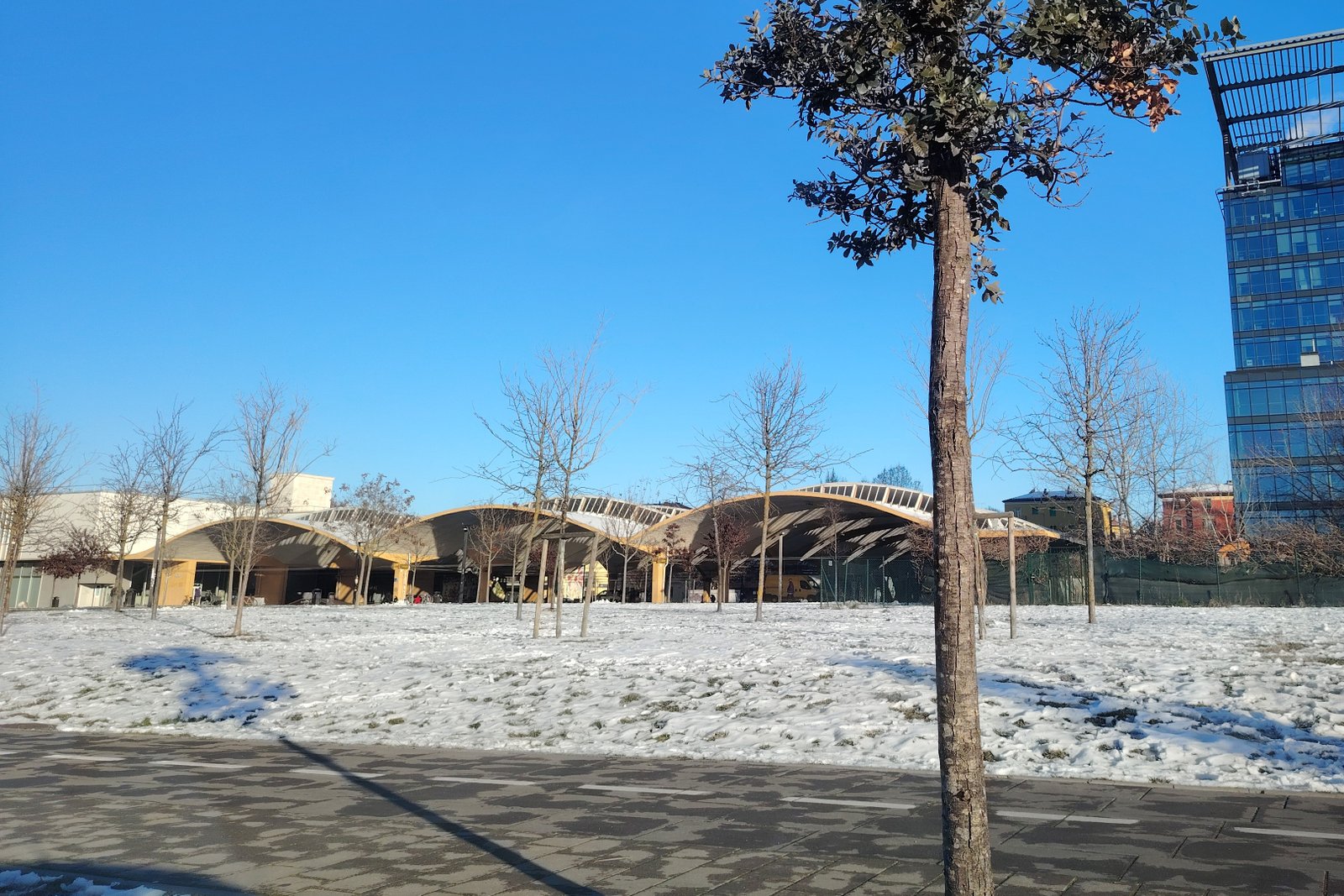
Pier Luigi Nervi designed Bologna’s wholesale produce market in 1939, on the northern edge of the Bolognina district. The canopy that gave the complex its identity, a long concrete vault built to shelter trucks, crates and porters, survived the closure of the market and the demolition of the surrounding sheds. Today it stands alone in Piazza Lucio Dalla, a civic square laid out around the structure that once defined Bologna’s daily flow of fruit and vegetables. The Tettoia Nervi belongs to the early phase of Italian Rationalism, where engineering ambition met the functional brief of a public market.
- Address
- Piazza Lucio Dalla, 40129 Bologna, Italy
- Period
- 1939 (completed)
- Architect / Engineer
- Pier Luigi Nervi (1891–1979)
- Client
- Comune di Bologna
- Style
- Italian Rationalism (Razionalismo italiano)
- Function
- Original: wholesale produce market (mercato ortofrutticolo). Current: civic square anchor, event venue
- Material
- Reinforced concrete vault structure
- District
- Bolognina, Quartiere Navile
- Status
- Surviving canopy preserved; surrounding market complex decommissioned and replaced by the modern CAAB in the 1990s
- Coordinates
- 44.5111° N, 11.3397° E
Visit on the map
Piazza Lucio Dalla, 40129 Bologna · 44.5111° N, 11.3397° E
Download for your navigator
A single waypoint, ready for GPS apps, navigators, and contacts.
Story
The wholesale market was commissioned by the Comune di Bologna in the late 1930s to consolidate the trade of fruit and vegetables that had until then crowded the streets near the old city walls. The site chosen lay just north of the railway yards, in the working-class Bolognina district that had grown around the central station in the previous decades. Pier Luigi Nervi, by then already the engineer of the Stadio Berta in Florence and the Orvieto aircraft hangars, received the commission for the covering structure. The market opened in 1939, on the eve of the Second World War, and served the city for half a century. After the new agroalimentary centre (CAAB) opened on Via Paolo Canali in 1991, the old market was progressively decommissioned. The sheds were eventually cleared, but the Nervi canopy was retained as a heritage piece and the surrounding land was redesigned as a public square, inaugurated in 2022 and dedicated to the Bolognese songwriter Lucio Dalla.
The canopy is a study in structural economy. Nervi shaped the cover as a continuous reinforced-concrete vault, ribbed on the underside in the pattern that became his signature: thin radial members joined by a denser web of secondary ribs, transferring load efficiently to a small number of supports along the perimeter. The result is a covered hall that reads almost as a single surface rather than a beam-and-column grid. Razionalismo italiano sought to align modern function and modern means, and Nervi’s market translated that programme directly into civic infrastructure: no decoration, no historicist citation, only the rational logic of a vault sized to the work it housed. Under the canopy, lorries could unload, traders could lay out crates, and the building’s own geometry organised the flow. The same structural language Nervi would later carry into the post-war exhibition halls of Turin and the Olympic venues of Rome can be read here in compact, early form.
The historical reception of the Tettoia Nervi was muted for decades, overshadowed by the more celebrated pre-war stadium in Florence and by the post-war works that made Nervi internationally famous. Local recognition came later, as the question of what to do with the disused market made the canopy a test case for industrial heritage in Bologna. The decision to preserve the structure and rebuild the public space around it, rather than demolish the lot, marked a shift in how the city read the architecture of the 1930s — less as politically compromised inheritance, more as a layer of civic infrastructure worth keeping. The Piazza Lucio Dalla project completed in 2022 set the canopy as the visual anchor of a new neighbourhood centre, with the surrounding ground used for concerts, markets and outdoor events. The Tettoia today is one of the few remaining works by Nervi in Emilia-Romagna that can be visited without an appointment, a piece of razionalismo engineering still doing public work nearly nine decades after it was built.
Visitors arrive most easily from Bologna Centrale, a fifteen-minute walk through the Bolognina grid. The canopy is open to the air on all sides, so there are no opening hours and no ticket. The square hosts the DiMondi festival each summer and an irregular calendar of neighbourhood markets and concerts; the rest of the year the structure can simply be walked under and read as the piece of engineering it was designed to be.
Resources & References
Editorial picks across Wikipedia, photo archives, and architectural databases.
Find it on the map
See this place and what’s around it →Record researched and written by Stefano Vigolo for Cultural Heritage Online, 2026.
📷 Become a Cultural Heritage Online photographer
Share your photos of places: they stay published under your name as the author. The more they're seen, the more you get noticed — and soon a contest will reward the most appreciated photos.
Log in or sign up free to add a photoIs this page about you?
This page is read by travellers and heritage enthusiasts who find it on Google. Tell us how you are connected to this place and we will take it from there.