

Curated Itinerary
Silk Roads: the Chang’an–Tianshan Corridor
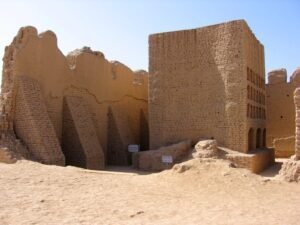
East to west along the Chang’an–Tianshan Corridor: Xi’an’s palaces and pagodas, the Gansu grottoes, the oasis ruins of Turpan and the caravan towns of the Chu Valley.
This itinerary follows the Chang’an–Tianshan Corridor of the Silk Roads, inscribed by UNESCO in 2014 across China, Kazakhstan and Kyrgyzstan. It runs east to west, the direction the silk itself travelled: from the imperial palaces and pagodas of Xi’an, through the Buddhist grotto sites of Gansu, to the earthen oasis cities of Turpan and the caravan towns of the Chu Valley.
The thirteen stops divide into four natural clusters — Xi’an, the Hexi Corridor, the Tarim oases, and the Central Asian valleys — and most travellers will treat each cluster as its own journey. Rail links the Chinese stages; Bishkek and Almaty anchor the western ones. What connects them is the listing itself: a single World Heritage property built out of distance, where each stop marks roughly what a caravan could reach before resting.
Allow two to three weeks to see the corridor properly, or take it cluster by cluster over several trips. Either way, start at the Giant Wild Goose Pagoda: the scriptures it was built to hold are the best argument that this road carried more than trade.
Read the full story of this route in the CHO Magazine →
Get this route — explore at your own pace
The walk and the notes are open to everyone, right here. To take the route with you — the GPX and KML tracks for your phone — you need a CHO account, and a free one is enough. We do not sell these routes: we build them ourselves and give them to the people who read us.
Create a free accountAlready have one? Log in.
This route was built with the tools we give operators.
Guides, associations and cultural operators build their own routes here: pick the stops from the archive, add your notes, and the map, the GPX and the printable version come out on their own. Your programme gets a permanent page, your events go on the city pages people read while planning — and if you sell a place on your walk, you keep 99% of it.
See how an operator account worksBefore you go
A word from your host
This is the longest route on CHO and nobody does it in one go. Treat each cluster as its own trip and let the trains do the work in China. The moment it clicks is standing at Burana Tower, five thousand kilometres from Xi'an, recognising the same road.
Getting around
High-speed rail connects Xi'an, Tianshui and Turpan; the Kyrgyz and Kazakh sites are day trips from Bishkek and Almaty by road. Check current visa and border-crossing requirements for all three countries before booking.
Step by step




Download for tour navigation
GPX for Garmin / Komoot / OsmAnd. KML for Google Earth and Maps.