
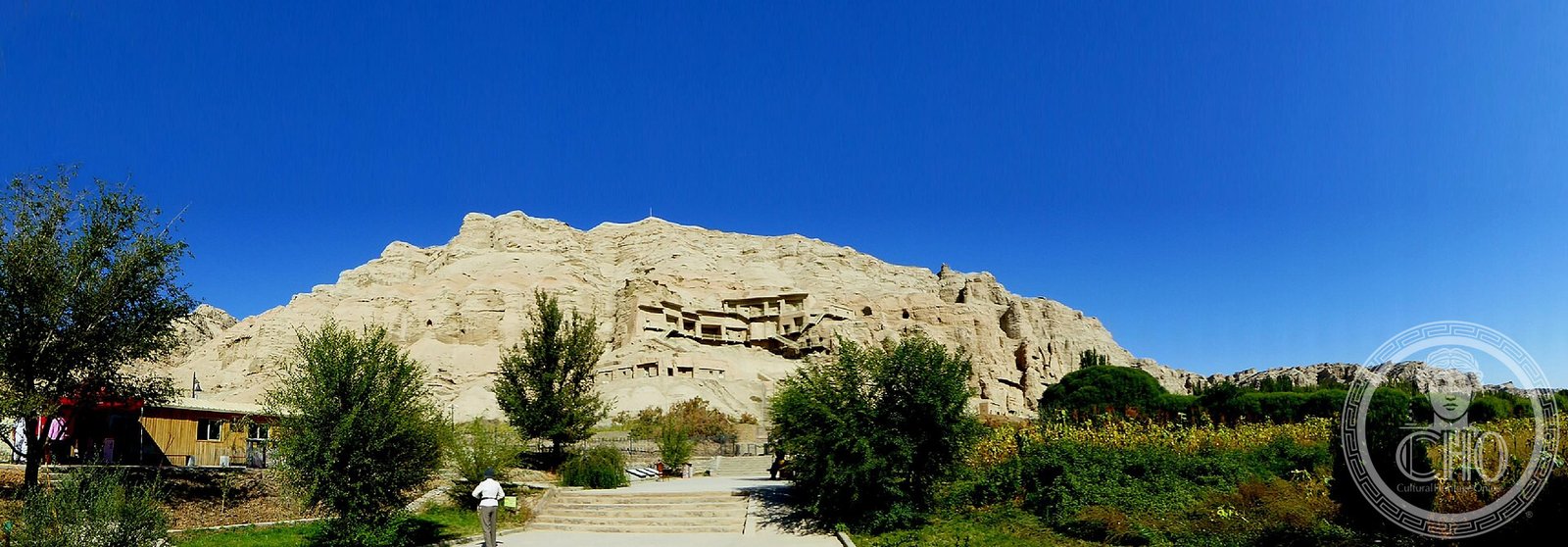
West of the ancient oasis city of Kucha, 236 rock-cut Buddhist caves line a river cliff — among the earliest surviving Buddhist grottoes in China, painted with murals that fuse Gandharan, Iranian and Indian styles before Buddhist art had fully taken on Chinese form.
At a glance
The Kizil Caves (also Qizil or Kizilgaha) sit around 65 km west of Kucha in Xinjiang’s Aksu Prefecture. According to Wikipedia, the earliest caves date to roughly 300 CE, with activity continuing until the site’s abandonment around 800 CE — placing it among the very earliest Buddhist cave complexes anywhere in China, predating the more famous Mogao and Longmen grottoes.
History
Kucha was one of the great oasis kingdoms of the Tarim Basin, a hub where Buddhist monks, merchants and pilgrims moving along the Silk Road exchanged goods, texts and artistic idioms. The Kizil caves served the monastic communities of this kingdom for roughly five centuries before the site was gradually abandoned as Buddhism’s regional fortunes shifted.
In 2014, Kizil was inscribed by UNESCO as a component of “Silk Roads: the Routes Network of Chang’an-Tianshan Corridor,” recognising it alongside sites in China, Kazakhstan and Kyrgyzstan as part of a single serial World Heritage listing documenting the historic Silk Road corridor.
What you see
Of the 236 caves cut into the cliff, around 135 remain relatively intact. Many follow a “central pillar” plan built for ritual circumambulation, with ceilings divided into diamond-shaped coffers each painted with a separate narrative scene — Jataka tales of the Buddha’s former lives, avadana legends, and episodes from his final life. The palette is distinctive: deep lapis lazuli blue (from imported pigment) alongside ochre, orange and green, in a style that visibly bridges Gandharan and Sasanian-Persian visual traditions rather than the more fully Sinicised painting of later Chinese Buddhist art.
Cultural significance
Art historians treat Kizil as a benchmark for how Buddhist iconography travelled and transformed along the Silk Road — the murals record a moment when Indian, Persian and Central Asian visual languages were still in active dialogue, before later Chinese grotto art absorbed and reworked those influences into a distinct national style.
Key facts
- Country: China (Xinjiang, Baicheng County, ~65 km west of Kucha)
- Coordinates: 41.784°N, 82.505°E
- UNESCO World Heritage component: Yes — part of Silk Roads: Chang’an-Tianshan Corridor (inscribed 2014)
- Scale: 236 caves (approx. 135 intact), active roughly 3rd–8th century CE
Practical information & getting there
Kucha is served by domestic flights and long-distance rail/road links within Xinjiang; the caves are a further drive west from the town. Some caves have restricted access to protect fragile murals — verify current visiting arrangements locally, as opening caves rotate and photography inside is typically limited.
Sources & resources
Find it on the map
See this place and what’s around it →


📷 Become a Cultural Heritage Online photographer
Share your photos of places: they stay published under your name as the author. The more they're seen, the more you get noticed — and soon a contest will reward the most appreciated photos.
Log in or sign up free to add a photo