
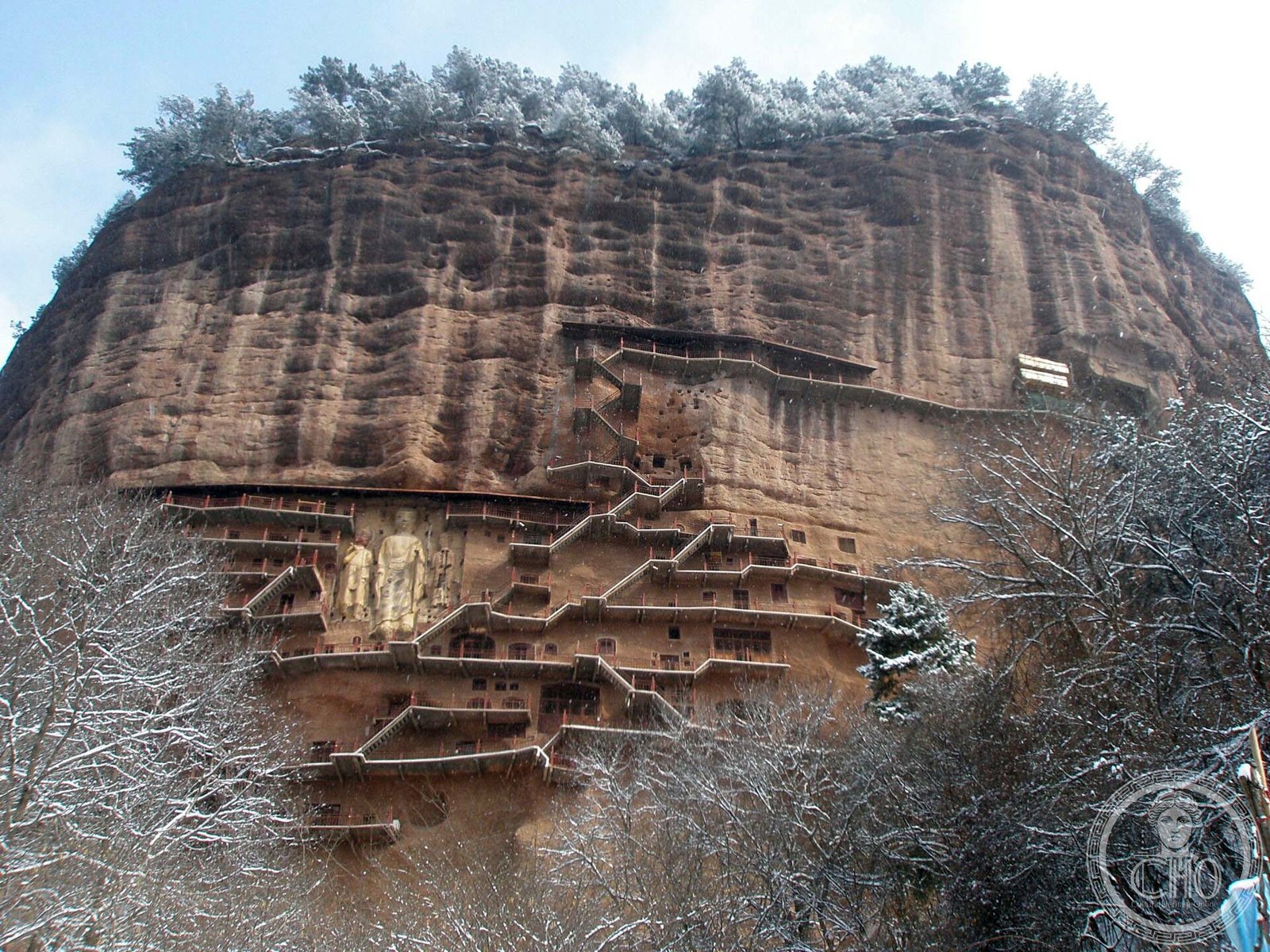
Carved into a freestanding sandstone cliff near Tianshui, the Maijishan Grottoes hold roughly 7,200 Buddhist sculptures and about 1,000 square metres of murals accumulated across twelve dynasties — a mountain-sized gallery on the eastern approach to the Silk Road.
At a glance
Maijishan (“Wheat Stack Mountain,” named for its shape) rises as an isolated purplish-red sandstone hill honeycombed with 194 rock-cut caves. Sculptures and murals were added continuously from the Later Qin dynasty (384 CE) through to the Qing dynasty, making the site a working record of how Buddhist art in China absorbed and reworked Central Asian, Indian and native traditions over more than a millennium.
History
According to Wikipedia, construction began around 384 CE under the Later Qin and continued across twelve successive dynasties, each adding caves, statues or restorations. The site sits on the Hexi Corridor route out of ancient Chang’an, and its patrons included both imperial sponsors and local communities seeking merit through devotional art.
In 2014, Maijishan was inscribed by UNESCO as one of the component sites of “Silk Roads: the Routes Network of Chang’an-Tianshan Corridor,” a serial World Heritage Site spanning 33 locations across China, Kazakhstan and Kyrgyzstan.
What you see
Caves and niches are cut into the cliff face between roughly 30 and 80 metres above the ground, connected today by a network of covered stairways and plank walkways bolted to the rock — not part of the original construction, but the only practical way to reach the higher galleries. Most figures are sculpted in clay over a stone or wood armature rather than carved directly from the sandstone, which is too soft for fine detail; a smaller number of stone sculptures survive from the earliest phases. The scale is cumulative rather than monumental in any single chamber: the effect comes from the sheer density of images layered across the cliff over centuries.
Cultural significance
As one of China’s four great Buddhist grotto sites (alongside Mogao, Longmen and Yungang), Maijishan is valued by art historians for showing the stylistic transition from Central Asian and Gandharan-influenced figures toward a distinctly Chinese sculptural idiom, visible in the softening of drapery and facial modelling across successive dynasties represented on the same cliff.
Key facts
- Country: China (Gansu province, Tianshui)
- Coordinates: 34.352°N, 106.003°E
- UNESCO World Heritage component: Yes — part of Silk Roads: Chang’an-Tianshan Corridor (inscribed 2014)
- Scale: 194 caves, approximately 7,200 sculptures, approx. 1,000 m² of murals
Practical information & getting there
Tianshui is reachable by high-speed rail from Xi’an (roughly 2 hours) or Lanzhou, with the grotto site a short taxi or bus ride from the city centre. Cliff-face walkways can be narrow and exposed; sturdy footwear is recommended. Verify current opening hours and any cave-access restrictions locally, as some upper galleries rotate access to limit wear.
Sources & resources
Find it on the map
See this place and what’s around it →


📷 Become a Cultural Heritage Online photographer
Share your photos of places: they stay published under your name as the author. The more they're seen, the more you get noticed — and soon a contest will reward the most appreciated photos.
Log in or sign up free to add a photo