
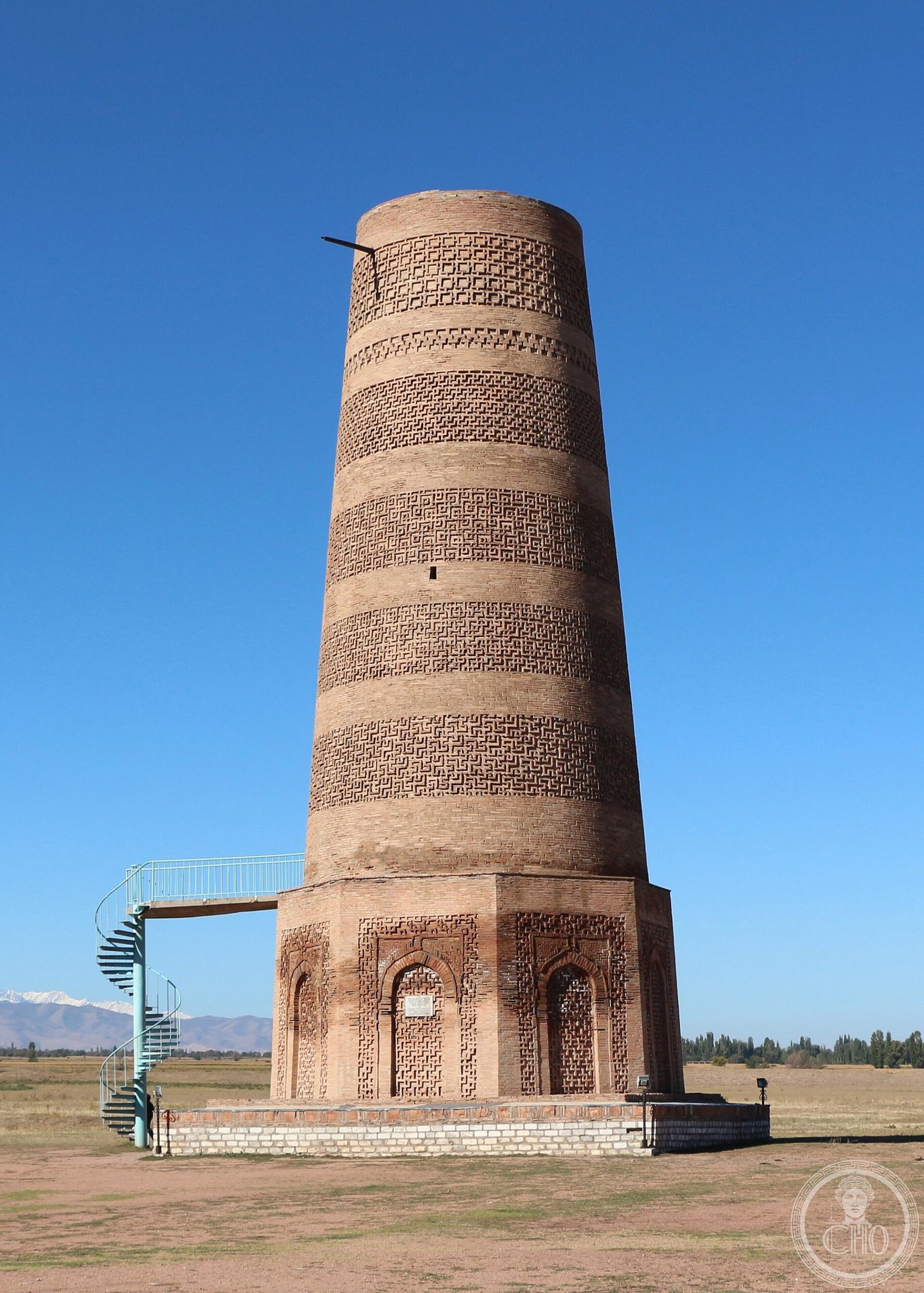
A weathered brick minaret rising from the Chuy Valley steppe, Burana Tower is the last upstanding monument of Balasagun, once capital of the Karakhanid khanate and a key waystation on the Silk Road’s westernmost reach into Central Asia.
At a glance
Roughly 80 km east of Bishkek near the town of Tokmok, the Burana Tower marks the site of Balasagun, a Karakhanid-era city founded at the end of the 9th century. According to Wikipedia, the minaret itself was built in the 11th century and originally stood around 45 metres tall; earthquakes, notably a major tremor in the 15th century, destroyed its upper half, leaving the roughly 25-metre stump that survives — and was restored — today.
History
Balasagun grew into one of the principal cities of the Karakhanid khanate, a Turkic Muslim state that controlled much of Transoxiana and the Chuy Valley from the 9th to 12th centuries. The tower functioned as a minaret for a mosque complex that has otherwise vanished, while the surrounding site preserves earthworks, castle foundations and the remains of at least three mausoleums.
Under the name Balasagun, the site was inscribed by UNESCO in 2014 as one of the three Kyrgyz component parts of “Silk Roads: the Routes Network of Chang’an-Tianshan Corridor,” alongside Suyab (Ak-Beshim) and Nevaket (Krasnaya Rechka) — all former waystations on the corridor’s western terminus in the Chuy Valley.
What you see
The brick minaret is climbed via an internal staircase reached by an external stairway — steep and narrow, but open to visitors, with views over the valley and the surrounding archaeological field from the top. Scattered around the base are balbals, carved stone figures associated with earlier Turkic burial practice, gathered here from sites across the region, along with petroglyphs and the low earthwork traces of the vanished city. A small on-site museum displays artefacts recovered from Balasagun and nearby settlements.
Cultural significance
As the most visually legible surviving structure from any Karakhanid city, Burana Tower gives physical form to a period — the Karakhanid khanate — that is otherwise known mainly through texts and scattered ruins, and anchors the western end of the Chang’an-Tianshan Silk Road corridor in the popular and scholarly imagination alike.
Key facts
- Country: Kyrgyzstan (Chuy region, near Tokmok, ~80 km east of Bishkek)
- Coordinates: 42.747°N, 75.249°E
- UNESCO World Heritage component: Yes — inscribed as “Balasagun,” part of Silk Roads: Chang’an-Tianshan Corridor (2014)
- Tower height: approx. 25 m today (originally approx. 45 m before 15th-century earthquake damage)
Practical information & getting there
Burana is a popular half-day trip from Bishkek by car, typically combined with other Chuy Valley sites. The tower’s internal stairway is narrow and low-ceilinged; visitors with mobility concerns may prefer to view the site from ground level. Verify current site hours locally before travelling.
Sources & resources
Find it on the map
See this place and what’s around it →


📷 Become a Cultural Heritage Online photographer
Share your photos of places: they stay published under your name as the author. The more they're seen, the more you get noticed — and soon a contest will reward the most appreciated photos.
Log in or sign up free to add a photoIs this page about you?
This page is read by travellers and heritage enthusiasts who find it on Google. Tell us how you are connected to this place and we will take it from there.