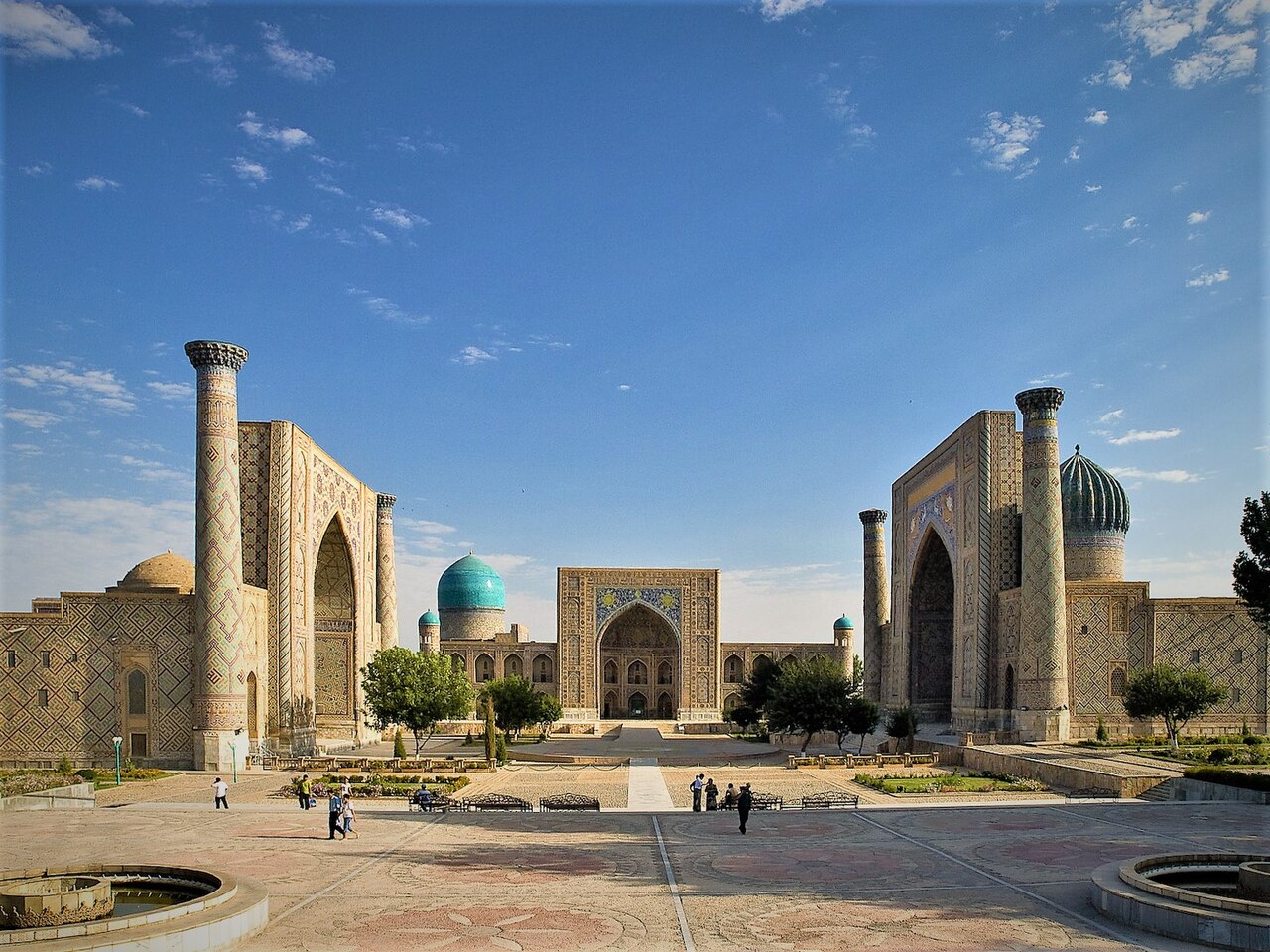
Uzbekistan has seven UNESCO World Heritage Sites, a compact but extraordinarily dense list that spans walled desert cities, monumental Timurid architecture, transcontinental trade routes, and the cold arid steppes of Central Asia. Five are cultural, two are natural, and several share their inscription with neighbouring countries across one of the world’s most consequential crossroads. From Cultural Heritage Online.
Why Uzbekistan’s list looks the way it does
Uzbekistan sits at the geographical heart of the ancient Silk Road network, the overland web of routes connecting the Mediterranean to East Asia. That position shaped civilisation here for more than two millennia: waves of Persian, Greek, Kushan, Arab, Mongol and Timurid influence left a built landscape of mosques, madrasas, caravanserais and fortified inner towns that still stand with unusual completeness. UNESCO’s criteria for cultural significance — outstanding universal value, integrity, authenticity — were met repeatedly and early as the international community began recognising Central Asian heritage in the final years of the Soviet Union.
The natural category arrived much later, reflecting a broader shift in UNESCO policy toward recognising arid and montane ecosystems that had long been overlooked in favour of rainforests and coral reefs. The two natural sites on Uzbekistan’s list, both inscribed in the 2010s and 2020s, belong to transnational serial nominations that required years of cross-border negotiation. The cultural sites, by contrast, are largely self-contained urban cores whose outstanding architecture made the case almost immediately.
The first inscriptions
The process began in 1990, making Uzbekistan one of the earliest Central Asian states to achieve World Heritage status even while still part of the Soviet Union. The inaugural inscription was:
- Itchan Kala (Khiva, 1990) — the fortified inner town of Khiva, enclosed by brick walls roughly ten metres high, preserving a near-intact ensemble of Muslim urban architecture from the 18th and 19th centuries.
Three further cultural sites followed in quick succession during the 1990s and early 2000s, as international attention turned to the Silk Road cities of the Zerafshan valley:
- Historic Centre of Bukhara (1993) — a city with more than 2,000 years of continuous occupation, anchored by the tenth-century Samanid Mausoleum, one of the earliest surviving examples of monumental Islamic architecture in Central Asia.
- Historic Centre of Shakhrisyabz (2000) — the birthplace of Amir Temur (Tamerlane), containing the ruined remnants of his Ak-Saray palace alongside Timurid-era mosques and mausoleums.
- Samarkand — Crossroads of Cultures (2001) — a city founded in the seventh century BCE, whose Registan square, Bibi-Khanum Mosque, and Shah-i-Zinda necropolis constitute one of the most architecturally ambitious urban ensembles in the Islamic world.
The most visited — and the alternatives
Samarkand draws the largest share of international visitors, and the Registan — three madrasas facing each other across a tiled square — is the image most associated with Uzbekistan abroad. Bukhara, with its intact bazaar domes, functioning madrasas and the luminous tilework of the Kalon Minaret complex, runs a close second. Both cities have well-developed tourism infrastructure and appear on most Central Asia itineraries.
Less trafficked are Khiva’s Itchan Kala, where the density of monuments within the walled perimeter is arguably greater than anywhere else on the list — the town contains more than fifty historic structures within a few hundred metres. Shakhrisyabz, inscribed for its Timurid legacy, offers the haunting silhouette of the Ak-Saray gate arch, the only substantial remnant of what was once one of the largest palace complexes in the medieval world. And the 2023 serial inscription of the Silk Roads: Zarafshan-Karakum Corridor formally recognises an 866-kilometre arc of archaeological sites, caravanserais and ancient settlements stretching across the Navoiy and Bukhara regions — a designation that draws scholarly attention to dozens of sites rarely included in standard itineraries.
Natural and shared sites
Uzbekistan’s two natural sites are both transnational. Western Tien-Shan (2016) extends across the mountain system shared with Kazakhstan and Kyrgyzstan, protecting exceptional biodiversity including wild fruit forests, alpine meadows, and endemic species found nowhere else. The inscription recognised an ecosystem that serves as a refuge for snow leopards and a critical seed bank for cultivated fruit varieties descended from wild Tien-Shan ancestors.
The more recent Cold Winter Deserts of Turan (2023) is a sprawling serial property comprising fourteen component parts across the arid zones of Central Asia, including portions in Uzbekistan, Kazakhstan, and Turkmenistan. The site protects one of the world’s last intact cold desert ecosystems, with populations of saiga antelope, Bukhara deer, and Przewalski’s horse reintroduction areas. Together, these two natural nominations shift the perception of Uzbekistan’s heritage beyond the Silk Road cities into landscapes that are equally ancient and considerably less understood.
How to find them
All seven sites are accessible by land within Uzbekistan’s well-connected rail and road network, and Samarkand, Bukhara and Khiva each have domestic airports. The Silk Roads: Zarafshan-Karakum Corridor inscription covers a long axis that largely parallels the Samarkand–Bukhara rail corridor, making many of its component sites reachable as day excursions. The natural sites require more planning: Western Tien-Shan is best approached from the Fergana Valley, while the Turan desert components are remote and typically visited on dedicated wildlife tours.
Uzbekistan’s World Heritage sites sit alongside thousands of other places on CHO’s interactive map, with GPS and sourced editorial history for each. See also our guides to Italy’s and France’s UNESCO sites, and our piece on cultural travel beyond mass tourism.
Frequently Asked Questions
How many UNESCO World Heritage Sites does Uzbekistan have?
Uzbekistan has seven UNESCO World Heritage Sites as of 2025. Five are cultural and two are natural; several are transnational serial nominations shared with neighbouring Central Asian states.
What was Uzbekistan’s first UNESCO World Heritage Site?
Itchan Kala, the walled inner town of Khiva, was inscribed in 1990 — making it the first World Heritage Site on Uzbek territory. Its fortified perimeter and dense concentration of historic Islamic architecture made it an early and unambiguous candidate under UNESCO’s cultural criteria.
Are any of Uzbekistan’s World Heritage Sites natural rather than cultural?
Yes, two of the seven sites are natural: Western Tien-Shan (2016), a transnational mountain ecosystem shared with Kazakhstan and Kyrgyzstan, and Cold Winter Deserts of Turan (2023), a serial property spanning fourteen components across the arid zones of Central Asia. Both protect ecosystems and species found nowhere else in the world at comparable scale.
What is the most recently inscribed World Heritage Site in Uzbekistan?
Two sites were inscribed simultaneously in 2023: Cold Winter Deserts of Turan and Silk Roads: Zarafshan-Karakum Corridor. The latter is a cultural serial nomination recognising an 866-kilometre arc of Silk Road sites, settlements, and caravanserais across the Navoiy and Bukhara regions.
Sources used in this article
- UNESCO — State Party Uzbekistan — World Heritage list.
- UNESCO — Uzbekistan: World Heritage Sites.
- CHO magazine — What is a World Heritage Site?
- CHO — Interactive map of heritage sites.