At the turn of the twentieth century, Palermo stood at the centre of a flowering that rivalled Vienna, Brussels and Barcelona. Sicily’s Belle Époque had a patron — the Florio dynasty, whose empire of Marsala wine, tuna canneries and shipping lines made them the richest family in unified Italy — and it had an architect. Ernesto Basile transformed that fortune into stone, iron and plaster, producing buildings that belong unmistakably to the Italian branch of the international Art Nouveau movement. The Palermitans called it Liberty, after the London department store whose fabrics seeded the style across the Mediterranean.
The Grand Hotel and Its Dynasty: Villa Igiea
The Florio commission that announced Basile to Europe arrived at the end of the century. Villa Igiea (Ernesto Basile, 1898–1900) rises from the Acquasanta waterfront north of the city centre, its pale façade meeting the Tyrrhenian light with the calm confidence of a building that knows exactly what it is. Inside, the grand salon carries sinuous floral stucco that wraps the walls the way kelp wraps rock — organic, insistent, impossible to date to any other decade. The Florio family built it as a hotel and filled it with Europe’s aristocracy, politicians and artists at the height of Sicily’s Belle Époque. Today Villa Igiea still operates as a working luxury hotel. The continuity is striking. The building has never stopped doing what Basile intended.
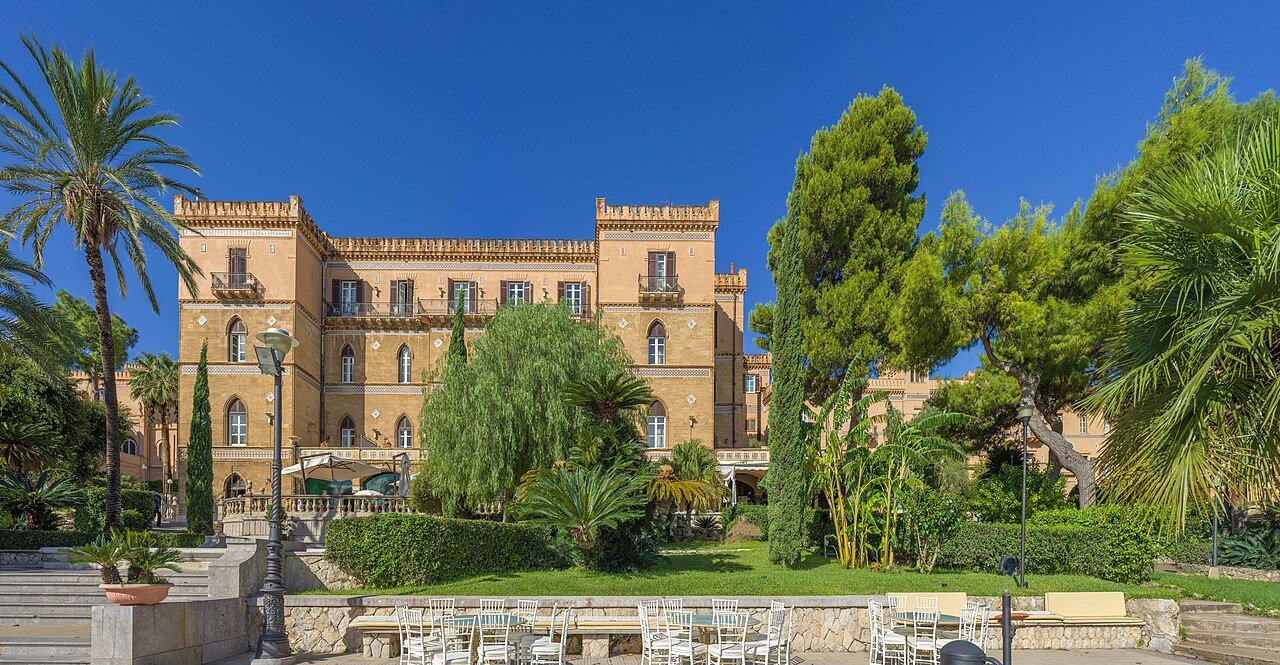
The connection between patron and architect was not incidental. Ernesto Basile grew up inside the Florio orbit, and the hotel reflects that intimacy. Where the Barcelona Modernisme of Domènech i Montaner or the Brussels Jugendstil of Victor Horta reached for the transgressive, Basile’s Liberty tended toward the sumptuous. Villa Igiea does not shock. It seduces.
The Family Villa and the Earliest Liberty Building
A few kilometres inland, the Florio family’s private residence tells a quieter story. Villino Florio all’Olivuzza (Ernesto Basile, from 1899) sits in a garden that once overlooked the city with theatrical ease. The ironwork at the entrance is the detail that stops visitors mid-step: wrought tendrils that curl and recurve in patterns drawn from Sicilian flora rather than the northern European lily or thistle more common in the movement. Medieval ornament anchors the composition, and then Liberty ironwork destabilises it. The tension is intentional. Basile was synthesising Sicily’s Norman heritage with the continental avant-garde. The result is one of the founding works of Sicilian Liberty.
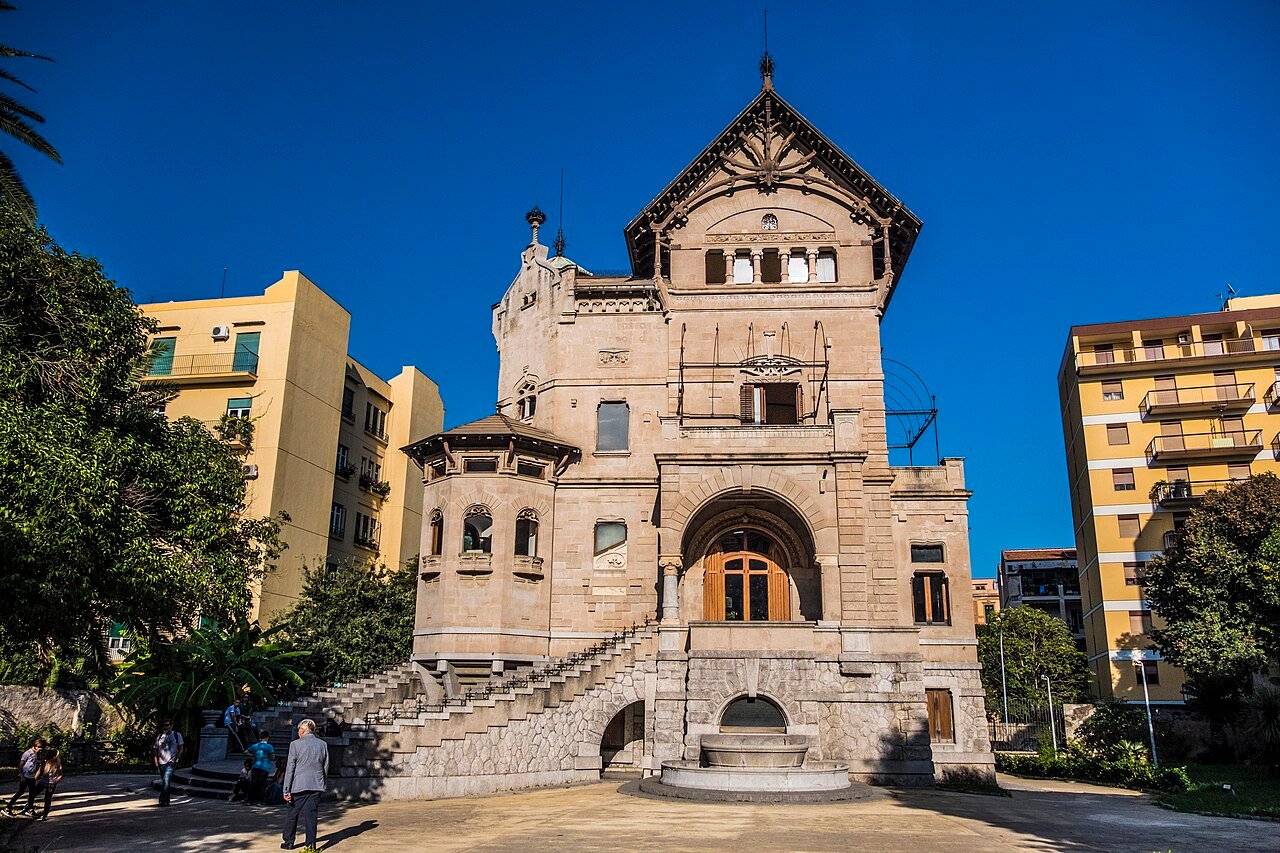
The earliest Liberty building in this itinerary, however, predates it by a decade. Villino Favaloro was begun in 1889 by Giovan Battista Filippo Basile — Ernesto’s father, professor at the Palermo School of Architecture and himself a foundational figure in Sicilian historicism. The son later enlarged the building with Liberty interventions that layer onto the father’s structure the way a second generation always layers onto the first: in conversation, not rupture. Villino Favaloro is among the earliest Liberty buildings in Sicily and now houses a Museum of Photography, which gives visitors a practical reason to step inside and study the transitions between the two architects’ hands.
A Complex for Pleasure: Kursaal Biondo
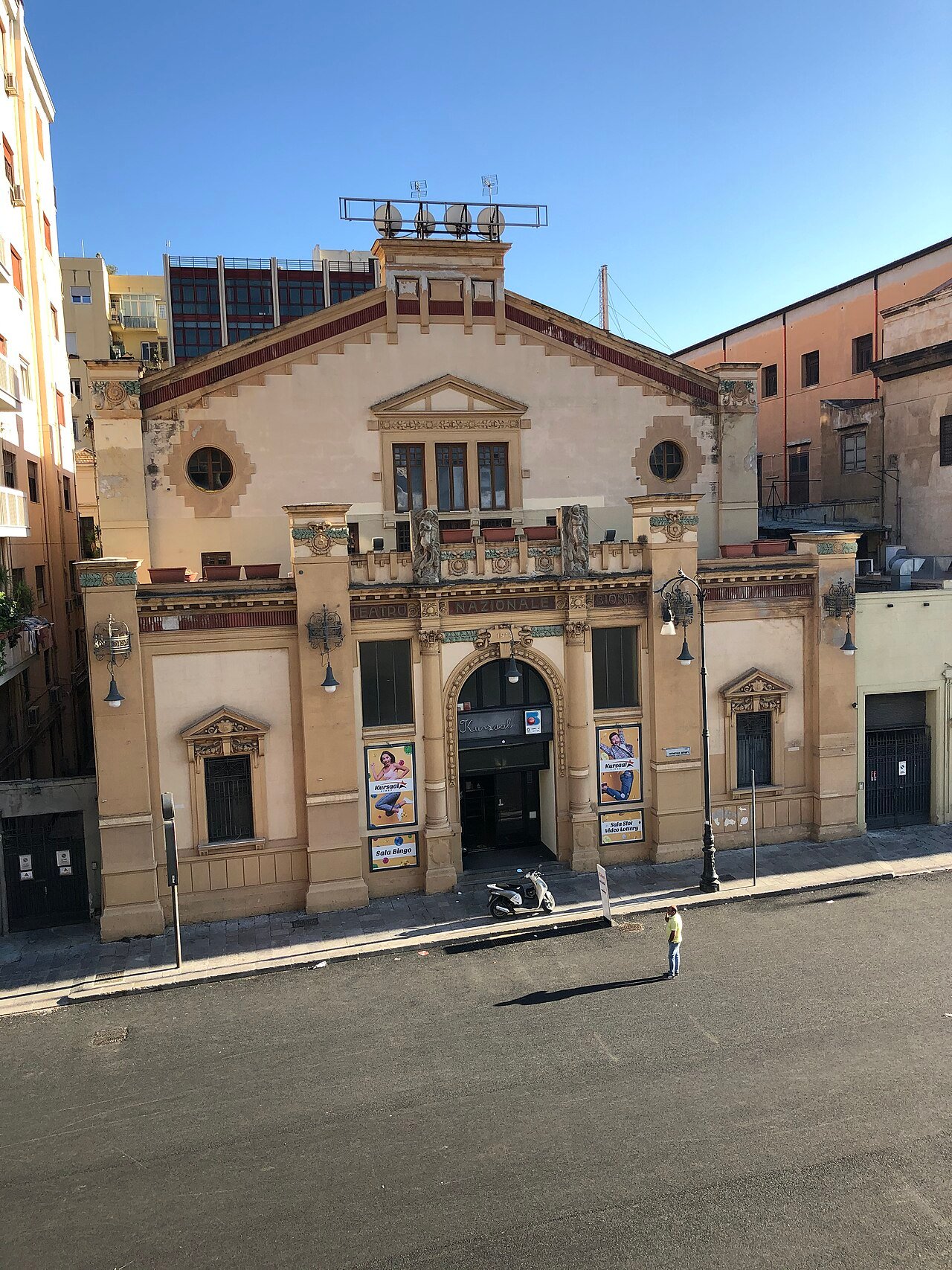
By 1913, the idiom had loosened. Kursaal Biondo (Ernesto Basile, 1913–1914) was not a villa or a hotel for the elite. The Biondo brothers commissioned a pleasure complex — cinema, garden café, concert loggia — woven into a single Liberty building for a general Palermitan public. The loggia arcade faces the garden with an openness that the earlier Basile works, turned inward toward their patrons, rarely permitted. Kursaal Biondo belongs to the same European moment that produced Vienna’s Prater pavilions and the pleasure gardens of fin-de-siècle Paris, translated into Sicilian limestone and Liberty ornament. It is late in Basile’s career. The confidence shows.
Why It Happened Here
The Florio fortune was not abstract wealth. It was Marsala wine exported to Britain, tuna packed in industrial canneries at Favignana, steamship lines connecting Sicily to the mainland. That money needed visible form. Ernesto Basile — by the early 1900s recognised as the leading architect of Italian Liberty nationally, not merely regionally — gave it form that was simultaneously Sicilian and European. Palermo’s Liberty was never provincial imitation; it was parallel invention, in dialogue with Brussels and Vienna but rooted in Norman and Arab ornamental traditions that the north of Europe simply did not possess.
Which makes the losses harder to accept. Post-war speculative development — the period Palermitans came to call the “Sack of Palermo” — erased a large portion of the city’s Liberty fabric. Villas were demolished, gardens built over, ironwork stripped and sold. The four buildings in this itinerary survived. They are not representative of what Palermo had. They are what remains of it.
How to Walk It
You can cover this itinerary in three to four hours, though Villa Igiea’s position on the Acquasanta waterfront means you will want to budget transport time. The logical order is chronological: begin at Villino Favaloro (Piazza Virgilio), where the two Basile generations meet, then walk south-east to Villino Florio all’Olivuzza, whose garden entrance is accessible and the building open as a visitable site. From there, take a taxi or the coastal bus north to Villa Igiea — even if you are not staying, the hotel’s public areas, including the Liberty salon, are generally open to visitors who approach the front desk; a coffee at the terrace bar solves any ambiguity. Kursaal Biondo lies back toward the city centre and completes the loop. Allow time. The ironwork at Villino Florio rewards ten minutes of close looking that no photograph will give you.
This walk connects naturally to the broader Art Nouveau story traced across Europe in the CHO magazine guides to Barcelona and Brussels.
Frequently Asked Questions
Who was Ernesto Basile and why is he important to Italian Liberty architecture?
Ernesto Basile (1857–1932) was a Palermo-born architect who became the foremost practitioner of Italian Liberty, the local variant of Art Nouveau. He studied under his father, Giovan Battista Filippo Basile, at the Palermo School of Architecture and developed a distinctive synthesis of northern European Art Nouveau ornament with Sicily’s Norman and Arab decorative heritage. His work for the Florio family — Villa Igiea, Villino Florio all’Olivuzza — established the idiom across Italian architecture at the turn of the century.
Can visitors enter Villa Igiea today?
Yes. Villa Igiea operates as a working luxury hotel on the Acquasanta waterfront. Non-guests can typically access the public areas, including the celebrated Liberty salon, by visiting the bar or terrace; it is courteous to confirm at the front desk on arrival. The exterior and waterfront garden are freely visible from the street.
What was the “Sack of Palermo” and how did it affect Liberty architecture?
The “Sack of Palermo” refers to a wave of speculative construction in the post-war decades that demolished large sections of the city’s historic fabric, including many Liberty villas and gardens. The demolitions were driven by corruption in the building sector and left Palermo with only a fraction of its early twentieth-century heritage intact. The surviving buildings — Villa Igiea, Villino Florio, Kursaal Biondo, Villino Favaloro — are precious precisely because so much was lost.
How does Palermo’s Liberty style differ from Art Nouveau in Belgium or Spain?
Italian Liberty shares the organic ornament, sinuous ironwork and rejection of historicist symmetry common to the broader movement, but Palermo’s version draws on a local repertoire absent elsewhere. The Norman and Arab architectural traditions of medieval Sicily — geometric interlace, pointed arches, decorative stonework — gave Basile a regional grammar that he wove into the continental style. Brussels Art Nouveau and Barcelona Modernisme emerged from northern European and Catalan Gothic roots; Palermo Liberty is Mediterranean in a distinct and specific sense.
Is Villino Favaloro open to the public?
Villino Favaloro, at Piazza Virgilio 32, now houses a Museum of Photography and is open as a visitable site. This gives the building an active public function and allows visitors to study the layered contributions of both Giovan Battista Filippo Basile, who began the building in 1889, and his son Ernesto, who added Liberty elements in later years.
How long does it take to walk this Liberty Palermo itinerary?
Allow three to four hours for a comfortable visit to all four buildings. Villa Igiea’s position on the northern waterfront means a short taxi or bus ride is necessary rather than a continuous walk; the other three sites are reachable on foot from the city centre. The route works best in the morning, when light on the waterfront façade of Villa Igiea is most direct and the garden of Villino Florio is coolest.