

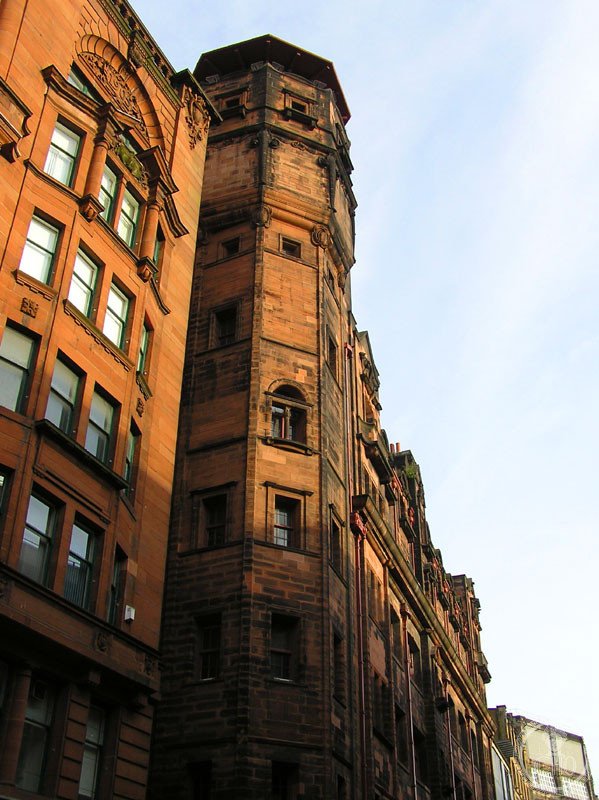
A young draughtsman hid his name inside a newspaper office. The tower he raised over Mitchell Lane gave him away.
At a glance
The Lighthouse is the A-listed former offices of the Glasgow Herald, completed in 1895 to designs by Charles Rennie Mackintosh while he worked for the firm Honeyman and Keppie, as a refronting and extension of an existing building on the site. It was his first major architectural commission. In 1999, the year Glasgow held the title of UK City of Architecture and Design, the converted building reopened as Scotland’s Centre for Design and Architecture, taking its name from the water-tower that rises from the corner. The Herald itself occupied the premises until 1980.
Key facts
- Designer: Charles Rennie Mackintosh, for Honeyman and Keppie
- Built: designed 1893–1894, completed summer 1895
- Original use: offices of the Glasgow Herald newspaper
- Style: Modern Style (British Art Nouveau), with Scottish baronial notes
- Status: A-listed building
- Since 1999: design and architecture centre
- Location: Mitchell Lane, central Glasgow
History
The building was designed between 1893 and 1894 and officially credited to Honeyman and Keppie, the practice Mackintosh had joined as a draughtsman. It was one of his first major commissions with the firm, carried out as a young assistant on a building the practice took on jointly. In a letter to the German critic Hermann Muthesius, Mackintosh expressed frustration that the work appeared under the firm’s name rather than his own, hoping that “when brighter days come” he might claim his work as his.
Construction began in February 1894 and finished by the summer of 1895. The offices were an extension to the Herald’s premises on Buchanan Street, and Mackintosh shaped the interiors as well; the editor’s room is singled out as bearing his hand most clearly. The Glasgow Herald stayed until 1980, after which the building stood empty for two decades.
Its revival came with Glasgow’s 1999 year as UK City of Architecture and Design, when a renovation turned it into Scotland’s Centre for Design and Architecture and gave it the name The Lighthouse.
What you see
The corner water-tower is the building’s signature, a tall narrow shaft that recalls the Italian bell-towers Mackintosh had sketched on his study trips. Inside it, a helical stair climbs to a viewing level over the rooftops of the city centre.
The street fronts blend Scottish baronial and Queen Anne elements, but the proportions and the rhythm of the windows already read as Mackintosh. The Modern Style he would soon make famous is here in its first, restrained form, worked out on a commercial building before he had a house of his own to design.
Practical information
- Access depends on the building’s current tenancy and programme; check before visiting.
- The Mackintosh Tower and viewing platform are the highlight when open.
- The exterior and the entrance off Mitchell Lane can be seen at any time.
- Time needed: 45–60 minutes when galleries and tower are open.
Getting there
The Lighthouse stands on Mitchell Lane, off Buchanan Street in the heart of Glasgow. It is a few minutes’ walk from Glasgow Central and Queen Street stations and from the St Enoch and Buchanan Street subway stations.
Nearby
- Glasgow School of Art — Mackintosh’s masterpiece, a short walk uphill.
- The Willow Tea Rooms on Sauchiehall Street.
- Buchanan Street and the city-centre shopping core.
Sources
- Wikipedia, “The Lighthouse, Glasgow”.
- Historic Environment Scotland listing (A-listed building).
- The Glasgow School of Art / Mackintosh resources.
Find it on the map
See this place and what’s around it →Record researched and written by Luigi De Marchi for Cultural Heritage Online, 2026.
📷 Become a Cultural Heritage Online photographer
Share your photos of places: they stay published under your name as the author. The more they're seen, the more you get noticed — and soon a contest will reward the most appreciated photos.
Log in or sign up free to add a photoIs this page about you?
This page is read by travellers and heritage enthusiasts who find it on Google. Tell us how you are connected to this place and we will take it from there.