

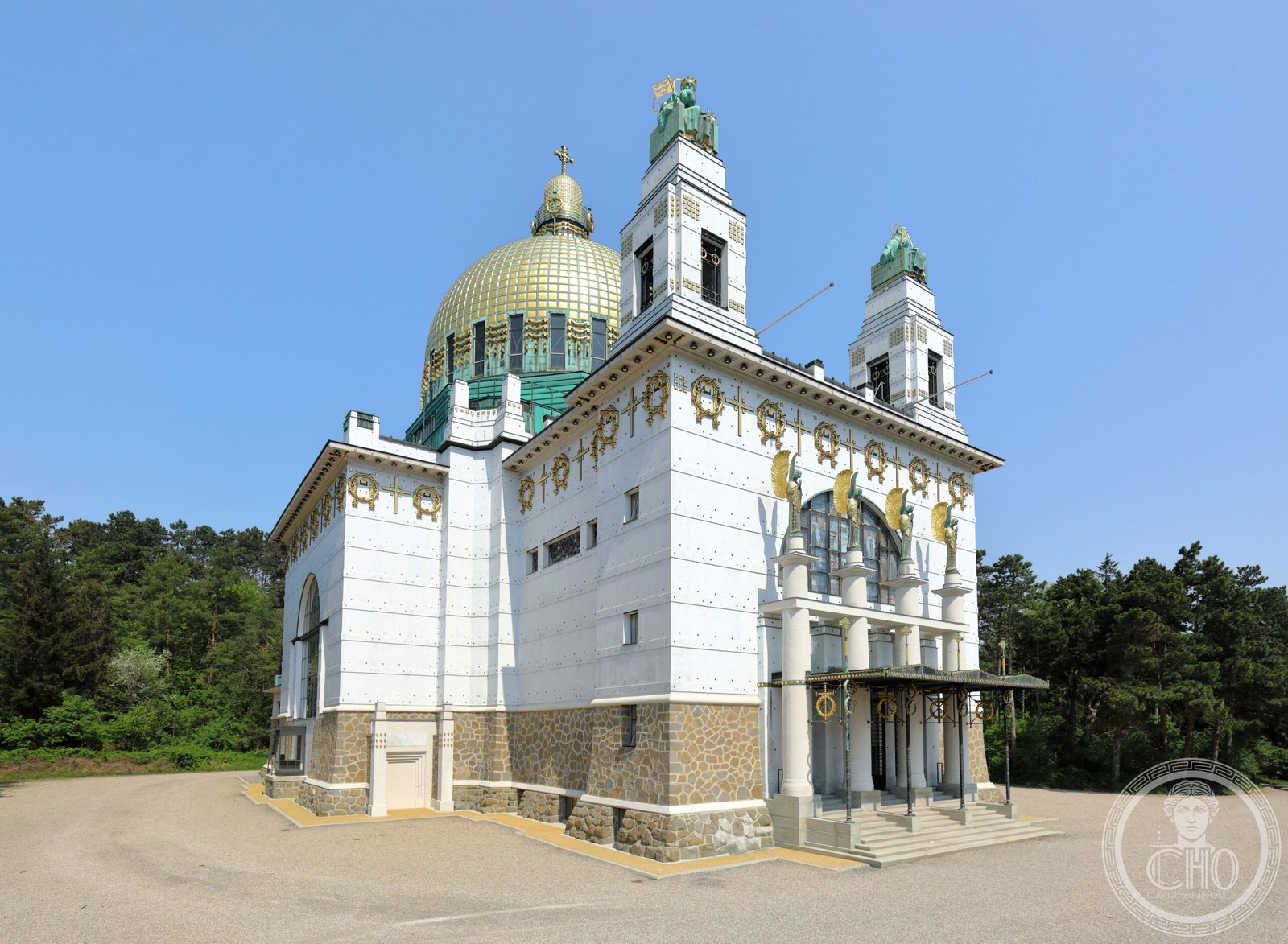
A church built for the most vulnerable congregation in Vienna. Wagner rounded every corner for them.
At a glance
The Kirche am Steinhof, dedicated to Saint Leopold, is the oratory of the psychiatric hospital at Steinhof, on a hillside in the Penzing district of western Vienna. Otto Wagner built it between 1904 and 1907, and it is widely regarded as one of the most important Art Nouveau churches in the world. Wagner conceived the building around the needs of the patients who would use it, and gathered the leading artists of the Vienna Secession to decorate it. Its gilded dome is visible across the city.
Key facts
- Architect: Otto Wagner
- Built: 1904–1907
- Mosaics & stained glass: Koloman Moser
- Sculptural angels: Othmar Schimkowitz
- Tower statues (St Leopold, St Severin): Richard Luksch
- Setting: Otto-Wagner-Spital, Baumgartnerhöhe, Penzing (14th district)
- Style: Vienna Secession / Art Nouveau
History
The church was built between 1904 and 1907, when Otto Wagner was already in his sixties and at the height of his authority as the leading architect of modern Vienna. It sits at the centre-top of the Lower Austrian state institution for the mentally ill at Steinhof, on the Baumgartnerhöhe below the Galitzinberg.
Wagner brought in the foremost artists of the Secession. Koloman Moser designed the stained glass and major mosaics; Othmar Schimkowitz made the sculptural angels; and the Viennese sculptor Richard Luksch carved the statues of Saint Leopold and Saint Severin, the patron saints of Lower Austria, on the two external towers. Most of the smaller details Wagner designed himself.
The church keeps a separate status from the Archdiocese of Vienna, belonging to the hospital it serves. Restored over the following century, it remains both a working oratory and a landmark of Viennese modernism.
What you see
Almost everything about the building answers its function inside an asylum. Wagner avoided sharp edges and rounded most corners; visible crosses are kept to a minimum; and the interior was planned for the safety and calm of psychiatric patients. The result is a church that feels engineered for serenity rather than for display.
Above it all rises the gilded copper dome, so striking that contemporaries compared the building to the tomb of an Indian maharaja. Unusually, the church is laid out on a north–south axis to fit the hospital plan, and light, white surfaces, and gold work together to lift the eye toward Moser’s glass.
Practical information
- The church opens to visitors on limited days and for guided tours; check the current schedule before going.
- It stands within a working hospital campus — follow the signed visitor route.
- The hillside setting offers wide views over Vienna.
- Time needed: about 1 hour with the approach through the grounds.
Getting there
The church is on the Baumgartnerhöhe in Penzing, in western Vienna. Bus 48A from the city reaches the hospital area, and the climb up through the campus is part of the experience. Allow extra time, as it sits well outside the central districts.
Nearby
- The Otto-Wagner-Spital pavilions, a planned hospital landscape of the same era.
- Otto Wagner’s Karlsplatz Stadtbahn pavilions and the Secession Building, in the centre.
Sources
- Wikipedia, “Kirche am Steinhof”.
- Otto-Wagner-Spital / City of Vienna heritage information.
- Bundesdenkmalamt (Austrian Federal Monuments Office) listing.
Find it on the map
See this place and what’s around it →Record researched and written by Luigi De Marchi for Cultural Heritage Online, 2026.
📷 Become a Cultural Heritage Online photographer
Share your photos of places: they stay published under your name as the author. The more they're seen, the more you get noticed — and soon a contest will reward the most appreciated photos.
Log in or sign up free to add a photoIs this page about you?
This page is read by travellers and heritage enthusiasts who find it on Google. Tell us how you are connected to this place and we will take it from there.