
While Vienna had its Secession and Brussels its Art Nouveau, Glasgow produced something entirely its own: the Glasgow Style — a synthesis of Arts and Crafts severity and decorative elegance whose defining voice was Charles Rennie Mackintosh.
At a glance
Glasgow at the turn of the twentieth century was one of the world’s great industrial cities — and also, paradoxically, a centre of progressive art and design. The Glasgow School of Art, under Francis Henry Newbery, incubated a generation of designers who resisted both Victorian excess and French floral Art Nouveau. The “Glasgow Four” — Mackintosh, Herbert MacNair, and the sisters Margaret and Frances Macdonald — developed a cooler, more geometric aesthetic sometimes called “Spook School” for its elongated, spectral figures. Mackintosh’s furniture, interiors and architecture remain among the most distinctive British contributions to international modernism.
Key facts
- Country: Scotland, United Kingdom
- Key period: 1890–1928 (Glasgow Style / Arts & Crafts)
- Key figure: Charles Rennie Mackintosh (1868–1928) — architect, designer, watercolourist
- Essential sites: Glasgow School of Art (Mackintosh Building), Kelvingrove Art Gallery, The Mackintosh House (Hunterian Museum), Mackintosh at the Willow, Hill House (Helensburgh)
- Collections: Kelvingrove holds works by Mackintosh and the Glasgow Boys; the Hunterian owns the largest Mackintosh collection in the world
- Annual anniversaries: Mackintosh nascita 7 giugno, Mackintosh morte 10 dicembre
History
Charles Rennie Mackintosh was born on 7 June 1868 in Glasgow, the second of eleven children. He began an architectural apprenticeship at sixteen and enrolled at the Glasgow School of Art, where he met Herbert MacNair and the Macdonald sisters. The four collaborated intensively through the 1890s, exhibiting at Vienna (where the Secessionists admired them greatly) and Turin, and winning international attention before achieving significant commissions at home.
Mackintosh’s masterpiece, the Glasgow School of Art on Renfrew Street (1897–1909), is among the earliest and most original Art Nouveau buildings in Britain. Its west wing library (1907–1909) in particular — with its complex timber structure and precisely positioned windows — is considered one of the finest interior spaces of the period. The building was severely damaged by fire in 2014 and again in 2018; restoration is ongoing, supervised by the Glasgow School of Art.
Beyond the GSA, Mackintosh designed the Willow Tea Rooms (1903, now open as Mackintosh at the Willow), the Hill House in Helensburgh (1902–1904, National Trust for Scotland), and a series of private houses and interiors. He moved to London in 1914 and then to France, where he produced a celebrated series of watercolour flower studies before his death in 1928.
What you see
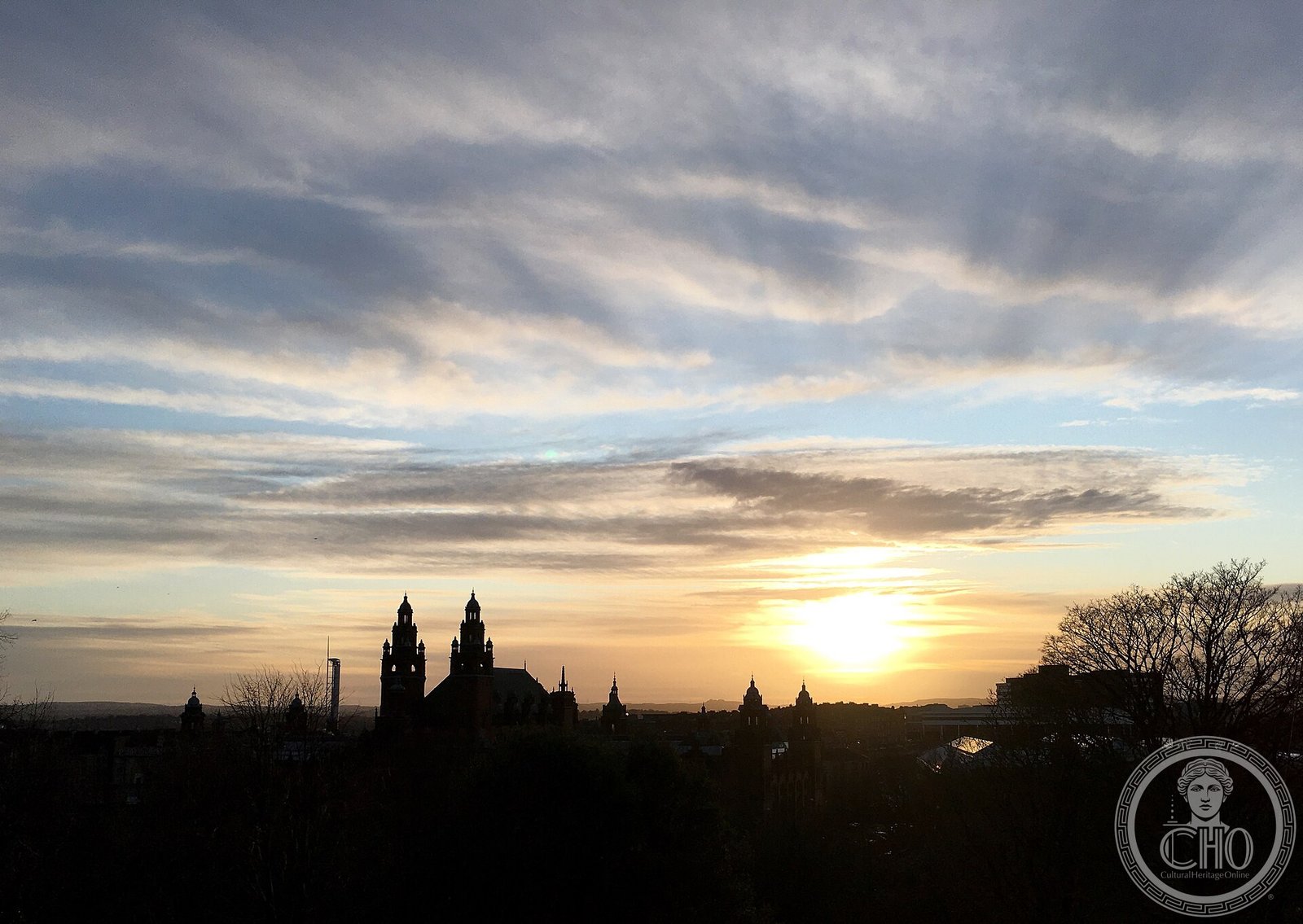
Kelvingrove Art Gallery and Museum (Argyle Street, West End) is Glasgow’s great Victorian red-sandstone palace — built for the 1901 International Exhibition and still free to enter. The collection includes Mackintosh furniture and drawings, alongside Salvador Dalí’s Christ of Saint John of the Cross and an encyclopaedic natural history collection. The Mackintosh House, a reconstruction of his Glasgow home, is housed in the adjacent Hunterian Museum at the University of Glasgow (also free).
Mackintosh at the Willow (217 Sauchiehall Street) offers the closest thing to an immersive Mackintosh experience in the city centre: the original 1903 tea rooms have been restored and are open for afternoon tea and tours. The Room de Luxe, with its mirrored frieze and high-backed silver chairs, remains exactly as Mackintosh and Margaret Macdonald designed it.
Practical information
- Kelvingrove: free entry, open daily 10:00–17:00 (Fri–Sun until 17:00)
- Mackintosh at the Willow: entry fee for tours; café open daily
- Hill House Helensburgh: National Trust for Scotland, 45 min by train from Glasgow Queen Street
- GSA tours: currently limited due to restoration; check glasgowschoolofart.ac.uk
- Time needed: full day for city Mackintosh itinerary; overnight for Hill House day trip
Getting there
Glasgow International Airport (GLA) is 13 km west; the 500 express bus reaches Glasgow city centre in 25 minutes. Glasgow Queen Street and Glasgow Central are the two main stations — all West End museums are reachable on foot (30 min from Central) or via Subway (Kelvinbridge or Hillhead stop). Mackintosh at the Willow is a 15-minute walk from Central Station along Sauchiehall Street.
Related in CHO
- Anniversario nascita: Charles Rennie Mackintosh — 7 giugno 1868
- Anniversario morte: Charles Rennie Mackintosh — 10 dicembre 1928
- Brussels — Victor Horta and Art Nouveau Architecture
- Vienna — Capital of the Vienna Secession
Sources
Find it on the map
See this place and what’s around it →Events here — now on & upcoming
- Birth Anniversary: Charles Rennie Mackintosh — June 7, 186807 Jun 2027See the event →
- Death Anniversary: Charles Rennie Mackintosh — December 10, 192810 Dec 2026See the event →
📷 Become a Cultural Heritage Online photographer
Share your photos of places: they stay published under your name as the author. The more they're seen, the more you get noticed — and soon a contest will reward the most appreciated photos.
Log in or sign up free to add a photo