
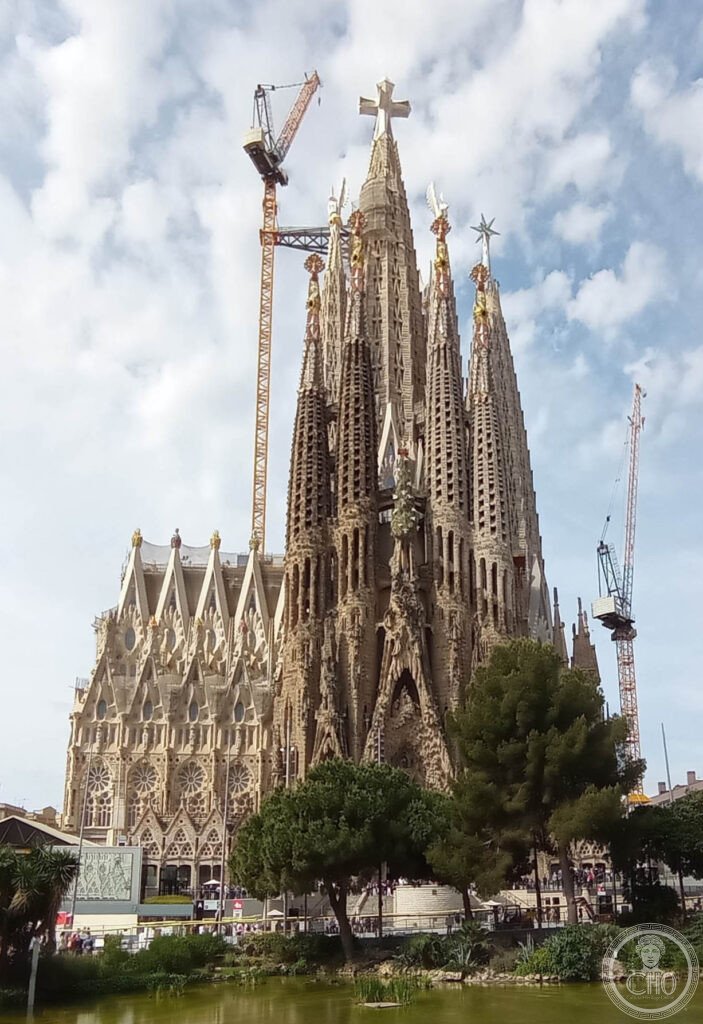
Sagrada Família — Barcelona
The most ambitious ongoing architectural project in human history and the most visited paid monument in Spain — the Sagrada Família, begun in 1882 and still under construction more than 140 years later, is Antoni Gaudí’s masterpiece: a cathedral that no other architect has attempted to replicate, combining Gothic structural logic with Art Nouveau organic ornament in a building that when completed in 2033 will be the tallest church in the world.
At a glance
The Sagrada Família (the most precisely visited single paid monument in Spain: 4.5 million visitors per year — the most attended single monument in Spain (the most precisely overcrowded single UNESCO heritage site in Barcelona: book online at sagradafamilia.org — the most frequently sold-out single church booking in Spain)); UNESCO WHS 2005 as part of the “Works of Antoni Gaudí” — 7 Gaudí properties inscribed: the Sagrada Família, Park Güell, Casa Milà (La Pedrera), Casa Batlló, Casa Vicens, Palau Güell, and the Crypt at Colònia Güell — the most precisely single-architect single UNESCO inscription in European heritage history; the most precisely still-incomplete single UNESCO inscribed monument: the Sagrada Família was inscribed under UNESCO before it was finished — the most precisely work-in-progress single UNESCO World Heritage Site in the world); the architecture (the most precisely biomorphic single Gothic cathedral design: Gaudí based his structural system entirely on natural forms — the most precisely parabolic-arch single Gothic structural solution: Gaudí rejected traditional flying buttresses and used parabolic arches, hyperboloids, and helicoids instead — the most precisely conic-section single Gothic structural vocabulary in any European cathedral; the result (the most precisely self-bracing single Gothic structure: the Sagrada Família needs no flying buttresses — the most precisely buttress-free single large Gothic building in the history of European ecclesiastical architecture)).
Key facts
- The three facades: the most precisely thematically contrasted single triple-facade programme in any European Gothic cathedral — the Nativity Facade (described in hero caption; the most precisely Gaudí-original single facade; east-facing — the most precisely sunrise-illuminated single facade at the Sagrada Família; the most densely figurative single Gothic facade in Europe: every surface covered with 100+ stone figures, plants, animals, and angels — the most precisely zoologically-populated single Gothic facade in any Spanish cathedral); the Passion Facade (west-facing — the most precisely sunset-illuminated single facade; the most precisely Subirachs-sculpted single facade: designed by Josep Maria Subirachs, 1987–2018 — the most precisely post-Gaudí single major sculptural programme; the most controversial single Sagrada Família addition: Subirachs’s angular, geometric style directly contradicts Gaudí’s organic naturalism — the most precisely stylistic-clash single paired facade in any European Gothic cathedral); the Glory Facade (south-facing; unfinished as of 2026 — the most precisely future-completion single facade in any 21st-century European heritage building)
- The towers and the nave: the most precisely light-engineering single Gothic nave in Spain — the towers (the most precisely height-planned single European Gothic tower programme: 18 towers total — 12 for the Apostles (completed), 4 for the Evangelists (in progress), 1 for the Virgin Mary (2021 — the most recently crowned single Sagrada Família tower: the Mary tower was completed with a 12-pointed star illuminated by LED lights on 8 December 2021 — the most precisely Immaculate Conception-dated single tower completion in any European Gothic cathedral), 1 for Jesus Christ (the tallest: 172.5 m when complete — the most precisely planned single tallest church tower in the world); the nave (the most precisely tree-canopy single Gothic nave: the branching columns support the ceiling like a forest — the most precisely biomimetic single Gothic column system in any European cathedral; the stained glass (the most precisely colour-gradient single stained glass in any 20th/21st century Gothic cathedral: the west windows are deep blue and green (cold palette: the most precisely sunset-blues single stained glass in any Spanish cathedral) while the east windows are warm yellow and red (the most precisely sunrise-orange single stained glass in any Spanish cathedral)))
- Antoni Gaudí: the most precisely one-client single architect-patron relationship in European architectural history — Gaudí (1852–1926: the most precisely Catalan-nationalist single major architect of the early 20th century; the most precisely Catholic single major Art Nouveau architect: his architecture is inseparable from his Catholic faith — the most precisely faith-architecture-fused single European architectural practice in the history of Art Nouveau; the beatification (the most precisely architect-beatification single Catholic Church process: Pope John Paul II beatified the Sagrada Família’s crypt in 2010 — the most precisely on-site-beatification single architectural patron in the history of the Church; Gaudí is currently a Venerable — the most precisely architect-sainthood-candidate single figure in the history of Catholicism)); the other Gaudí UNESCO works (Park Güell — the most precisely urban-mosaic-garden single Gaudí work; Casa Milà / La Pedrera — the most precisely wave-roof single building in Barcelona; Casa Batlló — the most precisely dragon-scaled single building facade in any European heritage city))
- Heritage: UNESCO World Heritage Site, Works of Antoni Gaudí, inscribed 2005
- GPS: 41.4036° N, 2.1744° E
History
The commission (the most precisely single-architect single greatest-legacy architectural commission: the Association of Devotees of St Joseph commissioned a neo-Gothic church in 1882; Francisco de Paula del Villar began the crypt; Gaudí took over in 1883 — the most precisely 1-year single Gothic start-to-Gaudí architectural transition in any European cathedral); Gaudí’s years (1883–1926: 43 years on a single building — the most precisely career-consuming single architectural commission in the history of European architects; Gaudí abandoned all other clients in his final decade to work exclusively on the Sagrada Família — the most precisely client-exclusive single late-career architectural decision in any European architect’s biography); the 1936 fire (the most precisely civil-war-archive single architectural catastrophe: Catalan anarchists burned the Sagrada Família workshop and Gaudí’s models in 1936 — the most precisely models-destroyed single architectural construction interruption in the history of any unfinished European heritage building; the models were painstakingly reconstructed from photographs — the most precisely photographic-reconstruction single architectural model project in the history of European heritage conservation); UNESCO WHS 2005.
What you see
The visit (the most precisely booking-essential single Spanish monument visit: always book online at sagradafamilia.org — the most frequently sold-out single European religious site; the tower access (the most dramatic single Barcelona view: the Nativity tower lift to the observation terrace at 65 m — the most precisely Nativity-tower single panorama: Barcelona grid on one side, the mountains of Collserola on the other, and the Mediterranean in the distance — the most precisely directional single 360° urban panorama in any Spanish UNESCO heritage building); the nave interior (the most precisely light-bathed single Gothic nave interior in any Spanish UNESCO site: visit at noon in summer for the most precisely colour-saturated single stained-glass effect — the most precisely time-optimised single Barcelona heritage visit; the forest of columns (described in Key Facts; the most precisely awe-generating single entering moment in any Spanish cathedral — the visitor’s first sight of the nave is the most consistently described single “wow moment” in any European heritage review)).
Practical information
- Getting there and Barcelona transport: Metro L2 or L5 to Sagrada Família station (the most precisely named single Metro station after any Spanish monument); Barcelona El Prat Airport (BCN; 13 km south-west; Aerobús to Plaça de Catalunya (35 min) or Metro L9 Sud (32 min + 5 min transfer — the most precisely two-leg single airport Metro journey in any Spanish capital); the T-Casual 10-trip card (the most economical single Barcelona public transport purchase for a 3-day stay — the most cost-effective single Metro card in any Spanish heritage city))
- The other Gaudí works in Barcelona: the most precisely single-architect single UNESCO heritage trail in any European city — Park Güell (the most mosaic-covered single park in any UNESCO heritage site: Gaudí’s 1914 garden city; the most precisely dragon-salamander single Barcelona heritage landmark: the mosaic dragon on the main staircase — the most frequently photographed single Gaudí detail in any Barcelona heritage site; timed-entry ticket for the monumental zone required); Casa Batlló (the most precisely dragon-scaled single building facade: Gaudí’s 1904–1906 remodel of a residential block — the most precisely skeleton-facade single Art Nouveau building in Europe (the balconies resemble the bones of St George’s dragon — the most precisely Catalan-legend single architectural facade in any Barcelona UNESCO building); Casa Milà/La Pedrera (the most precisely undulating single stone facade in any European heritage building; the rooftop warriors — the most precisely chimney-soldier single rooftop sculpture in any Gaudí building))
- El Born and the Gothic Quarter: the most precisely medieval single urban fabric in Barcelona — the Gothic Quarter (the most precisely Roman-to-medieval single urban overlay in Barcelona: the Roman colony of Barcino (1st century BCE — the most precisely Roman single founding in Barcelona; the foundations and parts of the Roman wall are visible in the basement of the Barcelona History Museum (MUHBA) — the most precisely Roman wall single archaeology in any Barcelona heritage building)); El Born (the most precisely 19th-century single iron market structure in Barcelona: the old Mercat del Born market (now the Born Cultural Centre) was Barcelona’s main wholesale market from 1876 to 1971 — the most precisely market-converted single Barcelona cultural centre; under the Born: the most precisely 1714-siege single urban archaeology in Catalonia: the buried ruins of the neighbourhood destroyed during the siege of Barcelona in 1714 — the most precisely War of Spanish Succession single urban archaeology in any Catalan heritage city))
Getting there
Metro L2 or L5 to Sagrada Família. Always book online at sagradafamilia.org. Nativity tower lift to 65m terrace recommended. Noon visit for maximum stained-glass colour saturation. GPS: 41.4036, 2.1744.
Nearby
- Park Güell (UNESCO WHS 2005) — 3 km north-west (Metro L3 to Lesseps + 10 min walk); mosaic dragon + terrace view over Barcelona; timed-entry required — described in Practical section
- Casa Batlló and Casa Milà/La Pedrera (UNESCO WHS 2005) — 2 km west (Metro L2 Passeig de Gràcia); dragon-scaled facade + undulating stone facade + chimney-soldier rooftop — described in Practical section; the Passeig de Gràcia block walk is the densest single Art Nouveau architecture street in the world
- Montserrat Monastery — 55 km north-west (1h by Renfe train from Plaça Espanya); the most precisely rack-railway single Catalan pilgrimage destination (Aeri funicular or Cremallera cog railway from Monistrol de Montserrat); the Black Madonna (La Moreneta — the patron saint of Catalonia; the most precisely black-Madonna single pilgrimage statue in any Spanish monastery)
Sources
- Wikipedia, Sagrada Família; Antoni Gaudí; Park Güell, accessed June 2026
- UNESCO, Works of Antoni Gaudí, WHS reference 320bis, inscribed 2005
- Rainer Zerbst, Antoni Gaudí: The Complete Works, Taschen, 2002
Find it on the map
See this place and what’s around it →📷 Diventa un fotografo di Cultural Heritage Online
Condividi le tue foto dei luoghi: restano pubblicate con la tua firma come autore. Più vengono viste, più ti fai conoscere — e presto un concorso premierà le foto più apprezzate.
Accedi o registrati gratis per aggiungere una fotoDo you manage this place?
This page is read by travellers and heritage enthusiasts who find it on Google. Keep it accurate — and make it work for you. Free for non-profit heritage institutions.