
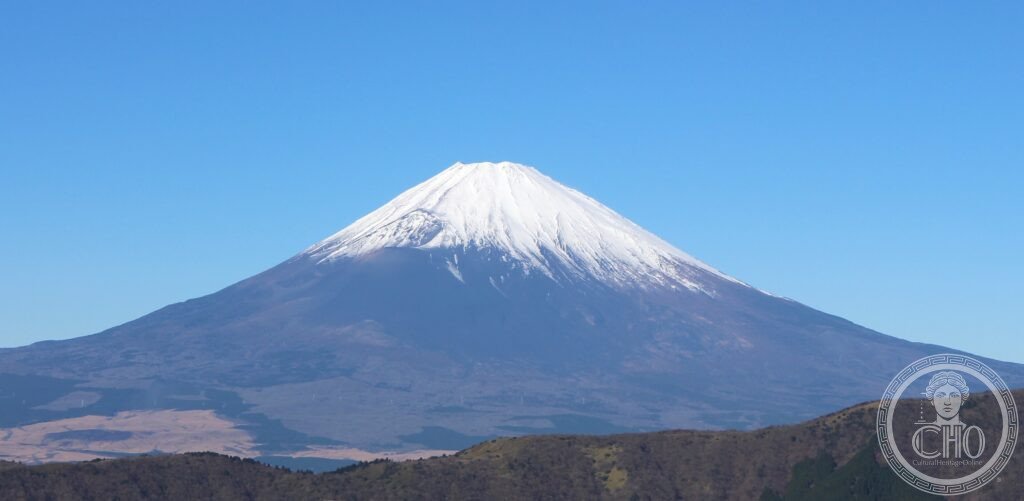
A near-perfect volcanic cone rising above the plains south-west of Tokyo, Mount Fuji has shaped Japanese religion and art for centuries. Sacred to Shinto pilgrims and the subject of Hokusai’s celebrated woodblock prints, it remains an active volcano climbed by huge numbers of visitors each summer.
At a glance
Mount Fuji rises to 3,776 metres in Yamanashi and Shizuoka Prefectures, its symmetrical cone visible across the Kantō plain when weather allows. It was inscribed by UNESCO in 2013 as a cultural rather than a natural heritage site, on the grounds that its significance lies chiefly in its role as a sacred place and a source of artistic inspiration rather than in geological criteria alone.
The mountain has long been a focus of Shinto worship. The Fujisan Hongū Sengen Taisha shrine at its base has around 25 affiliated shrines on the mountain itself, and pilgrims historically relied on guides known as oshi to organise their ascents. A well-known saying holds that climbing Fuji once is wise, but climbing it twice is foolish.
Key facts
- Height: 3,776 metres, the highest peak in Japan
- Status: an active stratovolcano, still capable of eruption
- Main routes: the Yoshida, Subashiri, Gotemba and Fujinomiya trails, each with a road-accessible fifth station
- Summit crater: around 800 metres wide and 200 metres deep
- Heritage listing: UNESCO Cultural World Heritage Site, inscribed 2013, reference 1418
- Coordinates: 35.3606° N, 138.7274° E
History
Fuji has erupted repeatedly through recorded history, most recently in the Hōei eruption of 1707, which deposited ash as far away as Edo, the city now known as Tokyo. Earlier, the eruption of 864 CE sent lava flows across the surrounding plain, forming the basins that became the Fuji Five Lakes and engulfing forests to leave cylindrical lava casts still visible today.
The tradition of climbing Fuji as an act of Shinto pilgrimage is said to date to the twelfth century, though the first recorded ascent is attributed to the Buddhist monk En no Gyōja in 663 CE. Ownership of the mountain above its eighth station belongs to the Sengen shrine, a right established under the Edo shogunate in the seventeenth century and upheld by Japan’s Supreme Court in 1974.
What you see
From the fifth stations reached by road, visitors get a close view of the upper slopes and, for those who continue on foot, the summit and its crater. Fuji is only visible from Tokyo on a limited number of clear days each year, which has given rise to the phrase Kakushi Fuji, or hidden Fuji, describing the mountain when cloud obscures it.
The UNESCO listing covers 25 separate heritage properties beyond the summit itself, including the Sengen shrines, the Fuji Five Lakes, historic pilgrimage routes and the lava tree moulds left by the 864 eruption. Katsushika Hokusai’s woodblock series, known as the Thirty-Six Views of Mount Fuji despite eventually running to 46 prints, remains the best-known artistic record of the mountain, and includes the widely reproduced Great Wave off Kanagawa. Hiroshige’s Fifty-Three Stations of the Tōkaidō also depicts Fuji in several of its prints.
Practical information
- Climbing season: the Yoshida trail’s official season runs from 1 July to 10 September; climbing outside this window is discouraged and, following a barrier installed by Yamanashi Prefecture in 2024, restricted on that route
- Ascent strategy: many climbers set out from a fifth station at night in order to reach the summit for sunrise, known as Goraiko; warm layered clothing is advisable given the cold at altitude
- Fuji Five Lakes: Kawaguchi, Yamanaka, Sai, Shoji and Motosu lie at the mountain’s base; Lake Kawaguchi is the most accessible by public transport and Lake Motosu’s reflection of Fuji appears on the reverse of the 1,000-yen banknote
- Current conditions and access: check official Yamanashi and Shizuoka prefecture or trail authority channels before planning a climb
Getting there
From Tokyo’s Shinjuku station, the Fuji Kyūkō Line runs to Kawaguchiko, either directly or via Ōtsuki. Alternatively, the JR Shinkansen connects Tokyo to Mishima or Shin-Fuji, from where local buses continue toward the mountain. An express bus also runs from Shinjuku directly to the Fuji Subaru Line fifth station at 2,305 metres. Travellers on the Tokyo–Osaka Shinkansen may catch a brief glimpse of Fuji from the right-hand side of the train between Shin-Fuji and Shizuoka stations.
Nearby
- Fuji Five Lakes — a short drive from the mountain’s base; Lake Kawaguchi offers the most familiar reflection views and easiest rail access
- Hakone — around 50 kilometres south-east, roughly an hour from Tokyo; known for hot spring baths with views of Fuji, the Hakone Open Air Museum, and the historic Hakone barrier on the old Tōkaidō road
- Nara — around 360 kilometres west; a UNESCO World Heritage Site since 1998, home to Tōdai-ji’s Great Buddha and the pagoda of Kōfuku-ji
Sources
- Wikipedia
- UNESCO
- Gunter Nitschke, Japanese Gardens, Taschen, 1993
Find it on the map
See this place and what’s around it →📷 Become a Cultural Heritage Online photographer
Share your photos of places: they stay published under your name as the author. The more they're seen, the more you get noticed — and soon a contest will reward the most appreciated photos.
Log in or sign up free to add a photo