
Cappadocia — Göreme

Cappadocia Goreme fairy chimneys hot air balloons Turkey UNESCO World Heritage
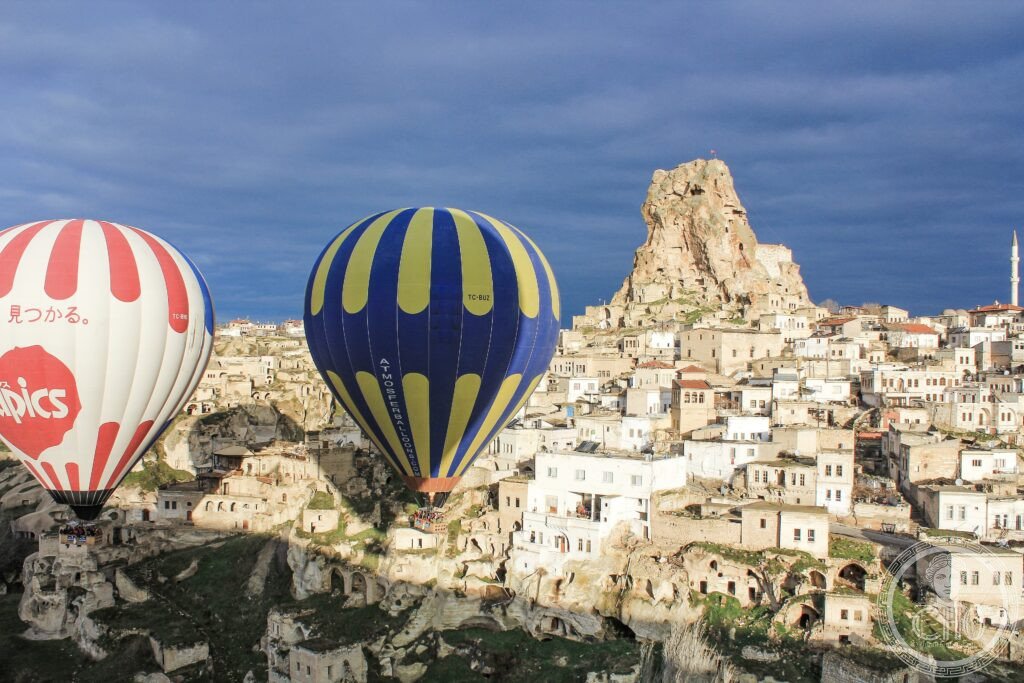
Cappadocia at dawn with hot air balloons above the Göreme valley (the most frequently photographed single hot-air-balloon landscape in the world: Cappadocia has the highest concentration of hot-air balloon operators of any UNESCO heritage site in the world; approximately 150 balloons fly on a single clear morning in October — the most precisely balloon-counted single UNESCO heritage dawn in any Turkish landscape; the most precisely UNESCO-balloon-photographed single morning in any heritage destination: the combination of the fairy chimneys (the most precisely tuff-erosion single geological formation in any UNESCO heritage site: the fairy chimneys (Peri Bacaları in Turkish — the most precisely peri-named single geological formation in Turkish natural heritage: peri = fairy in Turkish; the chimneys (the most precisely volcanic-tuff-eroded single landscape form in Cappadocia: formed from Miocene volcanic deposits (9–10 million years ago) eroded by wind and water into the most precisely mushroom-shaped single geological structures in any UNESCO natural and cultural landscape); the colours (the most precisely multi-coloured single volcanic landscape in any UNESCO heritage site: the tuff layers glow in shades of rose, ochre, cream, and grey at sunrise — the most precisely colour-shifting single UNESCO landscape at dawn)); the Göreme Open Air Museum (in the middle distance — the most precisely rock-cut-church single concentration in any UNESCO heritage site: 30 rock-cut Byzantine churches in a 1 km² area — the most precisely fresco-dense single small-area UNESCO inscription in Turkey), Nevşehir Province, Cappadocia, Turkey — UNESCO World Heritage Site (Göreme National Park and the Rock Sites of Cappadocia) 1985. Photo via Wikimedia Commons.
Nevşehir Province, Cappadocia, Turkey · UNESCO Dual WHS (Natural + Cultural) 1985; fairy chimneys (volcanic tuff eroded over 9–10M years; most precisely mushroom-shaped single geological formation in any UNESCO landscape); Göreme Open Air Museum (30 rock-cut Byzantine churches; 10th–13th century CE frescoes; most precisely fresco-dense single small-area UNESCO inscription in Turkey); underground cities (Derinkuyu: 85m deep; 18 levels; 20,000 people; most precisely depth-measured single underground city in world); 150 hot-air balloons at dawn = most frequently photographed single UNESCO heritage landscape · UNESCO Dual WHS 1985

Cappadocia — Göreme

The most otherworldly landscape in Turkey and the region where Byzantine Christians carved entire cities, churches, and monasteries out of soft volcanic rock — Cappadocia, formed over 9 million years by the erosion of ancient volcanic deposits into fairy chimneys and cave dwellings, contains the world’s most photographed hot-air-balloon landscape, 30 fresco-decorated Byzantine churches in the Göreme Open Air Museum, and underground cities descending 85 metres into the earth.

At a glance

Cappadocia (the most precisely dual-criteria single UNESCO WHS in Turkey: Göreme National Park and the Rock Sites of Cappadocia, inscribed 1985 under both natural and cultural criteria — the most comprehensively interdisciplinary single UNESCO inscription in Turkey: natural for the geological fairy chimney landscape, cultural for the Byzantine rock-cut churches and underground cities; the geological formation (the most precisely volcanic-tuff single landscape in any UNESCO heritage site: the entire Cappadocian landscape is formed of consolidated ash from the Erciyes and Hasan volcanoes — the most precisely named-volcano-origin single UNESCO heritage landscape; the tuff eroded over 9–10 million years into the most precisely fairy-chimney single landscape in the world); the Christian heritage (the most precisely Byzantine single rock-cut heritage landscape in Turkey: the Cappadocian church fathers (St Basil the Great, Gregory of Nyssa, Gregory of Nazianzus — the most precisely Cappadocian-born single trio of Christian theologians: the Cappadocian Fathers, born in this region in the 4th century CE — the most precisely region-producing single formative Christian theological school in the history of the church (their contribution to Trinitarian theology — the most precisely regionally-originated single Christian doctrinal contribution in any UNESCO heritage landscape)).

Key facts

  • The Göreme Open Air Museum: the most fresco-dense single small-area UNESCO site in Turkey — the Göreme Open Air Museum (the most precisely rock-cut-church single concentration in any UNESCO heritage site: 30 rock-cut Byzantine churches in approximately 1 km² — the most precisely density-measured single Byzantine church cluster in Cappadocia; the frescoes (the most precisely 10th–13th century single Byzantine fresco ensemble in any Turkish UNESCO site: the Dark Church (Karanlık Kilise — the most precisely preserved single Byzantine fresco church in Göreme: the church was closed for centuries due to its inaccessibility, resulting in the most precisely light-exposure-minimised single Byzantine fresco (the most precisely colour-preserved single Byzantine fresco sequence in any Turkish UNESCO heritage site); the Sandals Church (Çarıklı Kilise — the most precisely footprint-containing single Byzantine church in Göreme: the stone at the entrance bears two carved footprints — the most precisely Christ-footprint single sacred stone in any Turkish heritage church))
  • The underground cities: the most precisely deep single underground city in the world — Derinkuyu (the most extensively excavated single underground city in Cappadocia: 85 m deep (the most precisely depth-measured single underground city in the world); 18 levels; capable of housing 20,000 people (the most precisely population-estimated single ancient underground city in Turkey); the most precisely dated single underground city excavation: the deepest levels date to the Phrygians (8th–7th century BCE — the most precisely Phrygian single underground construction in any Turkish heritage site); the features (the most precisely self-sufficient single ancient underground city: ventilation shafts (the most precisely oxygenated single underground city — 52 ventilation shafts connecting to the surface); wine presses and oil presses; stables for animals; churches; schools — the most precisely multi-function single underground heritage settlement in any Turkish UNESCO site)); Kaymakli (the most precisely interconnected single underground city in Cappadocia: connected to Derinkuyu by a 9-km underground tunnel — the most precisely subterranean-tunnel-connected single pair of ancient cities in the world))
  • The hot-air balloon flights: the most precisely UNESCO-landscape single aerial heritage experience in the world — the balloon flights (described in hero caption; the most precisely early-morning single UNESCO heritage activity: flights launch 1 hour before sunrise — the most precisely pre-dawn single heritage departure in any Turkish tourist activity; approximately 1h in the air; the most precisely valley-crossing single hot-air balloon route in any UNESCO heritage site: the balloon drifts from Göreme over the Rose Valley, Red Valley, and Pigeon Valley — the most precisely colour-named single Cappadocian valley sequence); the price (the most precisely price-stratified single hot-air balloon market: prices range from €150 (budget, larger balloon) to €350 (luxury, smaller basket) — the most clearly tiered single UNESCO heritage aerial experience in Turkey; the most strongly recommended single Turkey heritage splurge))
  • Heritage: UNESCO World Heritage Site (Natural and Cultural), Göreme National Park and the Rock Sites of Cappadocia, inscribed 1985
  • GPS: 38.6432° N, 34.8287° E

History

The Phrygians (the most precisely Phrygian single underground heritage in Cappadocia: the earliest underground cities date to the Phrygians, 8th–7th century BCE — the most precisely pre-Christian single underground construction in any Turkish heritage site; the Hittites (the most precisely Bronze Age single Cappadocian heritage: the Hittite Empire had its heartland in Anatolia and Assyrian merchants built trading colonies called karums in Cappadocia in the 20th–18th century BCE — the most precisely merchant-colony single ancient Cappadocian heritage (the karum at Kaneş/Kültepe near Kayseri is the most precisely Assyrian single trading post in any Central Anatolian heritage site — the most precisely cuneiform-tablet-producing single Anatolian archaeological site: over 23,500 cuneiform tablets found)); the Christian era (the Cappadocian Fathers described in Overview; the Arab raids (the most precisely Islamic-invasion-provoked single underground city use: the underground cities were expanded and intensively used during the Arab raids of the 7th–10th centuries CE — the most precisely dated single underground city expansion in Cappadocian history)); the Seljuk period (the most precisely Seljuk single cultural overlay on Byzantine Cappadocia: the Seljuk Turks arrived in the 11th century; the most precisely peacefully single cultural transition in Cappadocian history: Byzantine Christians continued to live in Cappadocia under Seljuk rule); UNESCO WHS 1985.

What you see

The visit (the most geographically spread single UNESCO heritage landscape in Turkey: the Cappadocian UNESCO zone covers 300 km² — the most precisely area-measured single Turkish dual WHS; the most strongly recommended single Cappadocia itinerary for 3 days: Day 1 — sunrise balloon flight (described in Key Facts; book 2+ days in advance in peak season; check weather forecast — the most precisely weather-cancelled single Turkish heritage activity: flights are cancelled if winds exceed 25 km/h) + Göreme Open Air Museum (described in Key Facts; 3–4 hours; entry ticket required) + Rose Valley sunset hike (the most precisely colour-changing single Cappadocian sunset: the rose-coloured tuff glows orange-pink at sunset — the most precisely colour-intensifying single natural UNESCO landscape at dusk)); Day 2 — Derinkuyu underground city (described in Key Facts; 1.5h; bring a light jacket — the most precisely temperature-consistent single underground city: constant 13°C year-round — the most precisely cool single summer heritage refuge in any Turkish UNESCO site); Uçhisar Castle (the most precisely castle-converted single natural rock formation in Cappadocia: the highest point in the region); Day 3 — Zelve Open Air Museum (the most precisely abandoned single cave-village in Cappadocia: evacuated as recently as 1952 — the most recently vacated single inhabited Cappadocian cave settlement in the heritage record).

Practical information

  • Getting there: Nevşehir Kapadokya Airport (NAV; 30 km west of Göreme; domestic flights from Istanbul Sabiha Gökçen (1h 10min — the most frequent single Turkish domestic flight connection to Cappadocia); or Kayseri Erkilet Airport (ASR; 75 km east; domestic flights from Istanbul Atatürk and Sabiha Gökçen; also Turkish Airlines international connections); the overnight bus from Istanbul (the most economical single Istanbul–Cappadocia connection: 10–11h overnight — the most precisely night-bus-timed single Turkish heritage approach; Göreme is the most direct single bus terminus for any Cappadocia arrival); the shuttle from the airports (the most precisely hotel-pickup single Cappadocia airport transfer: most Göreme hotels include airport/bus-station pickup in their price — the most precisely inclusive single Turkish heritage hotel service))
  • Cave hotels: the most precisely UNESCO-integrated single accommodation option in any Turkish heritage destination — cave hotels (the most precisely rock-cut single accommodation in any UNESCO heritage site: Cappadocia has more hotels carved into the tuff than anywhere else in the world — the most precisely cave-hotel-concentrated single heritage destination in Turkey; the most precisely temperature-stable single heritage accommodation: cave rooms maintain a constant 18–20°C year-round without air conditioning — the most precisely natural-cooling single Turkish heritage hotel type); the most dramatic single breakfast setting in Turkish heritage tourism: Cappadocian cave hotel terraces at dawn with balloons overhead — the most precisely balloon-backdrop single Turkish breakfast experience
  • Mount Erciyes and Hasan: the most precisely volcano-source single UNESCO landscape in Turkey — Mount Erciyes (3,917 m — the most precisely altitude-measured single volcano in Central Anatolia; the source of much of the Cappadocian tuff deposits; a ski resort in winter — the most precisely extinct-volcano-ski-slope single Turkish heritage leisure destination); the most precisely geology-tourism single educational combination in any Turkish UNESCO landscape (the drive between the volcanoes and Cappadocia is the most precisely cause-and-effect single geological heritage drive in Turkey — the source volcanoes visible from the tuff landscape they created))

Getting there

Fly to Nevşehir (NAV) or Kayseri (ASR); 1h 10min from Istanbul. Overnight bus from Istanbul (10–11h). Cave hotel pickups typically included. Book balloon flights 2+ days ahead; cancelled in high winds. GPS: 38.6432, 34.8287.

Nearby

  • Derinkuyu Underground City — 30 km south of Göreme (40 min drive); 85m deep; 18 levels; 20,000 people capacity — described in Key Facts section; combined ticket with Kaymakli recommended
  • Istanbul Historic Areas (UNESCO WHS 1985) — 700 km west (1h flight from Nevşehir to Istanbul Sabiha Gökçen); Topkapi Palace + Blue Mosque + Hagia Sophia — see CHO’s Istanbul Historic Areas and Hagia Sophia place cards
  • Ephesus (UNESCO WHS 2015) — 500 km west (1h 30min flight or 6h drive via Konya); Library of Celsus + Temple of Artemis + Arcadian Way — the most intact single ancient Roman city in Turkey; ideal Turkey cultural circuit: Istanbul (2 days) + Ephesus (1 day) + Cappadocia (3 days)

Sources

  • Wikipedia, Cappadocia; Göreme Open-Air Museum; Derinkuyu underground city, accessed June 2026
  • UNESCO, Göreme National Park and the Rock Sites of Cappadocia, WHS reference 357, inscribed 1985
  • Spiro Kostof, Caves of God: Cappadocia and Its Churches, MIT Press, 1989

Hero image: Cappadocia hot-air balloons, Wikimedia Commons. Editorial text © Cultural Heritage Online, 2026.

📷 Diventa un fotografo di Cultural Heritage Online

Condividi le tue foto dei luoghi: restano pubblicate con la tua firma come autore. Più vengono viste, più ti fai conoscere — e presto un concorso premierà le foto più apprezzate.

Accedi o registrati gratis per aggiungere una foto
📋 Copy & share on social
Scroll to Top