
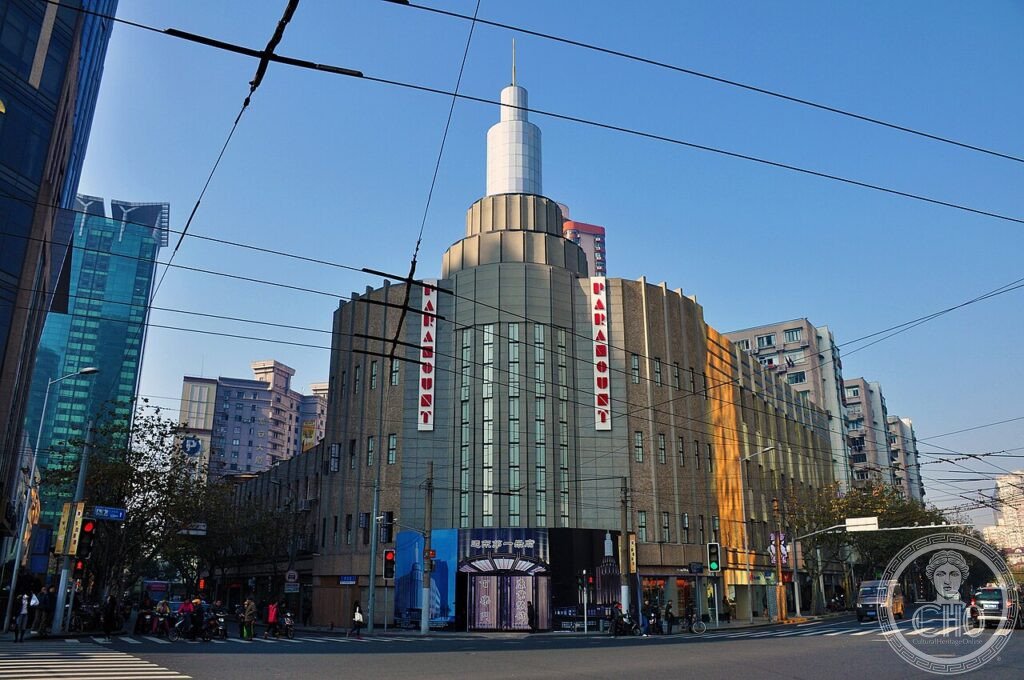

百乐门 — the “gate of a hundred pleasures”: Jazz Age Shanghai’s greatest ballroom, built by Chinese money and a Chinese architect, its neon-striped tower and glass spire once again lit above Yuyuan Road.
At a glance
The Paramount opened in December 1933 at 218 Yuyuan Road in Jing’an, near the old Bubbling Well Road, and immediately became the largest and most famous ballroom in a city that took dancing seriously. Its architect was S.J. Young — Yang Xiliu (1899–1978) — and its backers a group of Chinese bankers and merchants: a fully Chinese answer to the foreign-owned nightlife of the concessions. The building’s rounded, fluted corner rises through vertical neon strips to a glowing glass spire; inside, dancers moved over a sprung floor and, upstairs, across glass lit from beneath. Restored between 2013 and 2017, it is recognised among China’s 20th-Century Architectural Heritage.
Key facts
- Opened: 14 December 1933; construction from 1932
- Architect: S.J. Young (Yang Xiliu, 1899–1978)
- Backers: Chinese bankers and merchants, among them Gu Liancheng
- Signature: Fluted corner tower, vertical neon, glass spire; sprung main dance floor; upper glass floor lit from below
- Name: 百乐门 Bãilèmén — “gate of a hundred pleasures”
- Famous guests: Charlie Chaplin visited in 1936
- Heritage: Chinese 20th-Century Architectural Heritage (second batch); Shanghai Outstanding Historical Building
- GPS: 31.225472, 121.439532 — View on Google Maps
History
The Paramount was Jazz Age Shanghai at maximum wattage: an octagonal lobby feeding a double-height ballroom ringed by balconies, big bands, taxi dancers, gangsters and film stars — Du Yuesheng held court here, and Charlie Chaplin came through in 1936. The glamour outran the balance sheet: the original owners went bankrupt in 1936 and the house converted to a taxi-dance operation the following year, dancing on through occupation and civil war.
In 1956 the ballroom became the Red Capitol Cinema, its spire taken down and its repertoire changed to match the times. Decades of decline followed; a rebuilt spire in 1993 got the shape wrong, and a Taiwanese-funded refurbishment in 2001 kept the doors open. The Jing’an district government’s restoration of 2013–2017 was the serious one — the corridor and glass dance floor reinstated, the spire returned to its original profile — and the Paramount reopened in 2017 as a dance hall and event venue. The tea dances are back.
What you see
Approach along Yuyuan Road at dusk, when the building performs: the corner tower’s curved flutes carry PARAMOUNT in red neon down both faces, and the crowning spire — a stack of lit glass drums — glows like a lighthouse for pleasure. The composition is asymmetric, the entrance tucked under the tower with the long dance-hall block trailing behind; ribbon windows and horizontal string courses keep the eye moving. Inside survive the octagonal lobby, the sprung main floor under its balcony ring, and upstairs the celebrated glass floor lit from below — an effect no Shanghai ballroom ever matched.
Practical information
- Operating dance hall and event venue — afternoon tea dances and evening events; check current programmes before visiting
- The exterior is the icon: best photographed from the Yuyuan Road corner after dark, neon lit
- Combine with Jing’an Temple, five minutes away, for the sacred-profane double bill
Getting there
The Paramount stands at 218 Yuyuan Road, two minutes on foot from Jing’an Temple metro station (lines 2 and 7). West Nanjing Road’s heritage mile begins around the corner.
Nearby
- Jing’an Temple — the gilded Buddhist landmark across the junction
- Grand Theatre — Hudec’s picture palace of the same year, on People’s Square
- Former Park Hotel — the tallest building in 1930s Asia
- Shanghai — The Bund and the Art Déco of the East — the CHO city guide
Sources
- Wikipedia, “Paramount (Shanghai)” — architect, dates, interior sequence, post-1949 history, restorations
- SHINE / Shanghai Daily, “‘Gateway to 100 pleasures’ was at forefront of city’s entertainment” — investors, restoration
- Jing’an district restoration reports (2013–2017) — glass floor and spire reinstatement, 20th-Century Architectural Heritage listing
- OpenStreetMap / Nominatim — coordinates, 218 Yuyuan Road
Find it on the map
See this place and what’s around it →Record researched and written by Luigi De Marchi for Cultural Heritage Online, 2026.
📷 Become a Cultural Heritage Online photographer
Share your photos of places: they stay published under your name as the author. The more they're seen, the more you get noticed — and soon a contest will reward the most appreciated photos.
Log in or sign up free to add a photoIs this page about you?
This page is read by travellers and heritage enthusiasts who find it on Google. Tell us how you are connected to this place and we will take it from there.