
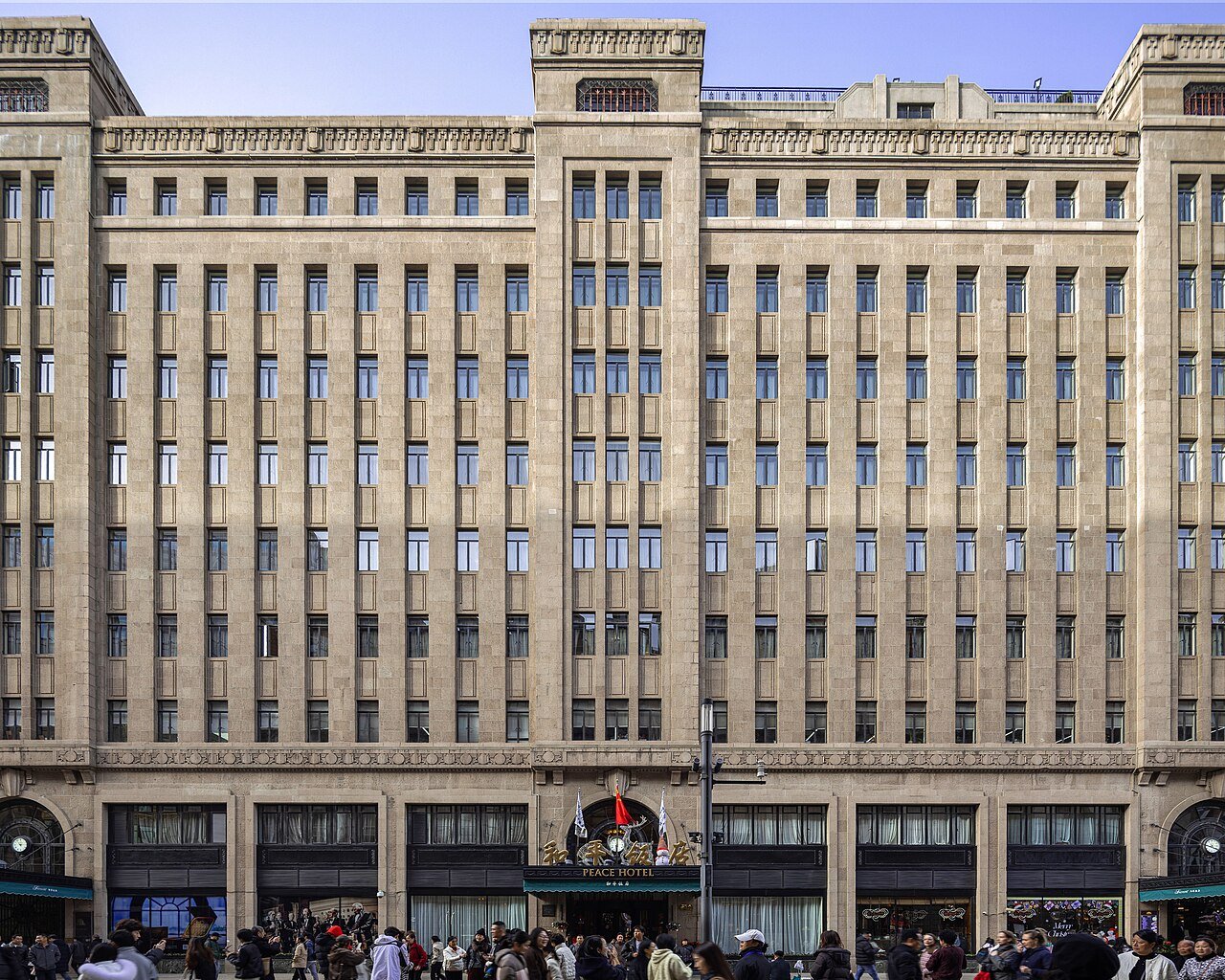
Between the world wars, a treaty-port boom raised one of the planet’s densest concentrations of Art Déco. Along the Bund and across the former concessions, the style still defines the city.
At a glance
Shanghai entered the 1920s as a divided, foreign-administered port and emerged as a metropolis of jazz, banking and concrete. Capital poured into the riverfront, and a generation of architects answered with towers, hotels and ballrooms in the new geometric idiom arriving from New York and Paris. The Bund, the curving embankment of the Huangpu, became its showcase: a wall of fifty-two buildings in which Beaux-Arts grandeur gives way to the verticals and setbacks of Art Déco. Behind it, the former French Concession and the settlement streets filled with cinemas, dance halls and apartment blocks. The result is a heritage landscape that survived war and revolution largely intact, and that today reads as a primer in interwar design.
Key facts
- Country: China
- Key period: 1920s–1930s
- Key figure: László Hudec (1893–1958), Hungarian-Slovak architect, and the firm Palmer and Turner
- Essential sites: The Bund, Peace Hotel / Sassoon House (1929), Park Hotel (1934), the Paramount ballroom (1933), the Grand Theatre (1933)
- Architectural setting: Shanghai International Settlement and the former French Concession
History
Shanghai’s foreign quarters were created in the wake of the treaties that opened China to outside trade in the mid-nineteenth century. The Shanghai International Settlement, formed in 1863 by the merger of the British and American areas, and the separately governed French Concession, operated for decades as legally protected enclaves where foreign banks, trading houses and residents lived under their own administrations. The Bund, the embankment fronting the Huangpu River, grew into the financial heart of this world. Commercial buildings in the Beaux-Arts style rose there around the turn of the twentieth century, but the great rebuilding came later.
The 1920s and early 1930s were Shanghai’s boom years. Money from trade, finance and speculation funded a wave of construction in which the new Art Déco language took hold. In 1929 Sir Victor Sassoon completed Sassoon House on the Bund, designed by the firm Palmer and Turner, with its luxury Cathay Hotel and the copper pyramid that has since weathered to pale green. Across the settlement, the Hungarian-Slovak architect László Hudec became the era’s defining designer. His Park Hotel, designed in 1931 and finished in 1934, rose to roughly eighty-four metres and remained the tallest building in Asia until 1963. The same years produced his Art Déco Grand Theatre (1933) and, by other hands, the Paramount (1933), the largest and most famous ballroom in the city.
The boom ended with the Japanese invasion and the Second World War, and the foreign concessions were dissolved in the 1940s. After 1949 the towers were repurposed rather than razed, and decades of relative neglect, paradoxically, preserved them. The Bund and the surrounding districts retain one of the world’s richest stocks of interwar architecture.
What you see
The Bund is best read as a single composition. Walking north to south along the raised promenade, the eye passes from heavy stone Beaux-Arts banks to the leaner, vertical massing of the late 1920s. Sassoon House is the pivot: a dark granite base, brown brick above, and the steep green pyramid that became the riverfront’s signature. Nearby, the Bank of China building was famously held to a low height so as not to overtop its neighbour. Together the fifty-two structures span Gothic, Neoclassical, Renaissance and Art Déco, which is why the embankment is often called an open-air museum of early-twentieth-century building.
Inland the Déco grows purer. Hudec’s Park Hotel, facing the former racecourse at People’s Square, climbs in dark brick setbacks plainly inspired by the American Radiator Building in New York. A short distance away the Paramount turns its rounded, fluted corner to the street, ribbed with vertical neon and crowned by a glowing spire, while inside a sprung dance floor sits beneath a double-height balconied hall. The former French Concession rewards slower wandering, its plane-tree streets lined with apartment houses and villas in the same restrained modern manner.
Practical information
- The Bund promenade is open and free; allow at least an hour to walk its length.
- The Peace Hotel still operates as a hotel; its public lobby and historic jazz bar can be visited.
- The Park Hotel functions as a hotel on Nanjing Road West, opposite People’s Park.
- The Paramount on Yuyuan Road in Jing’an district periodically reopens as a venue; check current status before visiting.
- Spring and autumn offer the most comfortable weather for walking the waterfront and concession streets.
Getting there
Shanghai is served by two airports: Pudong International (PVG) to the east, the main long-haul gateway, and Hongqiao (SHA) to the west for domestic and regional flights. From either, the metro reaches the centre; lines 2 and 10 serve stations a short walk from the Bund (East Nanjing Road and Yuyuan Garden), while line 1 stops at People’s Square beside the Park Hotel. The riverfront and the former French Concession are best explored on foot.
Related in CHO
- Miami — South Beach and Tropical Art Déco
- New York — Tiffany, the Gilded Age and Art Déco
- Mumbai — Marine Drive and the Art Déco Ensembles
Sources
Find it on the map
See this place and what’s around it →Record researched and written by Luigi De Marchi for Cultural Heritage Online, 2026.
📷 Become a Cultural Heritage Online photographer
Share your photos of places: they stay published under your name as the author. The more they're seen, the more you get noticed — and soon a contest will reward the most appreciated photos.
Log in or sign up free to add a photo