
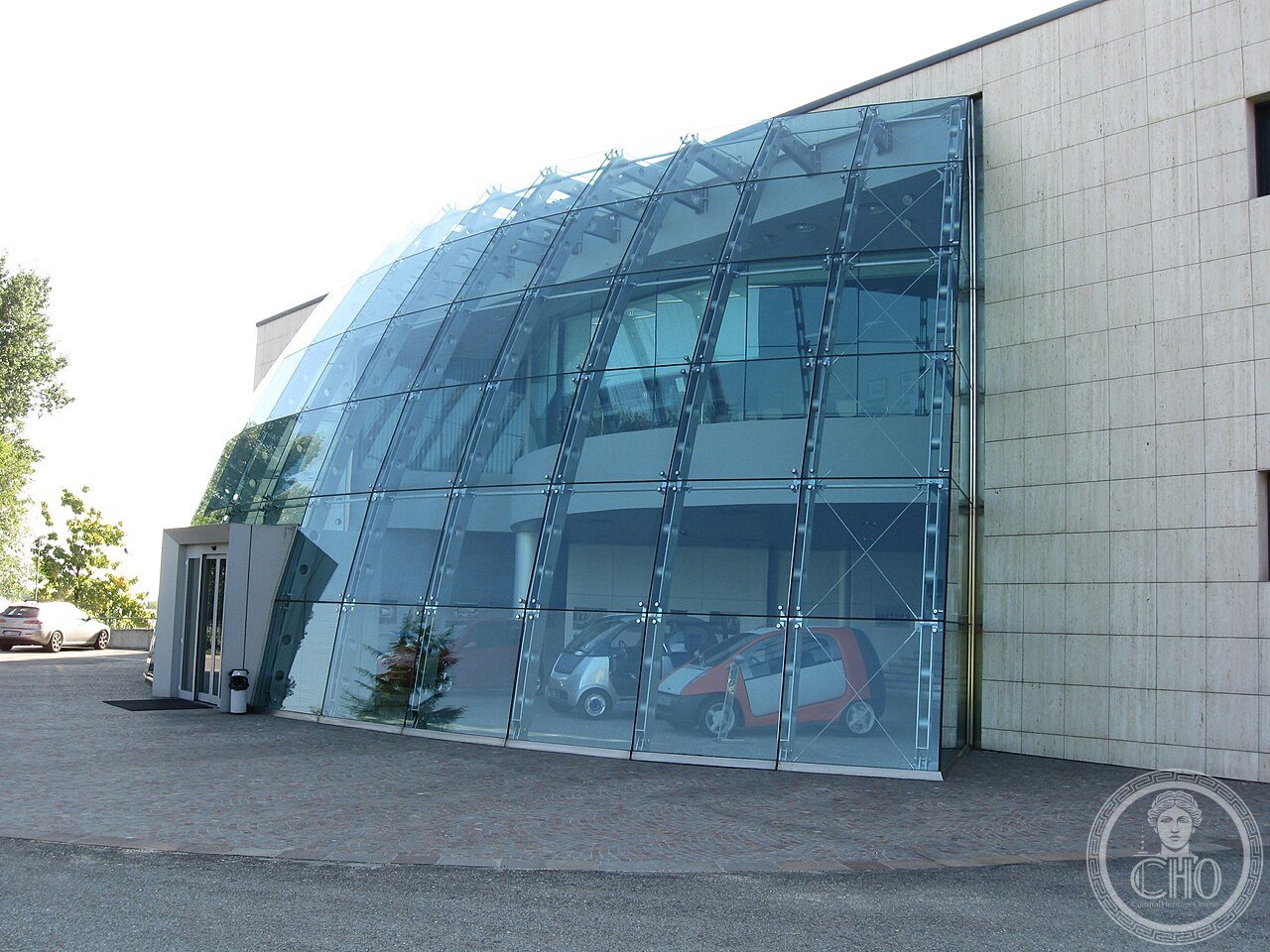
For nearly a century the world’s most admired automotive design studio has worked from a complex at the edge of Turin — the place where the Alfa Romeo Duetto, the Ferrari Dino, the Lancia Aurelia, and over a hundred Ferrari models were drawn. The Museo Pininfarina inside the Design Center holds the archive of that work and opens it to visitors on request.
At a glance
The Pininfarina Design Center at Via Nazionale 30 in Cambiano, 15 kilometres south-east of Turin’s city centre, is the working headquarters of one of the great names in twentieth-century design. Founded in 1930 by Battista “Pinin” Farina, Pininfarina S.p.A. has produced the exterior designs of more than 100 Ferrari models (a collaboration of nearly 70 years, the longest and most celebrated in automotive history), as well as iconic car bodies for Alfa Romeo, Lancia, Fiat, Maserati, and numerous international manufacturers. The site includes the wind tunnel, the design studios, the engineering workshops, and the internal museum holding the company’s historic collection of show cars, prototypes, and archival material. Visits are available on request through the “Visit Pininfarina” programme on the company’s website.
Key facts
- Founded: 22 May 1930 by Battista “Pinin” Farina
- Address: Via Nazionale 30, 10020 Cambiano (TO)
- GPS: 44.9698, 7.7656
- Ferrari collaborations: 100+ models, 1952–2017
- Visits: “Visit Pininfarina” programme, by appointment — pininfarina.com
- Also at the site: Wind tunnel, active design studios, engineering workshop
- Redesigned: for the Group’s 80th anniversary; highlights include the Giulietta Spider and the Sigma Grand Prix safety single-seater
History
Battista Farina — known since childhood as Pinin, the Piedmontese word for “smallest of the family” — founded his coachbuilding company in Turin on 22 May 1930, breaking away from the Stabilimenti Farina family business he had shared with his brother Giovanni. Among the company’s initial backers was Vincenzo Lancia, who believed in Pinin’s vision for automobile design as an autonomous discipline rather than a craft service subordinate to the engineering department. The first commissions confirmed that vision: the Lancia Astura cabriolets of the 1930s, the Alfa Romeo 6C convertibles, and the Cisitalia 202 (1947) — the car that MOMA New York placed in its permanent collection as a work of art in 1951.
The Ferrari relationship, which began in 1952 with the Ferrari 212 Inter, became the most sustained industrial design partnership of the twentieth century. Pininfarina drew the Ferrari 166 MM Barchetta (1948), the 250 GT berlinetta, the 330 GT, the 365 GTB/4 Daytona, the 308 GTB, the Testarossa, the F40, the 456 GT, the 550 Maranello, and the Enzo, among many others. The collaboration ended in 2017 with the Ferrari 812 Superfast — a 65-year creative relationship without parallel in the history of design. The company also designed the Alfa Romeo Duetto Spider (1966, used in the opening scene of The Graduate), the Lancia Aurelia B24 Spider, and the Fiat 124 Spider.
The headquarters moved to Cambiano in the 1960s to accommodate the growing wind tunnel and engineering facilities required by a company that had evolved from a small carrozzeria to an international design engineering firm. Today Pininfarina operates globally in architecture, product design, and mobility beyond the automotive sector — but the Cambiano complex remains the creative and historic centre of the organisation.
What you see
The Design Center complex reads as a working industrial campus rather than a cultural institution: offices, studios, and production facilities grouped around the central wind tunnel building, which has been expanded several times since the 1960s. What makes Cambiano a heritage site as much as a factory is the layering of its history: the same corridors where the Testarossa was finessed and the Enzo was modelled are still in active use, the creative context continuous rather than preserved.
The internal museum — accessible through the “Visit Pininfarina” programme — holds a rotating selection from the company’s collection of show cars and prototypes, including some of the most celebrated design objects of the late twentieth century: the Ferrari Mythos (1989), the Ethos (1992), the Sergio (2013), and cars from the historic Ferrari commissions. The archive of drawings, scale models, and photographs traces ninety-plus years of the design process.
Practical information
- Visits: By appointment through Visit Pininfarina on the company website
- Not a public museum: This is a working design studio; visits are arranged, not walk-in
- Time needed: Typically 1.5–2 hours for organised group visits
- Language: Italian and English visits available
Getting there
Cambiano is 15 km south-east of Turin city centre. By car: take the Tangenziale Sud from Turin toward Asti, exit Moncalieri / Cambiano, then 5 minutes to Via Nazionale. By public transport: direct bus from Moncalieri (which is on the Turin metro line 1) toward Cambiano. The Pininfarina campus is clearly signposted from the via Nazionale approach. Nearest train: Trofarello on the Turin–Genoa line (3 km from Cambiano).
Nearby
- Moncalieri — 7 km north-west, historic royal residence of the House of Savoy
- MAUTO — Museo Nazionale dell’Automobile, Turin — 18 km north, the national automotive museum with extensive Pininfarina-designed vehicles
- Lingotto Fiere, Turin — 15 km north, former FIAT factory (rooftop test track, Renzo Piano renovation)
- Galleria Ferrari, Maranello — 140 km south-east, the Ferrari museum in which Pininfarina’s designs dominate the collection
Sources
- Wikipedia (Italian): Pininfarina
- Pininfarina official: Visit Pininfarina
- Wikimedia Commons: File:Pininfarina 1.jpg, Public Domain
- Nominatim / OpenStreetMap: GPS 44.9698, 7.7656
Find it on the map
See this place and what’s around it →

📷 Become a Cultural Heritage Online photographer
Share your photos of places: they stay published under your name as the author. The more they're seen, the more you get noticed — and soon a contest will reward the most appreciated photos.
Log in or sign up free to add a photoIs this page about you?
This page is read by travellers and heritage enthusiasts who find it on Google. Tell us how you are connected to this place and we will take it from there.