
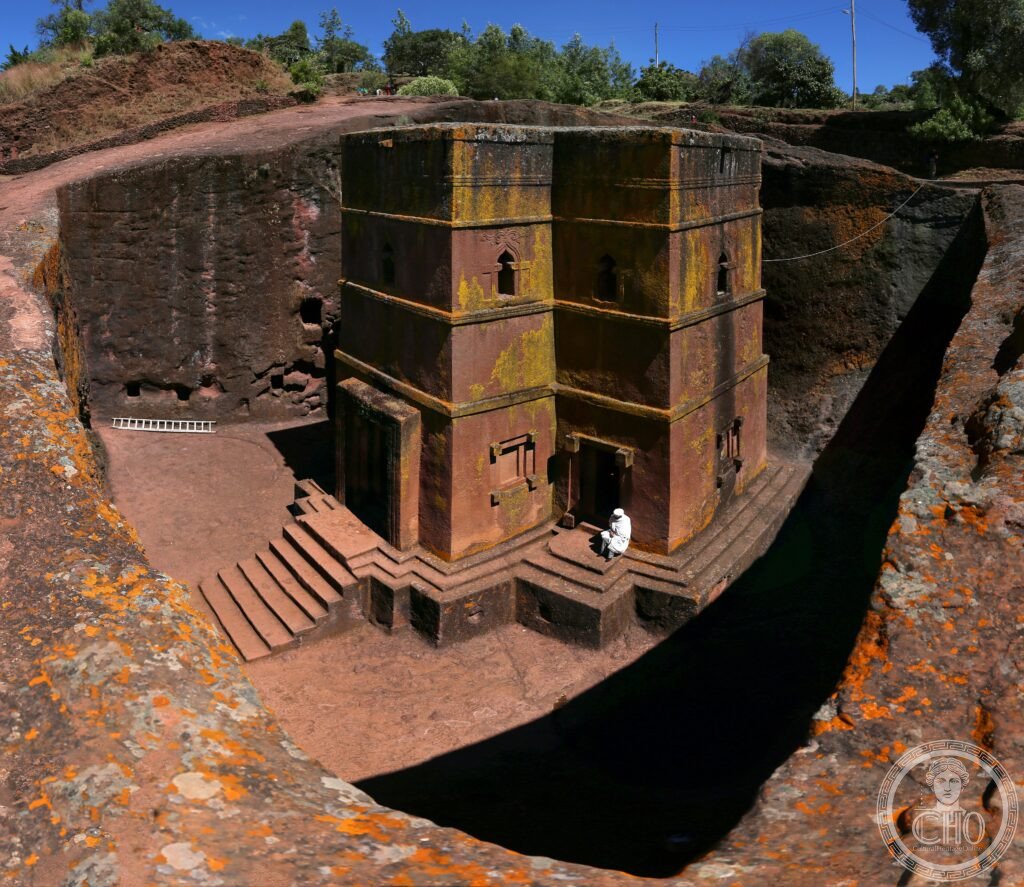
The most extraordinary architectural achievement in Africa and the holiest Christian pilgrimage site on the continent — the 11 rock-hewn churches of Lalibela, carved entirely from the solid volcanic basalt of the Ethiopian Highlands in the 12th–13th centuries by the Zagwe dynasty, are monolithic masterpieces that were excavated downward from the living rock, including every column, arch, window, altar, and carved decoration, without adding any material from outside.
At a glance
The Rock-Hewn Churches of Lalibela (UNESCO WHS 1978; located in the Amhara Region of northern Ethiopia at 2,600 m altitude; the town of Lalibela (population approximately 20,000) is the most important Christian pilgrimage destination in sub-Saharan Africa); the name (Lalibela is named for King Lalibela (Gebre Meskel Lalibela; r. c.1181–1221 CE) of the Zagwe dynasty; the king who built the churches (the Ethiopian Orthodox Christian tradition holds that Lalibela was born with a swarm of bees around him (a portent of his future greatness) and was taken to heaven during a coma in which he was commanded by God to build the churches; the king returned and spent 23 years building the 11 churches with the miraculous assistance of angels who worked at night while the human workers rested — the most practical miracle in the mythology of any world heritage site)); the construction method (the churches were carved by excavating the surrounding rock rather than by adding material; the process (the builders first excavated a trench to isolate a block of rock from the hillside; then carved down into the block from the top, removing successive layers of rock to shape the exterior of the church; then carved out the interior from above, working through windows and doors, to create the internal columns, arches, walls, and ceilings); the result (a monolithic building in which every element — from the roof down to the carved altar and font — is carved from a single piece of living rock; the most labour-intensive carving project in the history of Ethiopian architecture); the two church complexes (the churches are divided into two groups separated by the Yordanos (Jordan) River channel: the North-Western group (the more accessible and most visited, including Bete Medhane Alem and Bete Maryam); the South-Eastern group (the more remote, including Bete Giyorgis).
Key facts
- Bete Medhane Alem: the largest monolithic rock-hewn church in the world — Bete Medhane Alem (ቤተ መድኃኔ ዓለም; the Church of the Saviour of the World; the largest of the 11 Lalibela churches; dimensions approximately 33.5 m × 23.5 m × 11.5 m; the four external colonnades (each side of the church has a row of free-standing external columns carved from the rock; 72 columns in total (36 external + 36 internal) — the largest number of columns in any rock-hewn church in the world); the architecture (the external colonnade directly evokes the architecture of the pre-Christian Aksumite period (the Aksumite obelisks and palaces of the 1st–8th centuries CE); the colonnade is the most direct architectural reference to the Aksumite heritage in any Zagwe-period building; the interior (the largest single interior space in any rock-hewn church in Ethiopia; the columns support the ceiling at a height that creates a nave of cathedral-like proportions; the carved decoration (the window frames; the cross-shaped windows; the geometric carved patterns)); the tabot (the most sacred object inside; veiled and inaccessible to all non-clergy and non-Orthodox Christians))
- Bete Maryam and the interconnected tunnels: the most complex spatial experience in the complex — Bete Maryam (ቤተ ማርያም; the Church of the Virgin Mary; the most elaborately decorated of the Lalibela churches; the painted ceiling (the oldest surviving painted ceiling in the Lalibela complex; the colours (the deep cobalt blue, ochre red, and white of the Ethiopian Orthodox painting tradition); the subject matter (the typical Ethiopian Orthodox iconographic programme: the Virgin Mary; the saints of the Ethiopian church; the processional cross motifs)); the tunnels and passages (the churches of the North-Western complex are connected by a labyrinthine network of carved trenches, tunnels, and staircases; the most disorienting spatial experience in any heritage site in Africa; visitors regularly become temporarily lost in the tunnel network despite having guides; the tunnel between Bete Maryam and Bete Medhane Alem (the most important passage; runs entirely underground through the carved rock for approximately 40 m; navigated by torchlight; the narrowest section requires sideways walking)); the Bete Maryam pool (the pool of water at the base of the trench below Bete Maryam; the water is considered holy (it was blessed by King Lalibela himself, according to tradition); pilgrims immerse themselves in the pool during Timkat (Ethiopian Epiphany; the most important festival in the Ethiopian Orthodox calendar; celebrated 19–20 January every year at Lalibela; the most dramatic religious event at any African UNESCO WHS))
- Ethiopian Orthodox Christianity: the world’s oldest Christian state — the Ethiopian Orthodox Tewahedo Church (the most ancient surviving Christian church outside the Middle East; the Tewahedo Church (the name means “made one” — a reference to the Miaphysite doctrine (the belief that Christ has a single, unified divine-human nature; in contrast to the Chalcedonian doctrine of the Western and Eastern churches which holds that Christ has two distinct natures (human and divine); the Council of Chalcedon (451 CE) rejected Miaphysitism and the Ethiopian church has been in doctrinal separation from Rome and Constantinople ever since — the oldest surviving schism in Christian history)); the tabot (the ark replica; every Ethiopian Orthodox church has a tabot at its centre; the tabot is veiled and carried in procession by the clergy during festivals; the most important single object in Ethiopian Orthodox worship; never seen by laypeople; the claim (the Ethiopian Orthodox Church claims to possess the original Ark of the Covenant at the Church of Our Lady Mary of Zion in Aksum; the claim cannot be verified (access is restricted to a single guardian monk))); the Lalibela pilgrimage (at Genna (Ethiopian Christmas; 7 January) and Timkat (19–20 January), thousands of white-robed pilgrims fill every church and trench in the Lalibela complex in the most spectacular Christian pilgrimage event in Africa)
- Heritage: UNESCO World Heritage Site, Rock-Hewn Churches, Lalibela, inscribed 1978
- GPS: 12.0320° N, 39.0474° E
History
Pre-Christian Ethiopia (the Aksumite Kingdom (c.100–940 CE; the most important pre-Christian Ethiopian state; the adoption of Christianity (c.330 CE; the most important single cultural event in Ethiopian history; King Ezana of Aksum converted to Christianity under the influence of the Syrian missionary Frumentius — the first Christian king in sub-Saharan Africa; the most consequential royal conversion outside Rome)); the Zagwe dynasty (c.900–1270 CE; the rulers who built the Lalibela churches; non-Aksumite origin (probably from the Agew people of the Ethiopian Highlands); the Zagwe took power from the weakened Aksumite dynasty; King Lalibela (r. c.1181–1221 CE) is the most important Zagwe ruler because of the church-building programme; the Jerusalem symbolism (the churches and the landscape around Lalibela are given the names of Jerusalem landmarks: the Yordanos (Jordan) River; the Golgotha Church; the Mount of Calvary; King Lalibela intended to create a “New Jerusalem” in Ethiopia (perhaps because the original Jerusalem was under Muslim control and the pilgrimage was dangerous)); the restoration to the Solomonic dynasty (1270 CE; the Zagwe dynasty was overthrown by Yekuno Amlak, who claimed descent from Solomon and the Queen of Sheba; the Lalibela churches continued to be used and venerated; UNESCO WHS 1978.
What you see
The Lalibela visit (allow 2 full days; the churches are active places of worship (masses are held daily; at dawn the priests chant in the churches and the experience of hearing Ge’ez chanting echoing in the carved stone chambers is the most atmospheric single moment in Lalibela); buy a 3-day combined ticket (USD 50; the only way to see all churches; single-church tickets are not sold); dress code (shoes must be removed at every church entrance; modest clothing required; women must cover their heads inside the churches): Day 1 (the North-Western group; start with Bete Medhane Alem (the largest; best in morning light); Bete Maryam (the painted ceiling; the holy pool; the tunnels); the Bete Danaghel trench (the most atmospheric of the narrow carved passages; the carved wall niches containing the bones of the monks who died during the churches’ construction — the most solemn element of any Lalibela visit)); Day 2 (the South-Eastern group; Bete Giyorgis last (save the finest for the end; the descent into the trench; the view from the top of the Greek cross roof); the view from the surrounding hillside at sunset (the most photographed view of the complete complex)).
Practical information
- Getting there: Lalibela Airport (LLI; daily flights from Addis Ababa (1h 15min; Ethiopian Airlines; approximately USD 80–150 one way); the most practical approach for an international visitor; the overland route from Gondar (8–12h by bus; spectacular highland landscapes but rough roads)); Addis Ababa (the gateway; the most important African hub airport (Bole International Airport; Ethiopian Airlines is the most important airline in Africa; hub for all East and Central African connections); the National Museum of Ethiopia (the most important museum in East Africa; the most famous single object: Lucy (Australopithecus afarensis; 3.2 million years old; the most famous fossil hominid in the world; found at Hadar in the Afar Region of Ethiopia in 1974 by Donald Johanson; the skeleton (approximately 40% complete — the most complete Australopithecus skeleton found at the time; the key finding: bipedal locomotion (Lucy walked upright (the arrangement of the bones of the knee and femur proves bipedalism); the most important single fossil discovery in the study of human origins)))
- Ethiopian food and the injera tradition: the most distinctive national cuisine in Africa — Ethiopian cuisine in Lalibela (the essential elements: injera (ኢንጀራ; the sourdough flatbread made from teff flour (the grain of Eragrostis tef; indigenous to the Ethiopian Highlands; the most nutritious grain in the Horn of Africa; gluten-free; high in resistant starch; the most important staple in Ethiopian cooking); the fermentation (the batter is fermented for 2–3 days before cooking; the resulting bread is sour, spongy, and slightly grey; the texture (the foam-like holes in the surface of the injera are where the fermentation bubbles escaped; the injera is used as both plate and utensil — the stew is served on top of the injera and you tear off pieces of injera to scoop up the food; the communal eating from a single large injera is the most important social ritual in Ethiopian food culture; wot (ወጥ; the spiced stews served on the injera; the most important varieties: doro wot (chicken (doro) slow-cooked with berbere spice paste (the Ethiopian spice blend of chilli, fenugreek, coriander, allspice, ginger, and 12 other spices; the most complex spice blend in African cooking) and hard-boiled eggs; the most important Ethiopian feast dish); misir wot (red lentil stew; the most commonly served Lenten dish; Lent in the Ethiopian Orthodox calendar lasts approximately 200 days per year — the most extensive fasting regime of any Christian tradition; the Ethiopian Orthodox diet is therefore substantially vegan for most of the year; the most important consequence: Ethiopian cuisine has the most extensive vegan tradition of any African cuisine))
- Aksum and the Ark of the Covenant: the other essential northern Ethiopian heritage site — Aksum (Axum; 400 km north-west of Lalibela (8h by bus; 1h by flight to Aksum Airport); UNESCO WHS 1980; the ancient capital of the Aksumite Kingdom; the Obelisks of Aksum (the most important monuments; the tallest standing obelisk is 24 m; the most famous: the Obelisk of Axum (the 24-m obelisk taken to Rome by Mussolini in 1937 as war loot (the most culturally embarrassing looting of African heritage in the 20th century; the obelisk stood in front of the FAO building in Rome until 2005 when it was returned to Ethiopia); the Church of Our Lady Mary of Zion (the most important church in Ethiopia; the claim that it contains the original Ark of the Covenant; access to the sanctuary where the Ark is kept is restricted to a single appointed guardian monk who may not leave the church compound and who passes the guardianship to a successor on his death; the claim cannot be verified; the Archbishop of Canterbury visited in 1928 and was refused access; no scholar has ever been allowed to see the Ark; the most important unverified heritage claim in the world))
Getting there
Lalibela Airport (LLI; Ethiopian Airlines daily from Addis Ababa 1h15, ~USD 80–150). 3-day combined ticket USD 50. Remove shoes at every church entrance. GPS: 12.0320, 39.0474.
Nearby
- Simien Mountains National Park (UNESCO WHS 1978) — 180 km north of Lalibela (6h by road via Gondar); the most dramatic highland landscape in Africa and one of the most important wildlife parks in the continent — the Simien Mountains (the “Roof of Africa”; the highest range in Ethiopia; the highest peak: Ras Dashen (4,550 m; the fourth-highest mountain in Africa; the most accessible 4,000-m peak in Ethiopia (trekking routes from Debark (the most common gateway) reach the summit in 5–7 days)); the endemic wildlife (the Gelada baboon (Theropithecus gelada; the most social primate in the world; lives only in the Ethiopian Highlands; groups of 500–1,000+ are common in the Simien Mountains; the most accessible large primate aggregation in Africa; the striking display (the male gelada has a red hourglass patch of bare skin on his chest (the “bleeding heart” monkey); the Walia ibex (Capra walie; found only in the Simien Mountains; approximately 500 individuals (Critically Endangered)); the Ethiopian wolf (Canis simensis; the rarest canid in the world; approximately 500 individuals; found only in the Ethiopian Highlands above 3,000 m; the most endangered wolf in the world))
- Gondar (Fasil Ghebbi, UNESCO WHS 1979) — 280 km north-west of Lalibela (8h by bus; 1h by flight to Gondar Airport); the medieval royal castle compound and the most important Portuguese-influenced heritage in Ethiopia — the Royal Enclosure of Fasil Ghebbi (the castle compound of the Gondar emperors; 7 palaces built between 1636 and 1706; the most important: the Palace of Fasilides (Fasil Ghebbi; the first major stone castle built in Ethiopia; designed with Portuguese-influenced towers and Portuguese-Moorish decorative elements (the most important example of Iberian architectural influence in sub-Saharan Africa)); the Fasilides Bath (the flooded ceremonial pool used every year at Timkat (Ethiopian Epiphany) for the most spectacular single Timkat ceremony in Ethiopia (the pool is filled with water blessed by the Archbishop and the clergy jump in; watched by thousands of white-robed pilgrims)); the Debre Birhan Selassie Church (the most beautiful Ethiopian church in Gondar; the painted ceiling (72 winged angel faces looking down from the ceiling — the most admired painted ceiling in Ethiopia; each face is subtly different; the most photographed single interior detail in Gondar))
- Danakil Depression — 500 km north of Lalibela, reached from Mekelle by 4WD on a tour of two days or more. The floor of the depression lies about 125 m below sea level, among the lowest land on Earth. Dallol, on its northern edge, holds the record for the highest average annual temperature measured at an inhabited place: 34.4–34.6°C over the years 1960 to 1966. Figures around 60°C circulate for the depression, but they come from ground and direct-sun readings rather than standard air-temperature measurement, and we do not repeat them. The Erta Ale shield volcano holds Africa’s most persistent lava lake; reaching it takes roughly six hours by 4WD and a night hike of about five hours each way. The Dallol hydrothermal field, with its acid pools of yellow, green and white, is the lowest-lying land volcanic field in the world.
Sources
- Wikipedia, Lalibela; Ethiopian Orthodox Tewahedo Church; Bete Giyorgis; Rock-Hewn Churches of Lalibela, accessed June 2026
- UNESCO, Rock-Hewn Churches, Lalibela, WHS reference 18, inscribed 1978
- David Phillipson, Ancient Ethiopia: Aksum, Its Antecedents and Successors, British Museum Press, 1998
Find it on the map
See this place and what’s around it →📷 Become a Cultural Heritage Online photographer
Share your photos of places: they stay published under your name as the author. The more they're seen, the more you get noticed — and soon a contest will reward the most appreciated photos.
Log in or sign up free to add a photo