
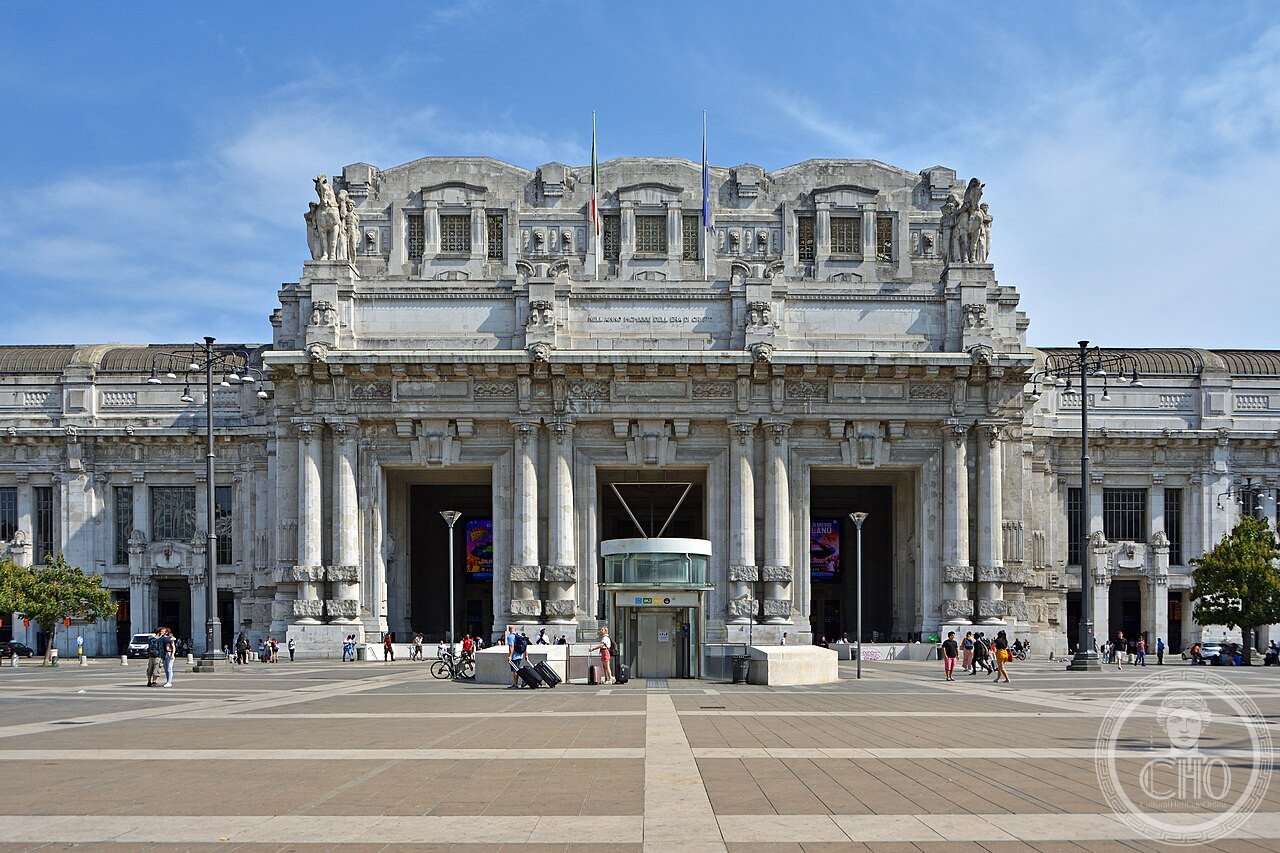
Milano Centrale is Europe’s largest railway station by volume and one of the most theatrically imposing public buildings of the twentieth century. Designed by Ulisse Stacchini and inaugurated on 1 July 1931, it presents a 200-metre facade of stone and steel that blends Art Deco ornamentation with the heavy Assyrian-Lombard symbolism favoured by the Fascist regime. The entrance hall’s soaring arched vault, 72 metres high — a world record at the time — transforms the act of departure into something close to ceremony. Frank Lloyd Wright reportedly called it the most beautiful station in the world. Today, with 120 million passengers a year and direct trains to Paris, Zurich, Vienna, and Frankfurt, it remains Milan’s great civic threshold: overwhelming, grandiose, and unmistakably Italian.
At a glance
- Type
- Railway terminus
- Period
- 1906–1931
- Style
- Art Deco / Fascist Monumental
- Location
- Piazza Duca d’Aosta, Milan, Italy
- Coordinates
- 45.4861° N, 9.2036° E
- Architect(s)
- Ulisse Stacchini; steel canopies by Albert Fava
Overview
Milano Centrale is the principal railway station of Milan and the second busiest in Italy after Roma Termini. Its 24 platforms are covered by steel canopies stretching 341 metres, spanning 66,500 square metres — among the largest station roofs in the world. The facade is 200 metres wide, adorned with sculptural eagles, winged horses, and allegorical reliefs that announce the Fascist state’s ambitions in stone. Despite its ideological origins, the station has become one of Italy’s most beloved civic landmarks, its grandiose interiors as much a destination as a transit point.
History
The original Milan station of 1864 was demolished to make way for a grander replacement. The cornerstone of the new station was laid by King Victor Emmanuel III in 1906, but construction stalled through the First World War. Under Benito Mussolini’s government, the project was accelerated as a prestige public works initiative, with the scale significantly enlarged beyond Stacchini’s original design. The station opened on 1 July 1931. A shadow fell over its history in 2013, when the Memoriale della Shoah was inaugurated in the basement, commemorating the 1,200 Jewish deportees transported from the secret platform Binario 21 to Nazi extermination camps.
Architecture & Design
Stacchini’s design fuses Liberty (Art Nouveau) elegance with Art Deco geometry and Fascist monumentalism, producing what critics have called an ‘Assyrian-Lombard’ style unique in European architecture. The main hall’s barrel vault soars to 72 metres — a record height at opening — and is lined with polished stone and bronze detailing. Eagle sculptures of extraordinary scale command the exterior, while the platforms are protected by a continuous steel-and-glass canopy of breathtaking engineering ambition. Some areas of the station retain unrestored mosaic floors, including chambers with swastika patterns that date to the Fascist-era decoration.
Cultural significance
Milano Centrale embodies the contradictions of Italian Fascist public architecture: genuine technical and aesthetic ambition in the service of an authoritarian state. Its Memoriale della Shoah, opened in 2013 in the deportation platform below street level, adds a layer of historical gravity that the station’s triumphalist exterior cannot obscure. As Europe’s largest station by volume, it also represents a milestone in 20th-century engineering, its steel canopies remaining among the most impressive of their kind on the continent.
Visiting today
The station is open 24 hours. The Memoriale della Shoah on Binario 21 is open to visitors and free to enter, with guided tours available. The grand entrance hall and upper galleries can be explored freely. Numerous cafes, restaurants, and shops occupy the station’s ground floor. The upper gallery level offers the best views of the main hall’s monumental architecture.
Getting there
Milano Centrale is served by Milan Metro lines M2 (green), M3 (yellow), and M5 (purple), all stopping at Centrale FS station directly beneath the terminus. ATM trams and buses serve Piazza Duca d’Aosta outside the main entrance. The Malpensa Express airport train departs from Centrale, reaching Malpensa in approximately 50 minutes. Direct international rail services connect Milan Centrale to Paris, Zurich, Geneva, Vienna, and Frankfurt.
Sources & resources
Find it on the map
See this place and what’s around it →📷 Become a Cultural Heritage Online photographer
Share your photos of places: they stay published under your name as the author. The more they're seen, the more you get noticed — and soon a contest will reward the most appreciated photos.
Log in or sign up free to add a photoIs this page about you?
This page is read by travellers and heritage enthusiasts who find it on Google. Tell us how you are connected to this place and we will take it from there.