
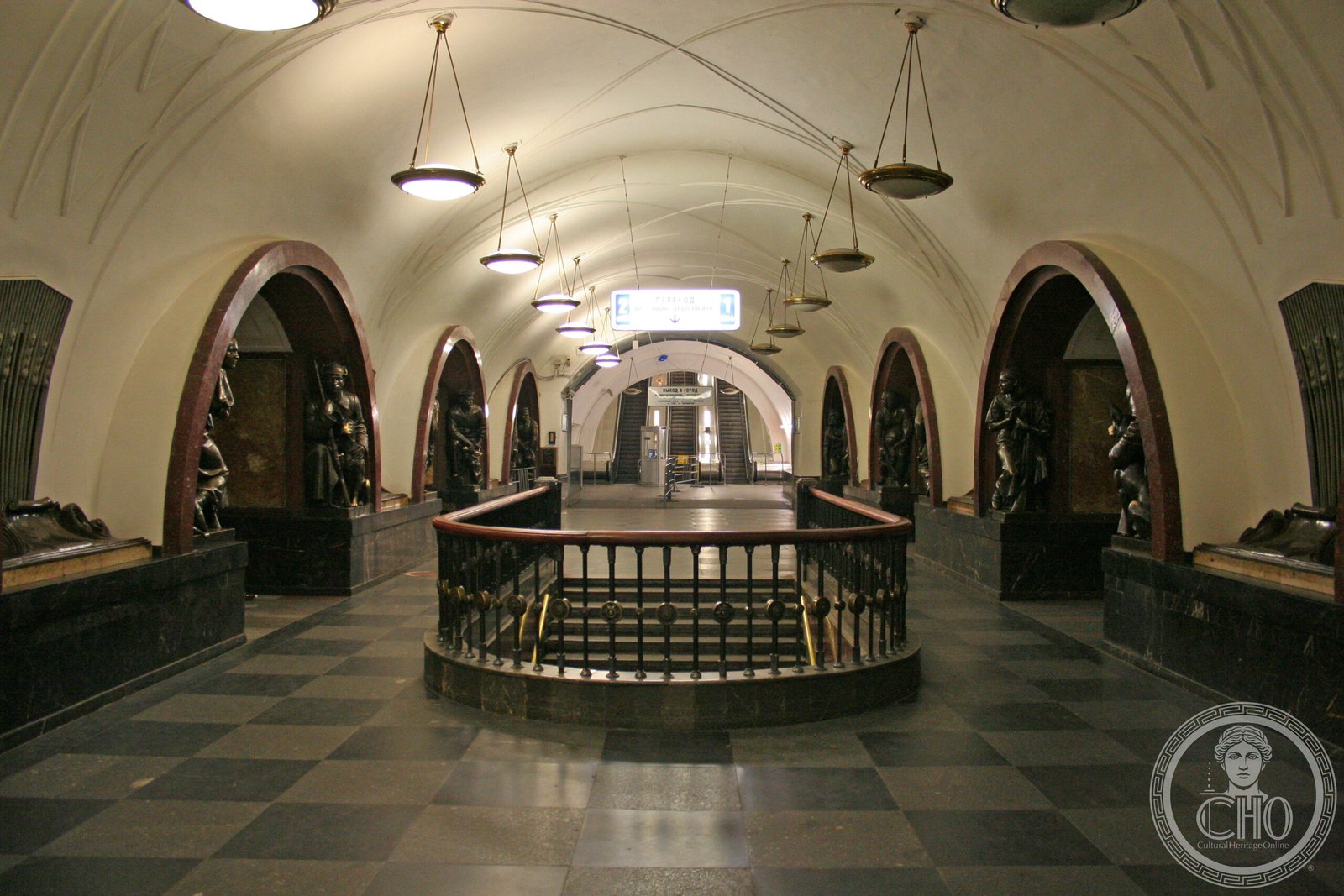
Beneath the streets of central Moscow, Aleksei Dushkin created one of the most extraordinary public interiors of the twentieth century. Opened in 1938, Ploshchad Revolyutsii station on the Moscow Metro presents travellers with a theatrical sequence of low red-marble arches populated by 76 larger-than-life bronze figures — soldiers, sailors, students, athletes, factory workers, border guards with German Shepherds — each crouching to fit within the vault, each embodying a heroic type of the Soviet citizen. The arches force passengers into close, almost intimate proximity with the bronzes. One figure, the border guard’s dog, has become a city-wide talisman: generations of Muscovites rub its nose for luck, leaving it buffed to a brilliant gold while the rest of the statue remains dark. The station is simultaneously a propaganda monument, a piece of high civic art, and one of the most visited interiors in Russia, receiving tens of millions of passengers each year. It is widely considered among the ten most beautiful metro stations in the world.
At a glance
- Type
- Underground railway station
- Period
- 1938
- Style
- Soviet Art Deco / Stalinist Baroque
- Location
- Teatralny Proyezd, Moscow, Russia
- Coordinates
- 55.7559° N, 37.6193° E
- Architect(s)
- Aleksei Dushkin
Overview
Ploshchad Revolyutsii (Revolution Square) station is a stop on Line 3 (Arbatsko-Pokrovskaya) of the Moscow Metro, located beneath the square of the same name adjacent to Red Square and the Kremlin. It is one of the most visited stations in the Moscow system and has become, de facto, one of the city’s primary tourist attractions in its own right — not merely a transit point but a destination. The combination of red marble vaulting, brass chandeliers, and the dense population of bronze sculptural figures gives the platform the quality of a subterranean palace or pantheon rather than a commuter infrastructure.
History
The Moscow Metro was conceived in the early 1930s as both practical infrastructure and a showcase of Soviet achievement. Ploshchad Revolyutsii opened on 13 March 1938 as part of the second stage of the metro’s expansion. Dushkin, already celebrated for his Kropotkinskaya station, was commissioned to create a station commemorating the revolutionary generation. He selected 76 bronze figures sculpted by Matvei Manizer, crouching within 19 arch pairs across both platforms. During World War II the station served as an air-raid shelter and command post. The sculptures were evacuated for safety and returned after the war. The station has been conserved multiple times but retains its original appearance with remarkable fidelity.
Architecture & Design
Dushkin’s design centres on a double row of low semi-circular arches in deep red Ukrainian marble framing the platform on both sides. The arches are deliberately undersized — a structural decision that creates dramatic compression and forces the bronze figures to crouch. The ceiling between the arches carries gilt mosaic panels and large brass pendant chandeliers. The floor is grey granite. The 76 bronze sculptures by Matvei Manizer represent 20 different archetypes of Soviet life, each mirrored across the paired arches: a revolutionary with a rifle, a border guard with dog, a female student with a book, a factory worker, a sailor, an aviator, an athlete. The poses combine Social Realist monumentality with unusual dynamism — figures caught in motion within their marble niches.
Cultural significance
Ploshchad Revolyutsii occupies a unique position in Russian cultural memory as the station where propaganda art and daily life intersect most tangibly. The tradition of rubbing the bronze dog’s nose — said to bring exam success, good luck in love, or professional fortune — has transformed one sculpture into a living folk ritual, an authentic piece of urban mythology unplanned by the station’s designers. The station has appeared in dozens of Russian novels, films, and artworks. It is listed as a cultural heritage monument of Russia and regularly cited in international rankings of the world’s most beautiful metro stations.
Visiting today
The station is fully operational and open daily from approximately 05:30 to 01:00. Entry requires a standard Moscow Metro ticket or Troika card. Best visited outside peak hours (avoid 08:00–09:30 and 17:30–19:30). Photography is permitted. The station connects directly to Okhotny Ryad (Line 1) and Teatralnaya (Line 2) within the paid zone, making it easy to combine with Red Square, the Kremlin, and the Bolshoi Theatre.
Getting there
Take Moscow Metro Line 3 (Arbatsko-Pokrovskaya, dark blue) to Ploshchad Revolyutsii. The station is one stop east of Arbatskaya and is a transfer hub with Lines 1 and 2. From Sheremetyevo Airport, take the Aeroexpress to Belorusskaya then metro (approximately 50 minutes). From Domodedovo, take the Aeroexpress to Paveletskaya and change to metro (approximately 60 minutes).
Sources & resources
Find it on the map
See this place and what’s around it →Record researched and written by Luigi De Marchi for Cultural Heritage Online, 2026.
📷 Become a Cultural Heritage Online photographer
Share your photos of places: they stay published under your name as the author. The more they're seen, the more you get noticed — and soon a contest will reward the most appreciated photos.
Log in or sign up free to add a photoIs this page about you?
This page is read by travellers and heritage enthusiasts who find it on Google. Tell us how you are connected to this place and we will take it from there.