
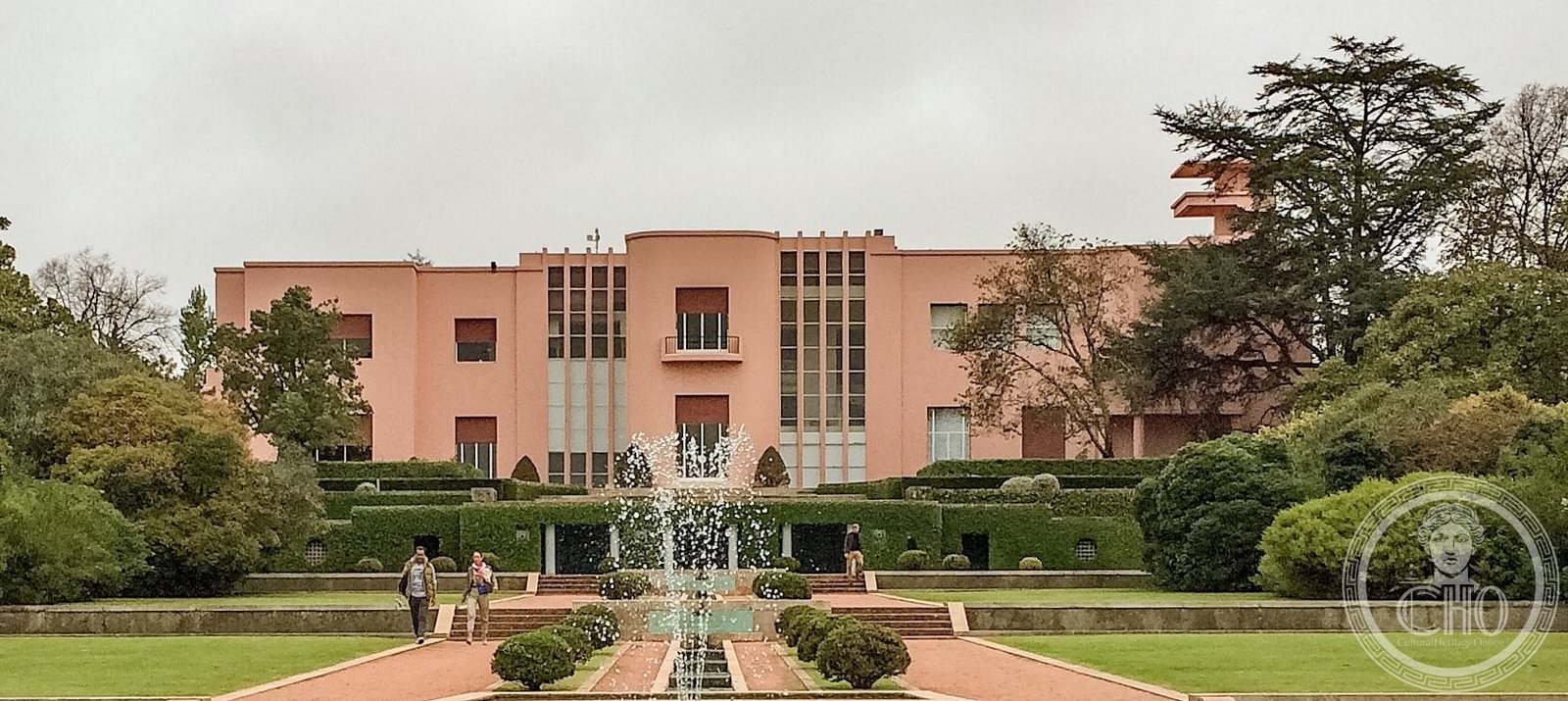
Tucked within a vast estate on the western edge of Porto, Casa de Serralves is one of the finest Art Deco villas on the Iberian Peninsula. Commissioned by Carlos Alberto Cabral, second Count of Vizela, in the years following the landmark 1925 Paris International Exposition of Modern Decorative Arts, the house embodies the confident elegance of the interwar era: clean geometric volumes, sculpted stone pilasters, and interiors that blend French decorative flair with Portuguese craftsmanship. Surrounding the villa, a romantic park designed by French landscape architect Jacques Gréber sweeps across eighteen hectares of terraced gardens, meadows, and woodland. Since 1989 the entire estate has been held in trust by the Serralves Foundation, Portugal's foremost contemporary arts institution, and the villa itself has served as an exhibition and event space open to the public since 1987. Classified as a National Monument in 2012, Casa de Serralves remains a rare survivor of a style that swept Europe between the wars yet left relatively few intact domestic monuments in Portugal.
At a glance
- Type
- Residential villa / cultural venue
- Period
- 1925–1944
- Style
- Art Deco / Streamline Moderne
- Location
- Rua de Serralves, Porto, Portugal
- Coordinates
- 41.1585° N, 8.6577° W
- Architect(s)
- José Marques da Silva (villa); Jacques Gréber (gardens)
Overview
Casa de Serralves sits at the heart of a protected estate that encompasses the Art Deco villa, an Álvaro Siza–designed contemporary museum opened in 1999, and eighteen hectares of gardens classified as a National Monument. The ensemble draws nearly one million visitors annually and functions as Portugal's most significant platform for contemporary visual culture. The villa itself represents the estate's Art Deco heritage, and its programme of reception rooms, terraces, and service quarters illustrates how French interwar taste filtered into the Portuguese bourgeoisie.
History
The Serralves estate belonged to the Cabral textile dynasty from the early twentieth century. Carlos Alberto Cabral inherited the property in 1923 and, inspired by what he had witnessed at the 1925 Paris Exposition, set about replacing an earlier eclectic manor with a house firmly in the Art Deco mode. Construction and decoration proceeded in phases between 1925 and 1944, with Porto architect José Marques da Silva leading the project and French landscaper Jacques Gréber reshaping the grounds. After Cabral's death the estate passed through private hands until the Portuguese State acquired it in October 1986. The villa opened to the public the following year and the Serralves Foundation was formally established by decree in 1989, charged with managing the whole estate as a public cultural asset. National Monument status was conferred in 2012.
Architecture & Design
The villa presents a symmetrical pink-rendered facade articulated by fluted pilasters, wrought-iron balconies, and a restrained ornamental programme drawn from Art Deco's geometric vocabulary. Inside, the principal rooms feature parquet floors, lacquered furniture, and decorative plasterwork that reflect the French ateliers fashionable among Iberian elites of the 1930s. Gréber's garden layout counterbalances the villa's rigour with romantic informality: a long central parterre descends toward a lake, flanked by clipped hedges, while woodland paths wind through camellias and sequoias. The deliberate contrast between architectural precision and naturalistic landscape is itself a hallmark of Art Deco estate design.
Cultural significance
Casa de Serralves holds a unique place in Portuguese cultural life because it fuses two distinct chapters of the country's modernist history: the Art Deco confidence of the interwar bourgeoisie and the critical contemporary art scene that emerged after the 1974 Carnation Revolution. The Serralves Foundation's programme positions Portugal within the international art conversation, while the villa acts as a tangible reminder of the cosmopolitan aspirations that shaped Porto in the 1930s. Its National Monument classification acknowledges both its architectural integrity and its symbolic role.
Visiting today
The estate is open daily except Mondays; opening hours vary seasonally. A single ticket covers the park, villa exhibitions, and the contemporary museum. The Foundation's bookshop and café are in the museum building. Guided tours of the villa interior can be booked in advance through the Serralves website. Weekend mornings are busiest.
Getting there
From central Porto, take Metro line B, C, or E to Casa da Música station, then bus 203 toward Serralves (approx. 10 min). By car, the estate has a dedicated car park off Rua de Serralves. Taxis and ride-share apps (Uber, Bolt) are available from the city centre; the journey takes around 15 minutes depending on traffic.
Sources & resources
Find it on the map
See this place and what’s around it →Record researched and written by Luigi De Marchi for Cultural Heritage Online, 2026.
📷 Become a Cultural Heritage Online photographer
Share your photos of places: they stay published under your name as the author. The more they're seen, the more you get noticed — and soon a contest will reward the most appreciated photos.
Log in or sign up free to add a photoIs this page about you?
This page is read by travellers and heritage enthusiasts who find it on Google. Tell us how you are connected to this place and we will take it from there.