
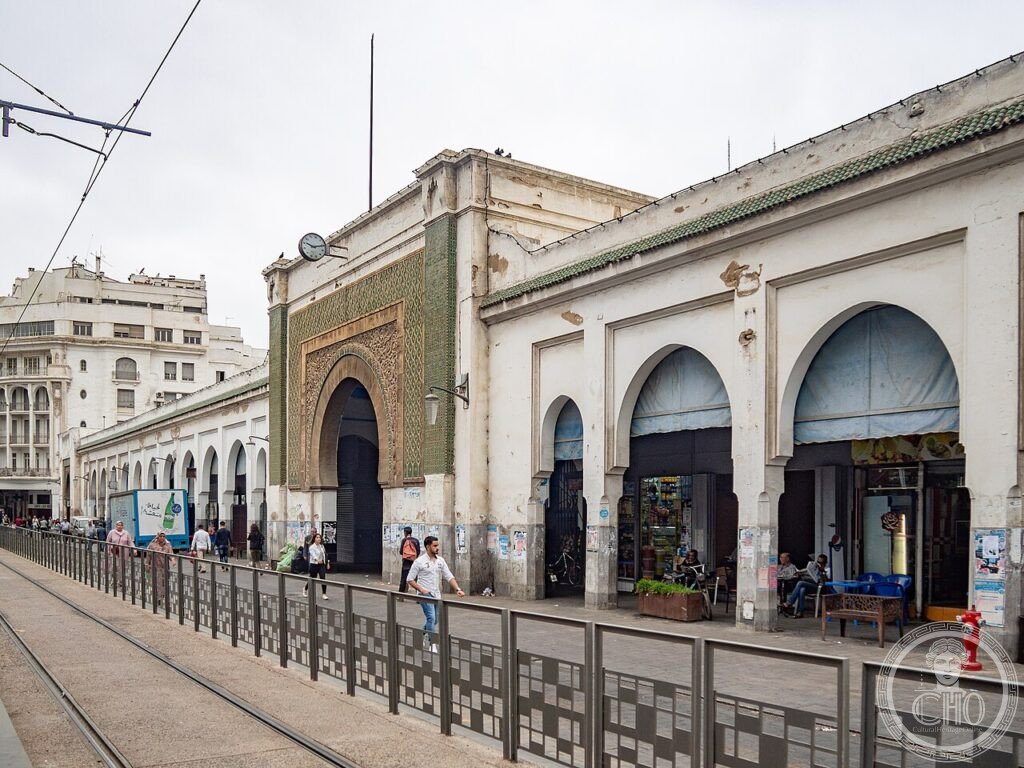

Before the Déco towers came the market: Bousquet’s Neo-Moorish gateway of 1917, modelled on the portals of Morocco’s imperial cities, still opens every morning onto fish, flowers and the noise of the centre.
At a glance
The Marché Central occupies a full block of Boulevard Mohammed V, built between 1917 and 1920 to designs by Pierre Bousquet on the site of the Franco-Moroccan fair of 1915. It was the most important marketplace of the European ville nouvelle — the working heart of the city the French Protectorate was building at speed — and it set the architectural tone the new boulevards would follow: the Néo-Mauresque, French planning dressed in Moroccan monumental forms. Its great horseshoe-arched gateway quotes the gates of Marrakesh, Fes, Rabat and Meknès; behind it, an octagonal cupola covers the seafood hall.
Key facts
- Built: 1917–1920, the first halls open by 1919, on the site of the Franco-Moroccan fair of 1915
- Architect: Pierre Bousquet
- Style: Neo-Moorish (Néo-Mauresque) — the monumental gateway imitates Morocco’s imperial-city gates
- Centrepiece: Octagonal central cupola over the seafood hall — Atlantic fish and oysters sold beneath it daily
- History: Bombed by resistance fighter Muhammad Zarqtuni on 24 December 1953, after the exile of Sultan Mohammed V
- Heritage: Classified as Moroccan national heritage in 2003
- Address: Boulevard Mohammed V, facing the Marché Central tram stop
- GPS: 33.594885, −7.611996 — View on Google Maps
History
When Bousquet laid out the market, Casablanca’s European city was barely a decade old and growing faster than any city in Africa; the Marché Central gave it a stomach and a centre. The choice of style mattered: rather than export a French iron market hall, the Protectorate’s architects wrapped modern function in Moroccan ceremonial form — green-tiled friezes, carved surrounds, the great gate — inventing the hybrid language that the city’s Art Déco decade would refine along the same boulevard.
The market also carries the city’s political memory. On 24 December 1953, four months after the French deposed and exiled Sultan Mohammed V, the nationalist Muhammad Zarqtuni bombed the Marché Central at the height of the Christmas trade, killing nineteen people — one of the defining acts of the independence struggle, commemorated today in the name of a major boulevard. The stalls returned, and never left: a century on, the halls still trade in fish, flowers, olives and everything else the centre eats.
What you see
From the boulevard, the gateway does the talking: a deep horseshoe arch in a carved rectangular frame, faced in green zellige-patterned tile, with a clock mounted above and white crenellated walls running away on either side — an imperial city gate compressed into a shopfront. Pass through and the ceremonial turns domestic: arcaded aisles, the octagonal cupola over the fish hall, produce stacked in pyramids, and the cafe tables of the flower sellers’ corner. The arcades along the outer wall shelter some of the centre’s best-loved oyster counters. Come before noon, when the fish is loudest.
Practical information
- Working food market — mornings are the show; many stalls wind down by mid-afternoon
- The oyster and seafood counters serve lunch on the spot — a Casablanca institution
- Watch bags in the crowd, and ask before photographing stallholders
Getting there
The market faces the Marché Central tram stop on Boulevard Mohammed V (tram T1), three stops from Casa-Port station. The Art Déco spine of the old ville nouvelle — from Place Mohammed V to the Rialto — is entirely walkable from here.
Nearby
- Cinema Rialto — the working Déco picture house of 1929, five minutes south
- Sacré-Cœur de Casablanca — the white concrete cathedral of 1930
- Villa des Arts — the Déco villa turned art centre
- Casablanca — Art Déco and the Mauresque City — the CHO city guide
Sources
- Wikipedia, “Central Market (Casablanca)” and “Architecture of Casablanca” — Bousquet, 1917, 1915 Fair site, style, gateway, cupola
- Historical accounts of the Zarqtuni bombing, 24 December 1953 — nationalist resistance context
- French Wikipedia, “Marché central de Casablanca” — construction phases 1917–1920, 2003 national heritage classification, bombing casualties
- OpenStreetMap / Nominatim — coordinates
Find it on the map
See this place and what’s around it →📷 Become a Cultural Heritage Online photographer
Share your photos of places: they stay published under your name as the author. The more they're seen, the more you get noticed — and soon a contest will reward the most appreciated photos.
Log in or sign up free to add a photoIs this page about you?
This page is read by travellers and heritage enthusiasts who find it on Google. Tell us how you are connected to this place and we will take it from there.