
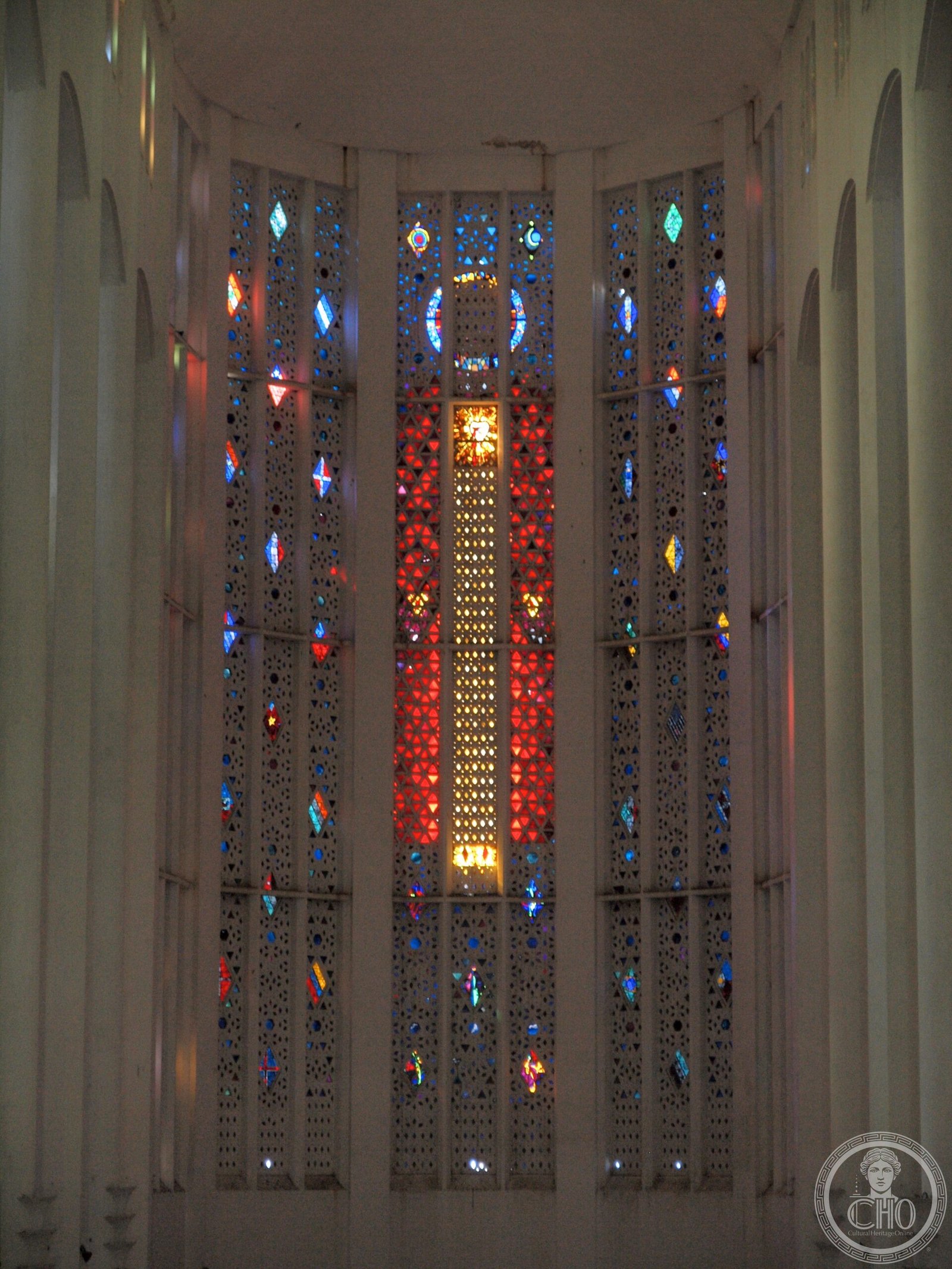
The Sacré-Cœur de Casablanca — formally the Church of the Sacred Heart — is a landmark Art Deco structure designed by French architect Paul Tournon and completed in 1930. Never technically a cathedral, it served as a Catholic church until Moroccan independence in 1956 and has since been reimagined as a vibrant public cultural centre open to all visitors.
At a glance
- Type
- Former church, now cultural centre
- Period
- Completed 1930
- Style
- Art Deco with Gothic Revival inflections
- Location
- West of Arab League Park, Casablanca, Morocco
- Coordinates
- 33.5911° N, 7.6244° W
- Architect(s)
- Paul Tournon
Overview
Rising above the greenery of Arab League Park in central Casablanca, the Sacré-Cœur de Casablanca is one of North Africa’s most distinctive examples of interwar Art Deco architecture. Designed by the prolific French architect Paul Tournon, it blends the bold geometry and restrained ornament of Art Deco with pointed arches and soaring towers borrowed from the Gothic tradition. Though built during the French Protectorate era to serve the European Catholic community, the building today belongs entirely to the public cultural life of the city, hosting exhibitions, performances, and events that draw local residents and international visitors alike.
History
Construction of the church was completed in 1930 during the period of the French Protectorate of Morocco, when Casablanca was undergoing rapid urban expansion under the influence of Resident-General Hubert Lyautey’s ambitious planning policies. The building was consecrated for Catholic worship under the jurisdiction of the Archdiocese of Rabat. Despite its monumental scale and the common use of the term “cathedral,” the structure was never the seat of a bishop and therefore never held cathedral status in the canonical sense. Following Morocco’s independence in 1956, the building ceased functioning as a church and was later repurposed as a public cultural centre, a transformation that preserved the architecture while giving the space new civic meaning.
Architecture & Design
Paul Tournon brought to Casablanca the same syncretic sensibility that distinguished his work in France — combining Art Deco’s emphasis on geometric simplicity, vertical lines, and restrained surface decoration with Gothic Revival’s pointed arches, twin towers, and sense of upward aspiration. The facade is composed in pale stone, its verticality emphasised by slender pilasters and lancet-shaped openings that filter light into the interior. The building’s massing is monumental yet refined, avoiding the excessive ornament of earlier eclectic styles while retaining a spiritual gravitas through its proportions. Inside, the nave retains the spatial drama of its religious origins even in its current secular use.
Cultural significance
The Sacré-Cœur de Casablanca stands as a witness to the complex layered history of the city — a place shaped by Berber, Arab, and French influences over centuries. Its survival and conversion into a cultural centre rather than demolition or neglect reflects Casablanca’s pragmatic approach to its colonial architectural heritage. The building has hosted art exhibitions by Moroccan and international artists and has been used for music events including electronic performances organised by the Institut Français, making it a meeting point between traditional heritage and contemporary creativity.
Visiting today
The building is open to the public as a cultural centre and exhibition space. Entry is generally free or low-cost depending on the event. It is located west of Arab League Park (Parc de la Ligue Arabe) in the heart of Casablanca’s historic European quarter, making it easily walkable from the city centre hotels and the Hassan II Mosque area.
Getting there
From Casablanca’s central train station (Casa-Voyageurs or Casa-Port), the building is reachable by taxi in under 15 minutes. Tram Line 1 stops near the city centre; from there it is a short walk through the European quarter. The Arab League Park is a recognisable landmark — the former church stands prominently on its western edge.
Sources & resources
Find it on the map
See this place and what’s around it →Record researched and written by Luigi De Marchi for Cultural Heritage Online, 2026.
📷 Become a Cultural Heritage Online photographer
Share your photos of places: they stay published under your name as the author. The more they're seen, the more you get noticed — and soon a contest will reward the most appreciated photos.
Log in or sign up free to add a photoIs this page about you?
This page is read by travellers and heritage enthusiasts who find it on Google. Tell us how you are connected to this place and we will take it from there.