

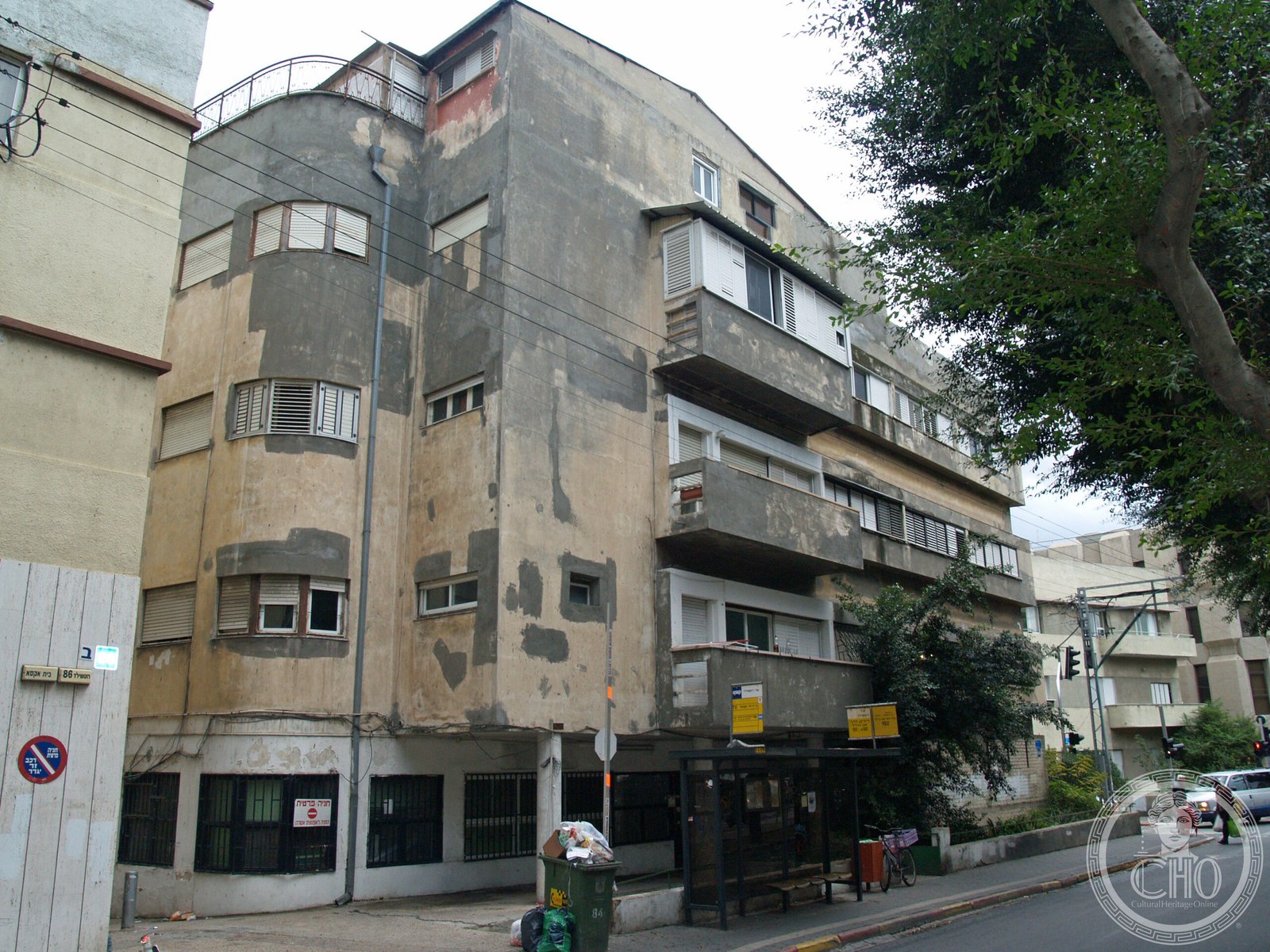
Rising on pilotis above Rothschild Boulevard, the Engel House is the building that set the grammar of Tel Aviv. Completed in 1933 by architect Zeev Rechter, it was the first structure in Mandatory Palestine to lift its volume off the ground on free-standing columns — a technique borrowed directly from Le Corbusier’s Five Points of Architecture. That single decision, multiplied across thousands of plots in a single decade, would make Tel Aviv the world’s largest intact ensemble of Modernist architecture and earn it a UNESCO World Heritage designation in 2003. The Engel House is therefore not merely one building but the prototype that gave an entire city its silhouette: white cubic volumes, ribbon windows, continuous shade beneath, and air moving freely at street level in the Mediterranean heat. It remains a private residential building on what is today one of the most celebrated urban boulevards in the Middle East.
At a glance
- Type
- Residential building
- Period
- 1933
- Style
- International Style / Bauhaus / Early Modernism
- Location
- 84 Rothschild Boulevard, Tel Aviv, Israel
- Coordinates
- 32.0688° N, 34.7748° E
- Architect(s)
- Zeev Rechter
Overview
The Engel House stands at 84 Rothschild Boulevard, one of Tel Aviv’s principal tree-lined promenades, as the founding monument of the White City. Its most radical feature — pilotis raising the entire block off the ground — answered both a functional need (ventilation and shade in a coastal Mediterranean climate) and a philosophical one (the Modernist dream of liberating the ground plane for collective use). Rechter had trained in Paris under Pierre Charreau, absorbing the lessons of the European avant-garde before bringing them to a city that was, in 1933, little more than sand dunes and colonial optimism. The result is a building whose influence far exceeds its modest footprint.
History
Tel Aviv was founded in 1909 as a garden suburb of Jaffa and grew rapidly as Jewish immigration from Europe accelerated in the 1920s and 1930s. Many of the arriving architects had studied at the Bauhaus in Dessau or at equivalent modernist schools in Germany, France, and the Soviet Union. When Zeev Rechter designed the Engel House in 1933 — the same year the Nazi regime closed the Bauhaus — he was translating the European modernist project into a new context. The building was commissioned by the Engel family and completed that year. Its immediate success as a prototype was visible within months: the raised-ground-floor solution spread rapidly across the city’s new residential quarters, becoming a default response to the climate and the street. By the 1950s Tel Aviv contained over 4,000 such buildings, collectively designated the White City.
Architecture & Design
Rechter’s design adheres closely to Le Corbusier’s Five Points: pilotis, roof garden, free plan, horizontal windows, and free facade. The pilotis here are expressed as slender concrete columns that lift a three-storey residential block, creating a shaded public passage beneath. The facade is smooth white render, with continuous balconies wrapping the upper floors to provide outdoor living space and solar shading. Interior layouts are freed from load-bearing walls, allowing flexible room configurations — unusual for its time. The building’s corner treatment, where a curved balcony rounds the angle between street and boulevard, became one of the signature moves of Bauhaus-influenced architecture in Tel Aviv and can be seen repeated on hundreds of nearby buildings.
Cultural significance
The Engel House is the origin point of what UNESCO recognized in 2003 as the White City of Tel Aviv — a buffer zone of approximately 1.7 square kilometres containing the world’s highest concentration of Bauhaus and International Style buildings. The inscription acknowledged not just the individual structures but the coherent urban experiment they represent: a 1930s attempt to build a modern, egalitarian Mediterranean city from scratch. The Engel House is the moment that experiment became architecturally legible. It also carries symbolic weight as a product of the same historical rupture — the closure of the Bauhaus by the Nazi regime — that sent its trained architects into diaspora, making Tel Aviv an involuntary archive of European Modernism at its most radical.
Visiting today
The Engel House is a private residential building and not open to the public. Its exterior on Rothschild Boulevard is freely visible and widely photographed. The surrounding boulevard is lined with cafes, galleries, and cultural institutions and is one of the most pleasant walks in Tel Aviv. The nearby Bauhaus Center Tel Aviv at 77 Dizengoff Street offers guided architectural walking tours that include the Engel House and the broader White City, and stocks the most comprehensive English-language library on Tel Aviv Modernism. The Independence Hall, where Israel’s declaration was signed in 1948, is also on Rothschild Boulevard.
Getting there
Rothschild Boulevard is in central Tel Aviv, walkable from most hotels in the city center. The nearest bus stops are on Allenby Street and King George Street, both served by multiple Dan Bus lines. Tel Aviv’s light rail Red Line, opened in 2023, has stops within a 10-minute walk. Ben Gurion International Airport is approximately 20 km away; the express train takes around 25 minutes to Tel Aviv HaShalom or Savidor Center stations, both within easy reach of the boulevard by taxi or bus.
Sources & resources
Find it on the map
See this place and what’s around it →Record researched and written by Luigi De Marchi for Cultural Heritage Online, 2026.
📷 Become a Cultural Heritage Online photographer
Share your photos of places: they stay published under your name as the author. The more they're seen, the more you get noticed — and soon a contest will reward the most appreciated photos.
Log in or sign up free to add a photoIs this page about you?
This page is read by travellers and heritage enthusiasts who find it on Google. Tell us how you are connected to this place and we will take it from there.