
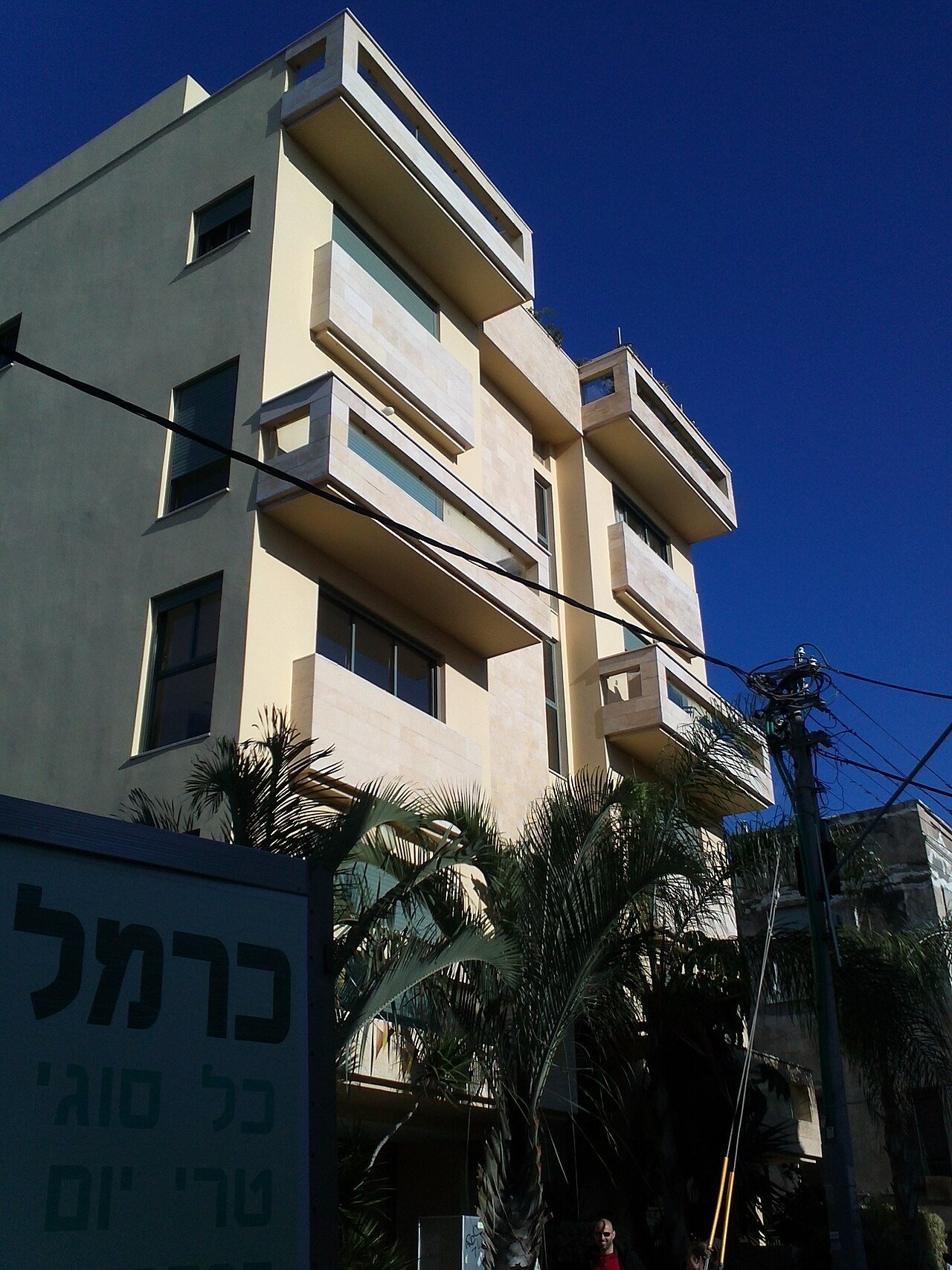
Tel Aviv holds the largest concentration of International Style architecture in the world. More than four thousand buildings, raised in a single decade, carry the modern movement to the Mediterranean shore.
At a glance
Between the early 1930s and the years around the Second World War, a young city on the Mediterranean coast became an open-air laboratory for European modernism. The architects who built it had studied in Germany and France, several of them at the Bauhaus in Dessau, and many arrived after the National Socialists took power in 1933. They brought with them the vocabulary of the International Style and adapted it to heat, light and sea air. The result is a dense fabric of white and pale buildings, low balconies and clean horizontal lines, concentrated above all between Rothschild Boulevard and the streets around Dizengoff Square. In 2003 UNESCO inscribed this ensemble on the World Heritage List as the White City of Tel Aviv, recognising it as an outstanding example of new town planning and architecture of the early twentieth century.
Key facts
- Country: Israel
- Key period: 1930s
- Architectural style: International Style, commonly known as Bauhaus
- UNESCO: White City of Tel Aviv, inscribed 2003
- Architects: Arieh Sharon (1900–1984, trained at the Bauhaus in Dessau), Ze’ev Rechter (1899–1960), Dov Karmi (1905–1962), Genia Averbuch (Dizengoff Square)
- Master plan: Patrick Geddes, prepared from 1925 and accepted in 1929
- Essential sites: Rothschild Boulevard, Dizengoff Square, the Bauhaus Center
History
The story begins not with a building but with a plan. In 1925 the Scottish biologist and urban planner Patrick Geddes was invited to lay out the northern expansion of Tel Aviv, and his proposal was accepted in 1929. Rather than impose a rigid grid, Geddes organised the new district around a hierarchy of streets, with broad boulevards for traffic and movement and quieter residential lanes between them, generous blocks broken by small interior gardens. This framework, humane and green, would shape the way the modern buildings of the following decade sat together.
The architecture arrived with a wave of immigration. After 1933, when the National Socialists came to power in Germany, a generation of German-Jewish architects left Europe for Mandatory Palestine. Some had trained at the Bauhaus itself: Arieh Sharon, born in 1900, had been admitted to the famous preliminary course by Walter Gropius and studied under Hannes Meyer before opening his office in Tel Aviv in 1931. Others, such as Ze’ev Rechter and Dov Karmi, had absorbed the lessons of Le Corbusier and the wider modern movement. Together they formed a community that, within little more than a decade, built over four thousand structures in the new idiom.
What they produced was not a transplant but a translation. The white renders and flat roofs of the International Style answered the local climate as much as any aesthetic creed, and the city grew so quickly and so consistently that the modern movement, scattered and contested elsewhere, here acquired the coherence of a whole urban quarter.
What you see
Walk the streets around Rothschild Boulevard and the grammar repeats with quiet variation. Buildings stand on pilotis, raised on slender pillars so that air and people pass beneath them. Facades are smooth and pale, articulated by long, narrow balconies, each one shaded by the balcony above, that wrap around corners in soft curves. Windows are kept small and recessed to limit the heat and glare of the Mediterranean sun, and flat roofs replace the pitched forms of the older European city, offering terraces open to the sea breeze. The cumulative effect is horizontal, calm and bright.
Particular landmarks anchor the wander. Dizengoff Square, designed by Genia Averbuch after she won a competition in 1934 and built in the years that followed, gathers a ring of curved modern facades around a circular plaza. Rechter’s residential work introduced the raised pilotis to housing in the city. For a guided reading of these details, the Bauhaus Center on Dizengoff Street offers tours and exhibitions, and the area rewards an unhurried half-day on foot.
Practical information
- The Bauhaus Center on Dizengoff Street runs guided walking tours and sells maps and books on the White City.
- The White City Center, in a restored building, hosts exhibitions on the architecture and its conservation.
- Allow at least a half-day on foot to take in Rothschild Boulevard and Dizengoff Square.
- Early morning or late afternoon light is kinder for both walking and photography in summer.
- Many buildings are private residences; appreciate the facades from the street and respect residents’ privacy.
Getting there
Tel Aviv is served by Ben Gurion Airport, the main international gateway to Israel, roughly twenty kilometres south-east of the city centre and connected to it by train, taxi and road. The White City lies in the heart of central Tel Aviv, and its principal axes, Rothschild Boulevard and Dizengoff Street, are easily reached on foot from much of the city centre.
Related in CHO
- Berlin & Dessau — Gropius, the Bauhaus and German Modernism
- Brno — Villa Tugendhat and Czech Functionalism
- Chicago — Wright, Mies and the architecture of modernity
Sources
Find it on the map
See this place and what’s around it →📷 Become a Cultural Heritage Online photographer
Share your photos of places: they stay published under your name as the author. The more they're seen, the more you get noticed — and soon a contest will reward the most appreciated photos.
Log in or sign up free to add a photo