
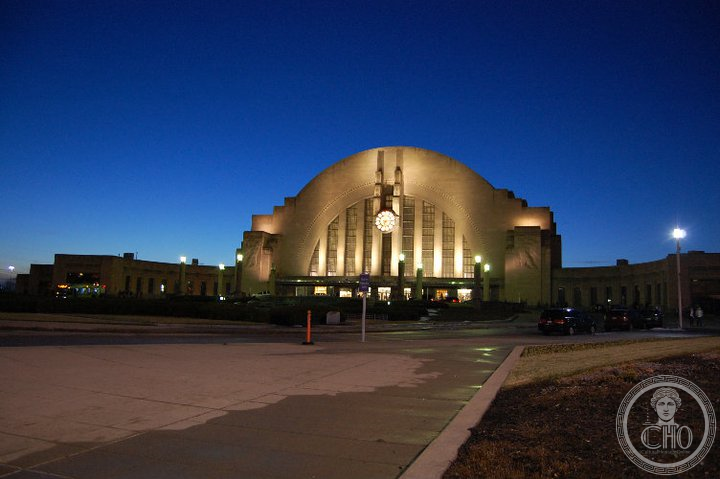
Rising above the Ohio River lowlands like a colossal Art Deco half-dome, Cincinnati Union Terminal opened in March 1933 as one of the grandest railway stations ever built in America. Designed by the New York firm of Fellheimer & Wagner, the terminal’s soaring rotunda — at 180 feet the largest half-dome in the Western Hemisphere at the time — sheltered millions of wartime travellers and became the symbolic gateway to the Queen City. Although passenger rail dwindled and the station closed in 1972, a citizen-driven campaign rescued the building from demolition, transforming it into the Cincinnati Museum Center in 1990. After a landmark 228-million-dollar restoration completed in 2018, Union Terminal stands fully rehabilitated: its mosaic murals gleam, its winged limestone reliefs frame the grand arch, and its halls once again buzz with visitors discovering natural history, local heritage, and the stories of the Holocaust and Humanity. Today it is among the most celebrated Art Deco landmarks in the United States.
At a glance
- Type
- Railway terminal / museum complex
- Period
- 1929–1933
- Style
- Art Deco
- Location
- 1301 Western Avenue, Cincinnati, Ohio, USA
- Coordinates
- 39.11° N, 84.54° W
- Architect(s)
- Fellheimer & Wagner (Alfred Fellheimer & Steward Wagner); Paul Philippe Cret, design consultant
Overview
Cincinnati Union Terminal is a monumental Art Deco railway station and museum complex on the west side of downtown Cincinnati, Ohio. Its defining feature is a vast semicircular facade and half-dome rotunda that dominate the skyline, making it one of the purest expressions of streamlined Deco architecture in North America. Since 1990 the building has housed the Cincinnati Museum Center, an umbrella institution comprising the Cincinnati History Museum, the Museum of Natural History & Science, the Duke Energy Children’s Museum, and the Nancy & David Wolf Holocaust and Humanity Center, drawing close to two million visitors annually.
History
Plans for a union station consolidating Cincinnati’s seven competing rail terminals began in the 1920s. Fellheimer & Wagner won the commission and construction started in 1929, with the cornerstone laid in 1931. The terminal opened on 31 March 1933, serving fourteen railroads at its peak. During World War II it processed over 17 million military personnel. Postwar highway expansion and the decline of passenger rail steadily eroded traffic; the station closed to trains in 1972. Repeated demolition threats followed until Hamilton County voters approved a 33-million-dollar conversion bond in 1986. The Cincinnati Museum Center opened in stages from 1988 to 1991. A second, far larger restoration — costing 228 million dollars — ran from July 2016 to November 2018, fully repairing the rotunda mosaics, mechanical systems, and public spaces.
Architecture & Design
The terminal’s most arresting element is its 180-foot half-dome rotunda clad in Indiana limestone, flanked by symmetrical wings that stretch nearly a quarter-mile. The interior rotunda features eight monumental WPA mosaic murals by Winold Reiss depicting Cincinnati’s industrial and civic history across 4,000 square feet of glass tesserae. Carved limestone reliefs of transportation allegories flank the main arch, while original terrazzo floors, Art Deco light fixtures, and a 1929 E.M. Skinner concert organ complete an interior of sustained grandeur. The building’s radial plan funnelled passengers from taxis and buses through the concourse to train platforms in a single, logical flow.
Cultural significance
Union Terminal is a defining monument of American Art Deco and of mid-century civic ambition. Its silhouette inspired the Hall of Justice in the animated DC Comics television series, cementing its place in popular culture. The Winold Reiss mosaics are among the finest examples of WPA public art in any American railway station. The building’s survival — the result of sustained grassroots advocacy — demonstrates how heritage conservation can transform a threatened industrial landmark into a thriving cultural institution. It is listed on the National Register of Historic Places.
Visiting today
The Cincinnati Museum Center is open Tuesday through Sunday, 10 AM to 5 PM; closed Mondays and major holidays. Combined admission tickets cover multiple museums; the Omnimax Theater requires a separate ticket. The building’s public spaces and rotunda can be admired free of charge. A museum shop and café are located inside the main rotunda. Parking is available in an adjacent lot and structure.
Getting there
Cincinnati Union Terminal sits at 1301 Western Avenue, roughly one mile west of downtown Cincinnati. The Metro bus network serves the site via several routes; check sorta.com for current schedules. By car, take I-75 to the Western Avenue exit. The terminal is also reachable on foot or by bicycle along the Mill Creek Greenway trail. Rideshare drop-off is at the main entrance on the south plaza.
Sources & resources
Find it on the map
See this place and what’s around it →Record researched and written by Luigi De Marchi for Cultural Heritage Online, 2026.
📷 Become a Cultural Heritage Online photographer
Share your photos of places: they stay published under your name as the author. The more they're seen, the more you get noticed — and soon a contest will reward the most appreciated photos.
Log in or sign up free to add a photoIs this page about you?
This page is read by travellers and heritage enthusiasts who find it on Google. Tell us how you are connected to this place and we will take it from there.