

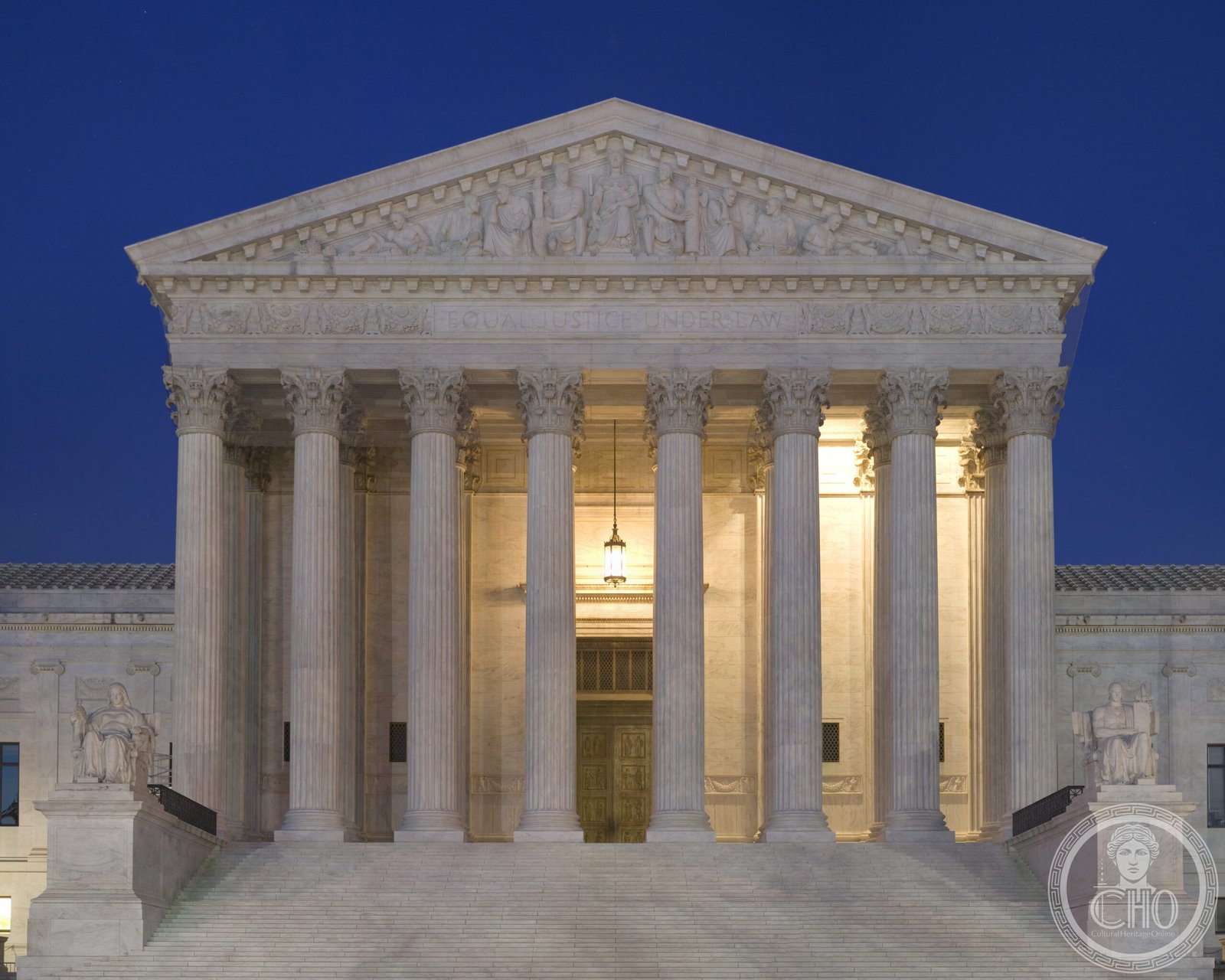
Completed in 1935 as the first permanent home of the nation’s highest court, the Supreme Court Building stands as an enduring monument to American civic ideals. Designed by Cass Gilbert and his son Cass Gilbert Jr., the structure occupies a commanding position on Capitol Hill, directly across from the United States Capitol. Its gleaming white Vermont marble facade, soaring Corinthian colonnade, and twin allegorical sculptures frame an institution conceived to embody the permanence and authority of the law. The pediment inscription “Equal Justice Under Law” has become one of the most recognised phrases in American public life. Inside, the Great Hall lined with marble busts of former Chief Justices leads to the courtroom where landmark decisions shaping modern America have been delivered. Designated a National Historic Landmark in 1987, it remains the last great Neoclassical civic structure completed before World War II transformed American architecture.
At a glance
- Type
- Federal courthouse / civic monument
- Period
- 1929–1935
- Style
- Neoclassical
- Location
- 1 First Street NE, Washington DC, USA
- Coordinates
- 38.8905° N, 77.0044° W
- Architect(s)
- Cass Gilbert; Cass Gilbert Jr.
Overview
The Supreme Court Building is the permanent home of the United States Supreme Court, the country’s highest judicial authority. Before 1935, justices convened in various Capitol rooms for 145 years. Chief Justice William Howard Taft lobbied throughout the 1920s for a purpose-built home; Congress authorised the project in 1925. The resulting structure gave institutional weight to an authority that had previously lacked a physical identity commensurate with its constitutional role, and it has served as the court’s seat through some of the most consequential legal decisions in modern history.
History
Cass Gilbert, renowned for the Woolworth Building and Minnesota State Capitol, was appointed architect in 1929. Construction proceeded through the early years of the Great Depression, employing hundreds of workers. Gilbert died in 1934 before completion; his son Cass Gilbert Jr. oversaw the final stages. The Court convened in its new chamber for the first time on 7 October 1935. The building survived the urban transformation of twentieth-century Washington largely unaltered, earning National Historic Landmark designation in 1987 in recognition of its architectural and civic significance.
Architecture & Design
Gilbert chose Vermont Danby marble for the exterior, prizing its dense, uniform whiteness. Sixteen monolithic Corinthian columns define the west portico; above them, sculptor Robert Aitken’s pediment group centres on Liberty enthroned, flanked by Order and Authority. Bronze entrance doors, each weighing 13 tons and measuring 17 feet high, bear bas-reliefs tracing the history of Western law. Inside, the Great Hall is lined with busts of every Chief Justice in Siena marble alcoves. The courtroom uses ivory Montarrenti marble columns chosen personally by Gilbert; a coffered oak ceiling and red drapes complete the effect — monumental yet refined, speaking of permanence rather than mere power.
Cultural significance
The Supreme Court Building is the physical embodiment of American constitutional government. Its inscription “Equal Justice Under Law” has entered the cultural lexicon as a touchstone of civic aspiration. As the venue for landmark rulings on civil rights, free speech, and the structure of government itself, the building carries weight far beyond its architecture. It also represents the capstone of the City Beautiful era in Washington, the last major Neoclassical public building completed before modernism reshaped federal design.
Visiting today
The building is open to the public Monday through Friday. Visitors may attend oral arguments (October through April) on a first-come basis — lines form early. The ground floor exhibitions, the Great Hall, and the courtroom are accessible free of charge. A cafeteria, gift shop, and lecture programmes are available on site. Security screening is required at entry. Photography is permitted in public areas outside the courtroom.
Getting there
The building is at 1 First Street NE, Washington DC. The nearest Metro stations are Capitol South (Blue/Orange/Silver lines) and Union Station (Red line), each a short walk away. Multiple Metrobus routes serve Capitol Hill. Street parking is extremely limited; public garages are available near Union Station. Rideshare drop-off is convenient on First Street NE.
Sources & resources
Find it on the map
See this place and what’s around it →Record researched and written by Luigi De Marchi for Cultural Heritage Online, 2026.
📷 Become a Cultural Heritage Online photographer
Share your photos of places: they stay published under your name as the author. The more they're seen, the more you get noticed — and soon a contest will reward the most appreciated photos.
Log in or sign up free to add a photoIs this page about you?
This page is read by travellers and heritage enthusiasts who find it on Google. Tell us how you are connected to this place and we will take it from there.