
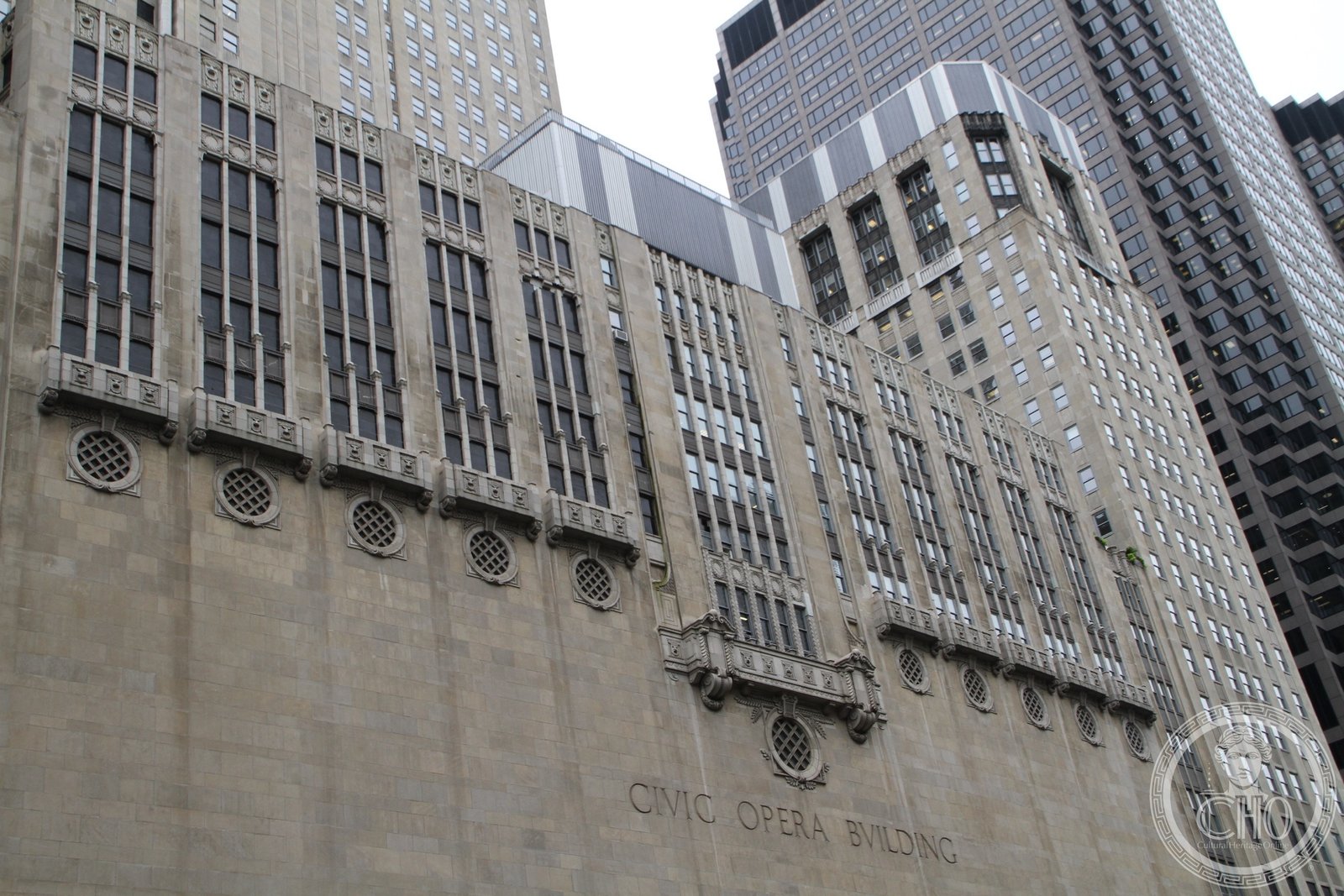

A 45-story Art Deco tower on the Chicago River’s west bank, built by utilities magnate Samuel Insull to house the second-largest opera auditorium in North America inside a commercial skyscraper — and to be read from the river as a throne.
At a glance
The Civic Opera Building at 20 North Wacker Drive stands on the west bank of the Chicago River in the Loop, its massive limestone façade facing the waterway with the deliberate grandeur of a building designed to be seen from boats and bridges. Completed in 1929 to designs by Graham, Anderson, Probst & White, it is one of the most architecturally sophisticated commercial buildings produced in the Art Deco period — a 45-story office tower organized around an 11-story opera house that seats more than 3,500 patrons, making it the second-largest dedicated opera auditorium in North America. The building was the culmination of Samuel Insull’s ambition to give Chicago an opera house worthy of the city’s cultural standing, financed by office rents from the tower above.
Key facts
- Address: 20 North Wacker Drive, Chicago, Illinois 60606.
- Completed: 1929.
- Architects: Graham, Anderson, Probst & White.
- Developer: Samuel Insull.
- Height: 45 stories, approximately 555 feet.
- Theater capacity: more than 3,500 seats (Lyric Opera of Chicago).
- Style: Art Deco.
- Status: Chicago Landmark; National Register of Historic Places.
- GPS: 41.8827°N, 87.6386°W.
History
Samuel Insull had made himself one of the most powerful men in America through the consolidation of electric utility companies in the midwest, and by the late 1920s he was the dominant figure in Chicago’s business world. His plan for a new opera house followed a model that had been tried in other cities: the costs of building and maintaining a large cultural institution would be subsidized by revenue from a commercial building wrapped around it. The opera house itself would occupy the base and lower floors; the office tower above would generate the income needed to keep it solvent.
Graham, Anderson, Probst & White — the successors to Daniel Burnham’s practice and among the most prolific commercial architects in the country — delivered a design that satisfied both programs simultaneously. The opera house faces Wacker Drive at the building’s base; its entrance lobby and auditorium occupy an interior volume defined by the tower above. The river elevation, where the full forty-five-story height is visible, was treated as a public façade of exceptional grandeur, with the tower’s setbacks and corner buttresses giving it a profile that contemporaries compared to a throne.
Insull’s financial empire collapsed during the Great Depression, and he fled to Europe to avoid prosecution for securities fraud; the building’s naming rights were eventually transferred and the venue passed through various institutional tenants. Since 1954 it has been the permanent home of the Lyric Opera of Chicago, which renamed the auditorium the Civic Opera House and has maintained it as one of North America’s most important opera venues. The broader building was designated a Chicago Landmark and listed on the National Register of Historic Places for the quality of its Art Deco design.
What you see
The river elevation is the building’s primary architectural statement. Seen from Wacker Drive bridge or from the water, the tower presents a full-width base of about 200 feet, with a setback sequence that carries the building upward to its rectilinear summit. The limestone cladding is worked with Art Deco relief panels at the lower floors: stylized Classical ornament applied with the geometric restraint typical of high commercial Deco, neither fully stripped nor fully decorative but reading as powerful authority from across the water. The corner pavilions at the building’s base anchor it to the riverbank with a formal solidity that is more civic than commercial in tone.
The opera house interior, accessible through the lobby at street level, is a separate architectural experience from the tower exterior: a horseshoe auditorium finished in warm gold and cream tones, with the kind of plasterwork and ornamental program that the theatre-design tradition of the 1920s brought to its peak. The Wacker Drive entrance lobby connects the building’s two identities — commercial office tower and grand cultural institution — in a sequence of spaces that acknowledges both without sacrificing either.
Practical information
- Opera season: Lyric Opera of Chicago, September–April; tickets at lyricopera.org.
- Office access: Building lobby open during business hours; upper floors restricted.
- Best view: From Wacker Drive bridge or Chicago Architecture Center river cruise.
- Time needed: 30 minutes exterior + river view; 3 hours for a performance evening.
Getting there
The Civic Opera Building stands at the corner of North Wacker Drive and Madison Street in the Chicago Loop, directly on the Chicago River’s west bank. By CTA, the closest L stations are Washington/Wacker (Blue Line) and Quincy (Brown, Orange, Purple, Pink lines), both within three blocks. By car, the building is accessible from the Kennedy Expressway via the Ohio Street or Randolph Street exits; parking is available in the Civic Opera Building’s own garage and in numerous nearby commercial garages. The Chicago Architecture Center at 111 East Wacker Drive, two blocks east, offers river architecture cruises that provide the best elevated view of the building’s river façade.
Nearby
- Chicago Board of Trade Building (1930) — four blocks south at Jackson and LaSalle; also Art Deco.
- Marina City (1964) — one block north, the iconic corn-cob towers by Bertrand Goldberg.
- Chicago Architecture Center — two blocks east on Wacker Drive; river architecture tours depart here.
- Carbide and Carbon Building (1929) — five blocks east on Michigan Avenue; Art Deco tower by Burnham Brothers.
Sources
- Chicago Landmarks Commission — landmark designation report, Civic Opera Building (chicago.gov/landmarks).
- National Register of Historic Places — Civic Opera Building nomination form.
- Chicago Architecture Center — building documentation and tour materials (architecture.org).
- Lyric Opera of Chicago — venue history and institutional archives (lyricopera.org).
- Chicago Tribune, coverage of building dedication, November 4, 1929 (ProQuest Historical Newspapers).
Find it on the map
See this place and what’s around it →Record researched and written by Luigi De Marchi for Cultural Heritage Online, 2026.
📷 Become a Cultural Heritage Online photographer
Share your photos of places: they stay published under your name as the author. The more they're seen, the more you get noticed — and soon a contest will reward the most appreciated photos.
Log in or sign up free to add a photoIs this page about you?
This page is read by travellers and heritage enthusiasts who find it on Google. Tell us how you are connected to this place and we will take it from there.