
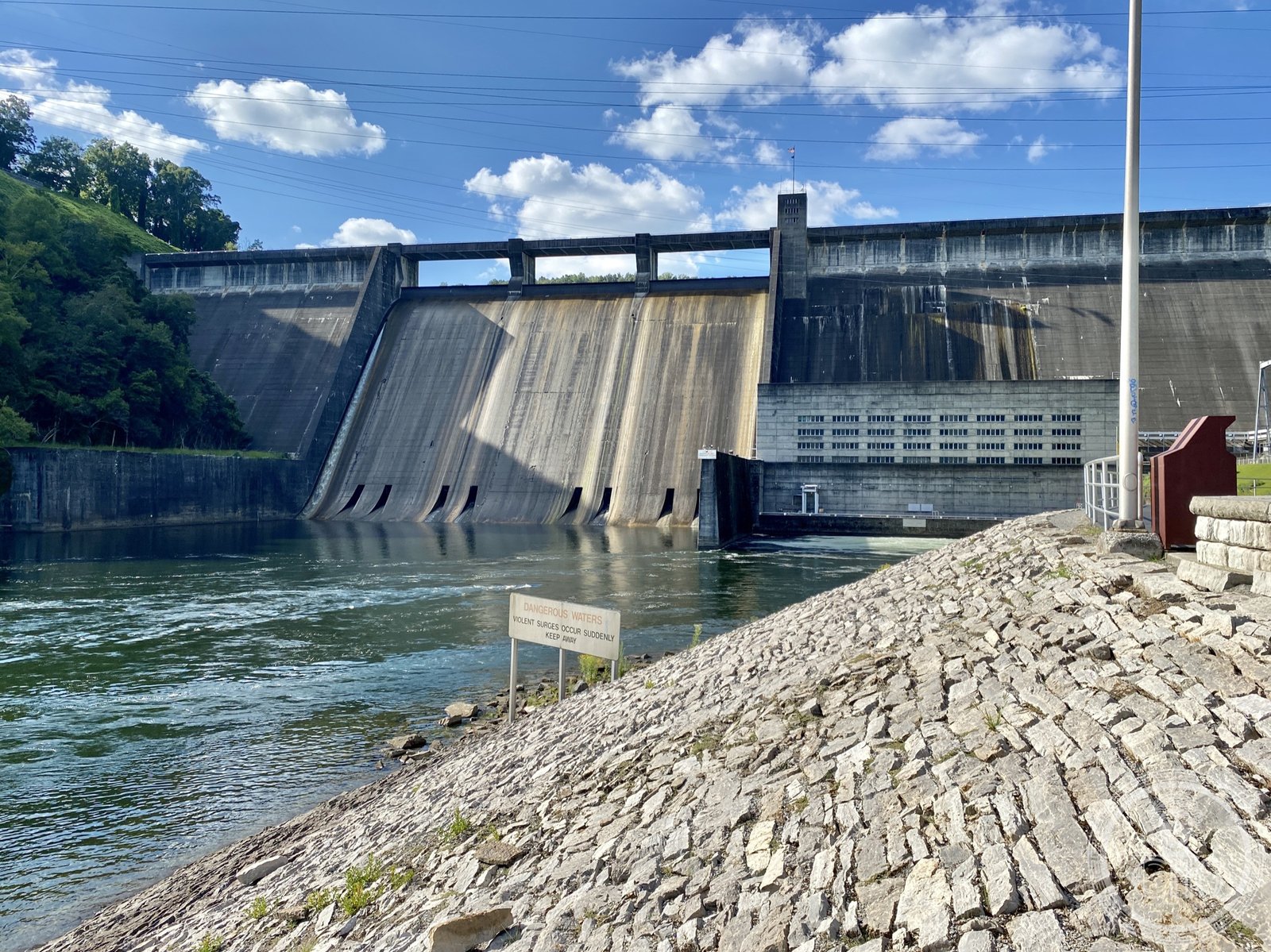

The first dam completed by the Tennessee Valley Authority — a concrete monument to New Deal planning that brought electricity to Appalachian Tennessee and gave Art Deco its most consequential expression in American hydraulic engineering.
At a glance
Norris Dam spans the Clinch River in Anderson County, Tennessee, thirty-five miles north of Knoxville. Completed in 1936, it was the first dam built to completion by the Tennessee Valley Authority, the New Deal agency created by Congress in 1933 to bring flood control, navigation, and electric power to one of the most economically depressed regions of the United States. The TVA’s design staff — working under the authority’s chief architect Roland Wank — gave the dam and its associated structures an Art Deco aesthetic that was deliberately chosen to communicate modernity, purpose, and public confidence. Norris Dam is a National Historic Landmark and the symbolic origin point of the TVA’s transformation of the Tennessee River watershed.
Key facts
- Location: Clinch River, Anderson County, Tennessee
- Completed: 1936
- Design authority: Tennessee Valley Authority, Roland Wank (chief architect)
- Type: Concrete gravity dam
- Height: 265 feet
- Style: Art Deco / Streamline Moderne
- Designation: National Historic Landmark
- GPS: 36.2228°N, 84.0831°W
History
The Tennessee Valley Authority was established in May 1933 as one of the most ambitious New Deal programs ever enacted — a federal agency with the mandate to plan and develop an entire river system, including its tributaries, for the benefit of a multi-state region that had been largely bypassed by twentieth-century industrialization. The Clinch River site in Anderson County, Tennessee, was selected as the location for the first dam because of its engineering characteristics and because the valley to be flooded was less densely settled than alternative sites.
Construction on Norris Dam began in October 1933 and was completed in March 1936. The project employed thousands of workers at the height of the Depression and created Norris, Tennessee — a planned model town built by the TVA to house workers and their families — as the first entirely planned federal community in the United States. Roland Wank, a Hungarian-born architect who had emigrated to the United States, was responsible for the architectural character of the dam and its associated structures. Wank’s decision to treat the dam as an exercise in civic Art Deco — clean concrete surfaces, geometric ornament at the control house and powerhouse, streamlined profiles — was a deliberate statement about the modernity of public works.
Norris Reservoir, created by the dam, became one of the first large recreation lakes in the Tennessee Valley, and Norris Dam State Park was established to provide public access to the shoreline. The dam’s designation as a National Historic Landmark recognizes both its engineering significance as the first TVA project and its architectural contribution as the primary example of New Deal public works aesthetics in American hydraulic infrastructure.
What you see
Norris Dam is a concrete gravity dam — a structure that holds back water by sheer mass rather than by arch action or buttress. Its upstream face is a nearly vertical plane of concrete that drops 265 feet to the river below; the downstream face is sloped, giving the dam its characteristic trapezoidal profile when seen from the reservoir. The Art Deco vocabulary enters at the powerhouse and control structures: the powerhouse at the base of the dam is a rectangular pavilion with horizontal banding, tall metal-framed windows, and the kind of stripped-down geometric ornament that distinguishes TVA design from both the purely functional engineering of earlier dams and the more florid Deco of contemporaneous commercial buildings.
The approach road and overlook areas were also designed as architectural experiences: the TVA treated visitor access to the dam as part of the public program, and the concrete parapets, observation areas, and signage all share the same streamlined language as the powerhouse. The overall effect — still largely intact — is of a landscape intervention that takes its modernity seriously, applying aesthetic intention to every surface that a visitor encounters from the parking area to the downstream face of the dam itself.
Practical information
- Access: Norris Dam State Park — open year-round; dam overlook accessible from the park road
- Norris Dam State Park: Swimming, fishing, boating, and camping on Norris Reservoir
- Museum of Appalachia: Located in nearby Norris — open year-round; documents the history of the Norris project and TVA
- Time needed: 1–3 hours for dam overlook, powerhouse exterior, and state park visit
Getting there
Norris Dam is located on State Route 61 in Anderson County, Tennessee, approximately 25 miles north of Knoxville via Interstate 75 (exit 122 to US-441 north, then State Route 61 west). The drive from Knoxville takes approximately 35 minutes. There is no commercial air service to the immediate area; the nearest major airport is McGhee Tyson Airport (TYS) in Alcoa, Tennessee, approximately 40 miles south. The planned town of Norris, built by the TVA in 1933–1934, is located about two miles from the dam and retains much of its original character.
Nearby
- Museum of Appalachia — Norris, TN; documenting Appalachian material culture and TVA history
- Norris, Tennessee (1933) — the TVA’s planned model town, still recognizable in its original layout
- Oak Ridge National Laboratory — 20 miles south, established 1943 as part of the Manhattan Project
- Fort Loudoun Dam — 60 miles southeast; another TVA landmark on the Little Tennessee River
Sources
- National Historic Landmark nomination form, Norris Dam (National Park Service)
- Tennessee Valley Authority — official history and architectural records (tva.com)
- David Nye, Electrifying America: Social Meanings of a New Technology — TVA’s role in rural electrification
- Tennessee State Library and Archives — Anderson County survey records and TVA construction photographs
- Roland Wank Papers, Avery Architectural and Fine Arts Library, Columbia University
Find it on the map
See this place and what’s around it →Record researched and written by Luigi De Marchi for Cultural Heritage Online, 2026.
📷 Become a Cultural Heritage Online photographer
Share your photos of places: they stay published under your name as the author. The more they're seen, the more you get noticed — and soon a contest will reward the most appreciated photos.
Log in or sign up free to add a photo