

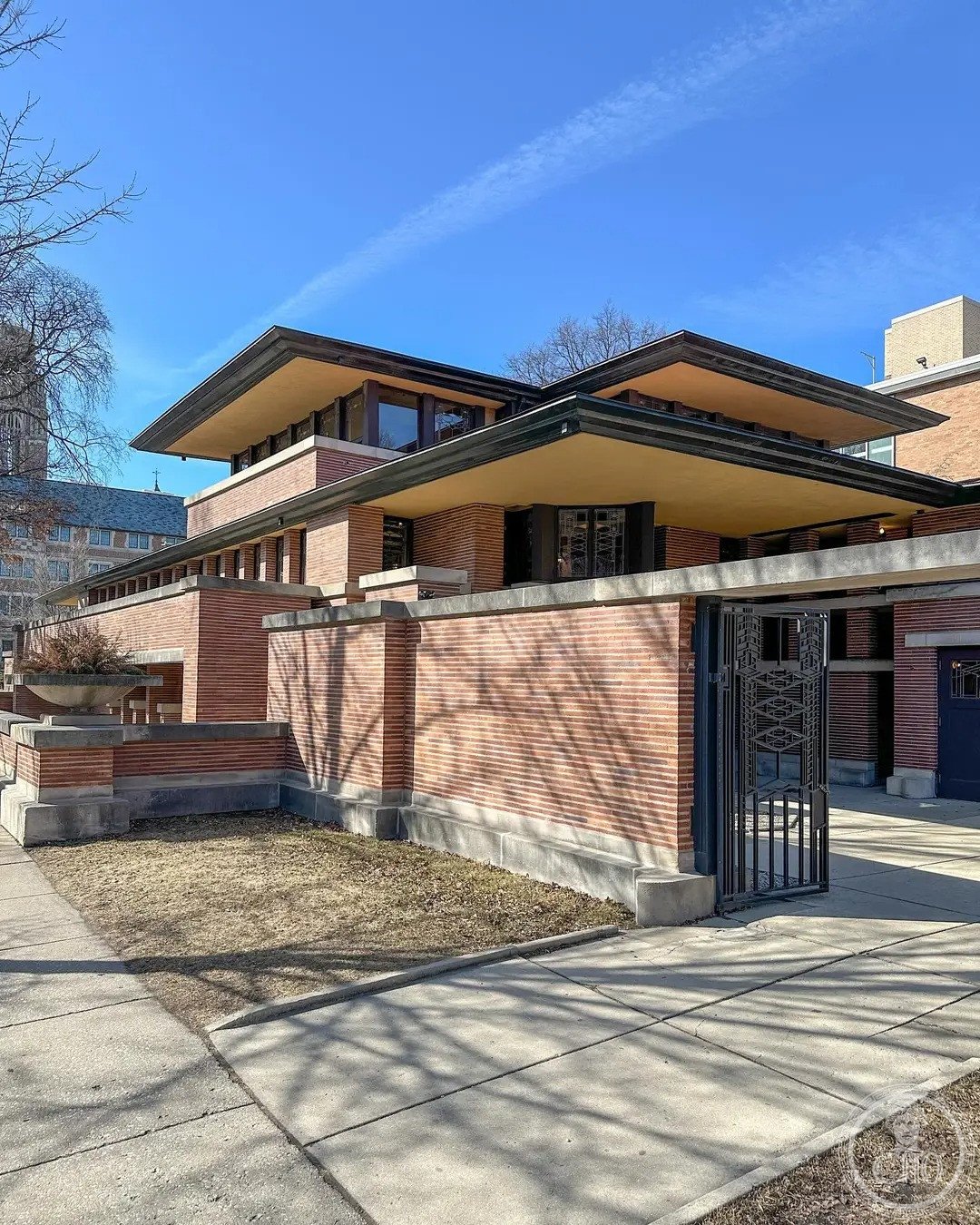
Chicago did not merely host the modern movement — it generated it. From Louis Sullivan’s skyscraper ornament to Frank Lloyd Wright’s Prairie Houses and Mies van der Rohe’s steel-and-glass minimalism, the city compressed a century of architectural innovation into its grid.
At a glance
No city in the world displays a more continuous sequence of architectural invention than Chicago. After the Great Fire of 1871, the city rebuilt at speed and scale, inventing the steel-frame skyscraper in the process. Louis Sullivan (1856–1924) gave that skyscraper its ornamental language — sinuous terracotta in the Art Nouveau spirit — and his assistant Frank Lloyd Wright then broke architecture out of the box entirely with the Prairie Style. Thirty years later, Mies van der Rohe arrived from Europe and spent the rest of his career in Chicago, reducing architecture to its most essential geometry. Their work survives in extraordinary density across the city and its suburbs.
Key facts
- Country: United States of America (Illinois)
- Key period: 1890–1969 (Prairie Style / Chicago School / Miesian Modernism)
- Key figures: Frank Lloyd Wright (1867–1959), Ludwig Mies van der Rohe (1886–1969), Louis Sullivan (1856–1924)
- Essential sites: Robie House (Hyde Park), Frank Lloyd Wright Home & Studio (Oak Park), IIT Crown Hall (Mies), Chicago Architecture Center, Sullivan Center (Loop)
- UNESCO heritage: Wright buildings in the USA are part of the “Twentieth Century Architecture of Frank Lloyd Wright” UNESCO World Heritage site (2019)
- Annual anniversaries: Wright born 8 June; Wright died 9 April; Mies born 27 March; Mies died 17 August
History
Frank Lloyd Wright was born on 8 June 1867 in Richland Center, Wisconsin. After brief studies at the University of Wisconsin, he moved to Chicago in 1887 and joined the office of Adler & Sullivan. Sullivan’s ornamental system — an intricate botanical weaving applied to structural surfaces — shaped Wright’s early sensibility, though the two fell out in 1893 when Wright began taking independent commissions. The clearest surviving trace of those years is the Charnley-Persky House (1891–1892) on Astor Street, designed in the Adler & Sullivan office with Wright in the drafting room and today the headquarters of the Society of Architectural Historians. Wright established his own studio in Oak Park (west of Chicago) and over the following decade developed the Prairie Style: low-slung horizontal volumes, cantilevered roofs, continuous bands of windows, open floor plans and a complete rejection of the box room.
The Robie House in Hyde Park (1908–1910) is the mature statement of the Prairie philosophy: its south facade extends 27 metres on three levels, the cantilevered eaves reaching 2 metres beyond the last support. It was designated a National Historic Landmark in 1963 and is now owned by the University of Chicago, which administers guided tours.
Ludwig Mies van der Rohe arrived in Chicago in 1938 to direct the Illinois Institute of Technology’s architecture school. His campus plan for IIT (1941–1958) and the Crown Hall (1956) represent the Miesian programme at maximum clarity: steel exposed, brick walls flush with the frame, glass filling every remaining plane. His Farnsworth House in Plano (1951), 90 minutes south of Chicago, takes the principle to its logical extreme — a glass box suspended on eight steel columns above the floodplain of the Fox River.
What you see
The Chicago Architecture Center (111 E. Wacker Drive) is the best starting point: its ground-floor exhibition traces the city’s full architectural history, and it operates the most comprehensive boat and bus tour programme covering over 50 buildings. The Loop — Chicago’s central business district — contains Sullivan’s Carson Pirie Scott store (now Sullivan Center, 1 S. State Street) with its famous cast-iron ornamental entrance panels, and the Chicago Cultural Center (78 E. Washington), a Beaux-Arts palazzo with Tiffany-glass domes.
In Oak Park (30 min by CTA Green Line), the Frank Lloyd Wright Home and Studio (951 Chicago Avenue) offers immersive guided tours; the surrounding streets contain 25 Wright houses, the highest concentration in the world. IIT’s Crown Hall (3360 S. State Street) is open when the school is in session and can be viewed from outside at any time — the steel I-beams of the facade are painted dark grey, and the interior is one long uninterrupted space beneath a coffered ceiling.
Practical information
- Robie House: Thu–Mon, guided tours; book at flwright.org
- Wright Home & Studio (Oak Park): daily tours; CTA Green Line to Harlem/Lake
- Chicago Architecture Center: open daily; boat tours run April–November
- Chicago CityPASS: covers Art Institute and several other museums
- Time needed: full day in the Loop + South Side; overnight recommended for Oak Park day trip
Getting there
O’Hare International Airport (ORD) is served by the CTA Blue Line direct to the Loop (45 min, $2.50). Midway Airport (MDW) connects via the Orange Line (30 min). Chicago Union Station serves Amtrak routes from New York (18h), Washington DC (18h) and New Orleans (19h). The Architecture Center and Robie House are both accessible by CTA without a car.
Related in CHO
- Birth anniversary: Frank Lloyd Wright — 8 June 1867
- Death anniversary: Frank Lloyd Wright — 9 April 1959
- Birth anniversary: Ludwig Mies van der Rohe — 27 March 1886
- Death anniversary: Ludwig Mies van der Rohe — 17 August 1969
Sources
Find it on the map
See this place and what’s around it →Events here — now on & upcoming
- Birth Anniversary: Frank Lloyd Wright — June 8, 186708 Jun 2027See the event →
- Death Anniversary: Frank Lloyd Wright — April 9, 195909 Apr 2027See the event →
- Birth Anniversary: Ludwig Mies van der Rohe — March 27, 188627 Mar 2027See the event →
- Death Anniversary: Ludwig Mies van der Rohe — August 17, 196917 Aug 2027See the event →
- Birth Anniversary: Louis Sullivan — September 3, 185603 Sep 2027See the event →
- Death Anniversary: Louis Sullivan — April 14, 192414 Apr 2027See the event →
📷 Become a Cultural Heritage Online photographer
Share your photos of places: they stay published under your name as the author. The more they're seen, the more you get noticed — and soon a contest will reward the most appreciated photos.
Log in or sign up free to add a photo