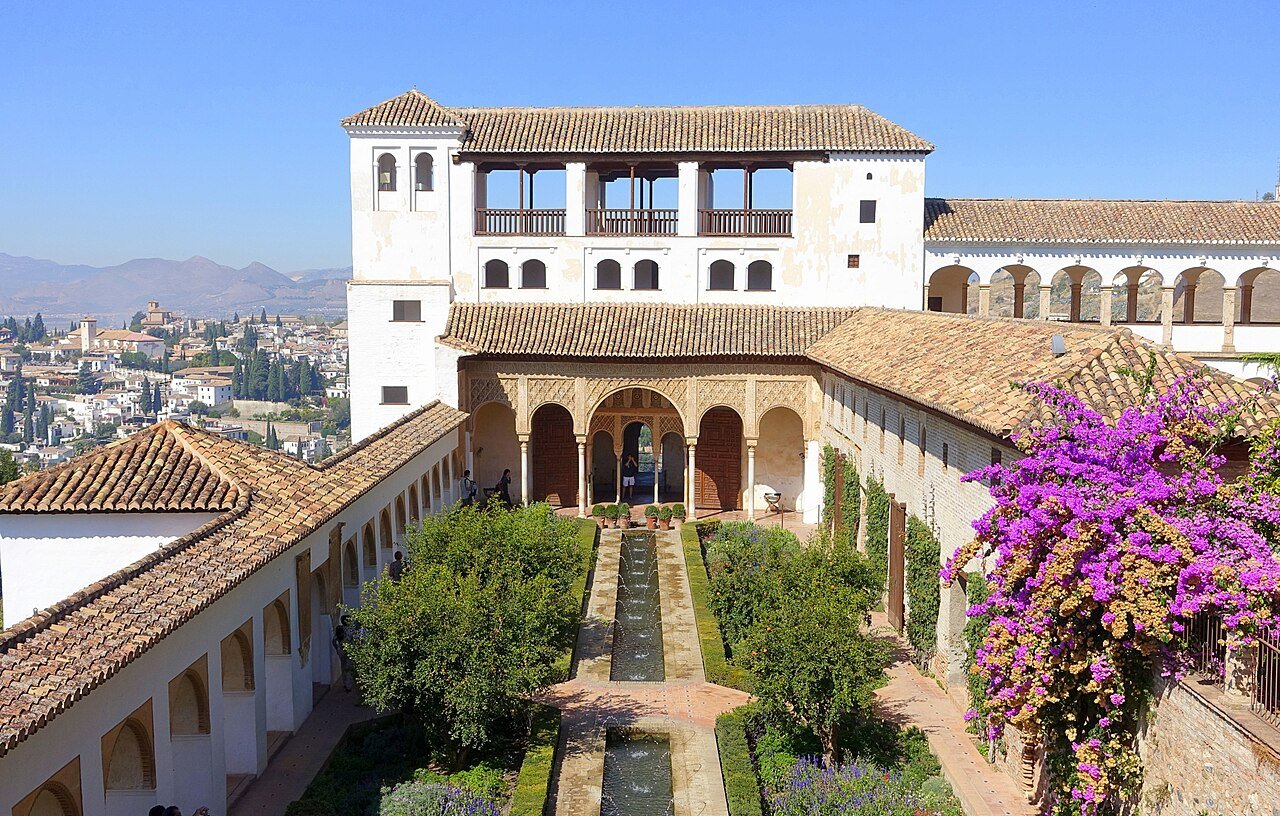
Spain has 50 UNESCO World Heritage Sites, a collection that ranges from Moorish palaces and Romanesque cathedrals to volcanic Canary Island landscapes, prehistoric cave paintings, and a 19th-century iron transporter bridge — a record that reflects more than three millennia of layered civilisations on one peninsula. From Cultural Heritage Online.
Why Spain’s list looks the way it does
Few countries in Europe carry as many distinct cultural layers as Spain. Phoenician traders, Romans, Visigoths, Umayyad rulers, and medieval Christian kingdoms each left built evidence across the same territory, which partly explains why Spain’s inscriptions skew so heavily cultural — 44 of its 50 sites carry that designation. The weight of that history means the list ranges from the engineering of Roman hydraulic mining at Las Médulas to the organic Modernisme of Antoni Gaudí in Barcelona, with medieval pilgrimage routes, Renaissance monasteries, and prehistoric megalithic complexes in between.
Spain submitted its first nominations in 1984, the same year UNESCO’s list was barely four years old, and it has added sites steadily since. By 2024 it ranks fifth globally by number of inscriptions, behind Italy, China, Germany, and France. Two sites are classified as mixed (cultural and natural), and four as purely natural, including landscapes in the Canary Islands that belong geographically to Africa while remaining administratively European.
The first inscriptions
When Spain joined the World Heritage Convention in 1984, UNESCO inscribed five sites simultaneously — an opening statement that immediately set the country among the convention’s most significant participants:
- Cathedral of Our Lady of the Assumption, Córdoba
- Alhambra and Generalife, Granada
- Burgos Cathedral
- Monastery and Site of the Escorial, Madrid
- Park Güell, Palau Güell, and Casa Milà, Barcelona
The selection was deliberate in its breadth. It paired the peak of Andalusian Islamic architecture (the Alhambra) with Gothic power (Burgos Cathedral), placed a counter-Reformation royal monastery alongside a revolutionary Modernista complex, and anchored everything with the Great Mosque of Córdoba — a building that had functioned successively as a Roman temple precinct, a Visigothic church, one of the world’s great mosques, and a cathedral. Rarely has a country’s first UNESCO list told such a compressed story of a civilisation.
The most visited — and the alternatives
The Alhambra in Granada, Gaudí’s Barcelona portfolio, the Escorial, and the pilgrimage city of Santiago de Compostela (inscribed 1985) draw the bulk of Spain’s heritage tourism. All four appear on most visitors’ itineraries and, at peak season, all four can feel crowded to the point of obscuring what makes them remarkable. Spain’s list, however, runs to 50 entries, and the depth of what lies beyond the headline sites is considerable.
The Archaeological Site of Atapuerca (Burgos province, inscribed 2000) holds the world’s largest collection of hominid fossils dating back roughly one million years — a site that fundamentally reshaped the understanding of early human migration into Europe. The Vizcaya Bridge near Bilbao (2006) is the world’s oldest surviving transporter bridge, completed in 1893, and still carries passengers across the Nervión estuary in suspended gondolas. The Palmeral of Elche (2000) preserves an Arab-designed irrigation system that turned a semi-arid coastal plain into one of Europe’s largest date-palm groves. And the San Millán Yuso and Suso Monasteries in La Rioja (1997) house the Glosas Emilianenses, glosses in early Romance and Basque that represent the oldest written examples of the Spanish language.
Natural and shared sites
Spain’s four natural and mixed inscriptions concentrate in the south and in the Atlantic archipelagos. Doñana National Park (Andalusia, 1994) protects one of Europe’s most critical wetland habitats for migratory birds along the Atlantic flyway. Garajonay National Park on La Gomera (1986) shelters a laurisilva cloud forest — a relic ecosystem of subtropical laurel woodland that covered much of southern Europe before the ice ages. On Tenerife, Teide National Park (2007) centres on Spain’s highest peak, a stratovolcano whose protected landscape is one of the most visited national parks on earth. Pirineos – Monte Perdido, shared with France and inscribed in 1997, is a mixed site: a geological showpiece of karstic canyons and glacial cirques that also preserves a traditional transhumant livestock culture still practised by communities on both sides of the border.
Several inscriptions place Spain within larger transnational frameworks. The Prehistoric Rock-Art Sites in Côa Valley and Siega Verde (2010) links Spanish open-air Palaeolithic engravings with a Portuguese riverside site across a shared river corridor. The Heritage of Mercury: Almadén and Idrija (2012) pairs Spain’s Almadén — which supplied roughly a third of the world’s mercury for three centuries — with a Slovenian mining town, telling a global story of industrial extraction. Spain also participates in the Ancient and Primeval Beech Forests inscription alongside seventeen other European nations, a serial property recognising the ecological significance of old-growth beech woodland across the continent.
How to find them
Spain’s World Heritage sites sit alongside thousands of other places on CHO’s interactive map, with GPS and sourced editorial history for each. See also our guides to Italy’s and France’s UNESCO sites, and our piece on cultural travel beyond mass tourism.
Frequently Asked Questions
How many UNESCO World Heritage Sites does Spain have?
As of 2024, Spain has 50 UNESCO World Heritage Sites, placing it fifth in the world by total number of inscriptions. The list comprises 44 cultural sites, 4 natural sites, and 2 mixed sites — one of the most diverse national rosters in the convention.
What was Spain’s first UNESCO World Heritage Site?
Spain received five simultaneous first inscriptions in 1984: the Cathedral of Córdoba, the Alhambra and Generalife in Granada, Burgos Cathedral, the Monastery and Site of the Escorial, and the Gaudí complex in Barcelona. All five were inscribed together when Spain joined the World Heritage Convention that year.
What is the most recently inscribed UNESCO site in Spain?
The Prehistoric Sites of Talayotic Menorca, inscribed in 2023, is Spain’s most recent World Heritage listing. The site encompasses megalithic structures across the Balearic island of Menorca, including the well-preserved Naveta des Tudons burial monument dating to the Bronze Age.
Does Spain share any UNESCO World Heritage Sites with other countries?
Yes. Spain participates in several transnational inscriptions, including Pirineos – Monte Perdido (shared with France), the Prehistoric Rock-Art Sites in Côa Valley and Siega Verde (shared with Portugal), the Heritage of Mercury: Almadén and Idrija (shared with Slovenia), and the Ancient and Primeval Beech Forests (shared with seventeen other European countries).
Sources used in this article
- UNESCO — State Party Spain — World Heritage list.
- UNESCO — Spain: World Heritage Sites.
- CHO magazine — What is a World Heritage Site?
- CHO — Interactive map of heritage sites.
Sources
- S1 — Carr, Raymond, ed. Spain: A History. Oxford University Press, 2000. ISBN 978-0-19-820612-5.
- S2 — Fletcher, Richard. Moorish Spain. University of California Press, 1993. ISBN 978-0-520-08496-4.
Spotted an error? Write to editorial@culturalheritageonline.com and we correct it the same day.