
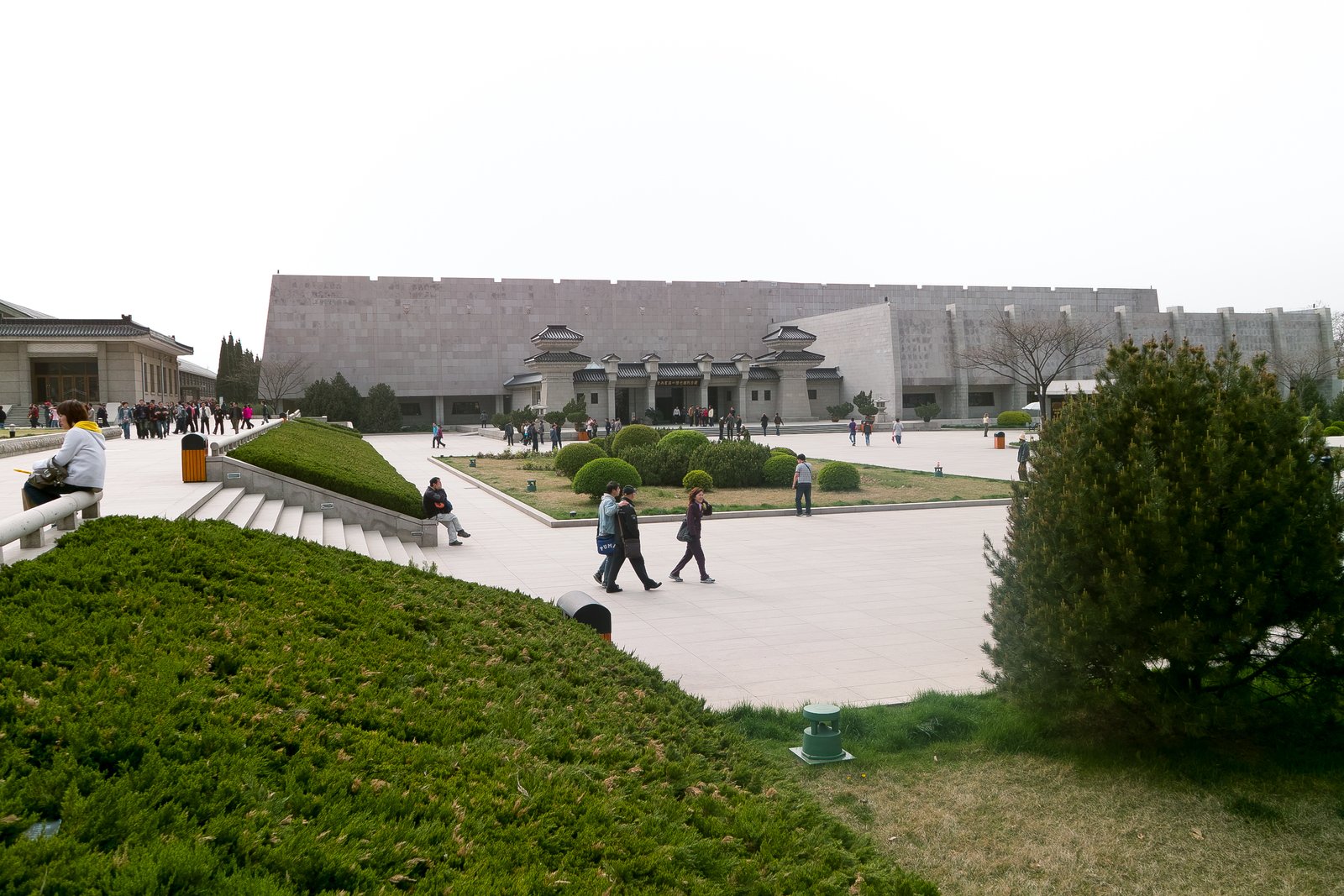
Xi’an served as the imperial capital of China under more than a dozen dynasties, and the ground beneath Shaanxi Province still holds an extraordinary concentration of monumental heritage. Three UNESCO inscriptions connect this city to the ancient world: a buried army sealed for two millennia, a Tang-dynasty pagoda that anchors the Silk Roads nomination, and a cliff-face of ten thousand carved Buddhas reached by high-speed rail. From Cultural Heritage Online.
Mausoleum of the First Qin Emperor & Terracotta Warriors 1 hr from city centre
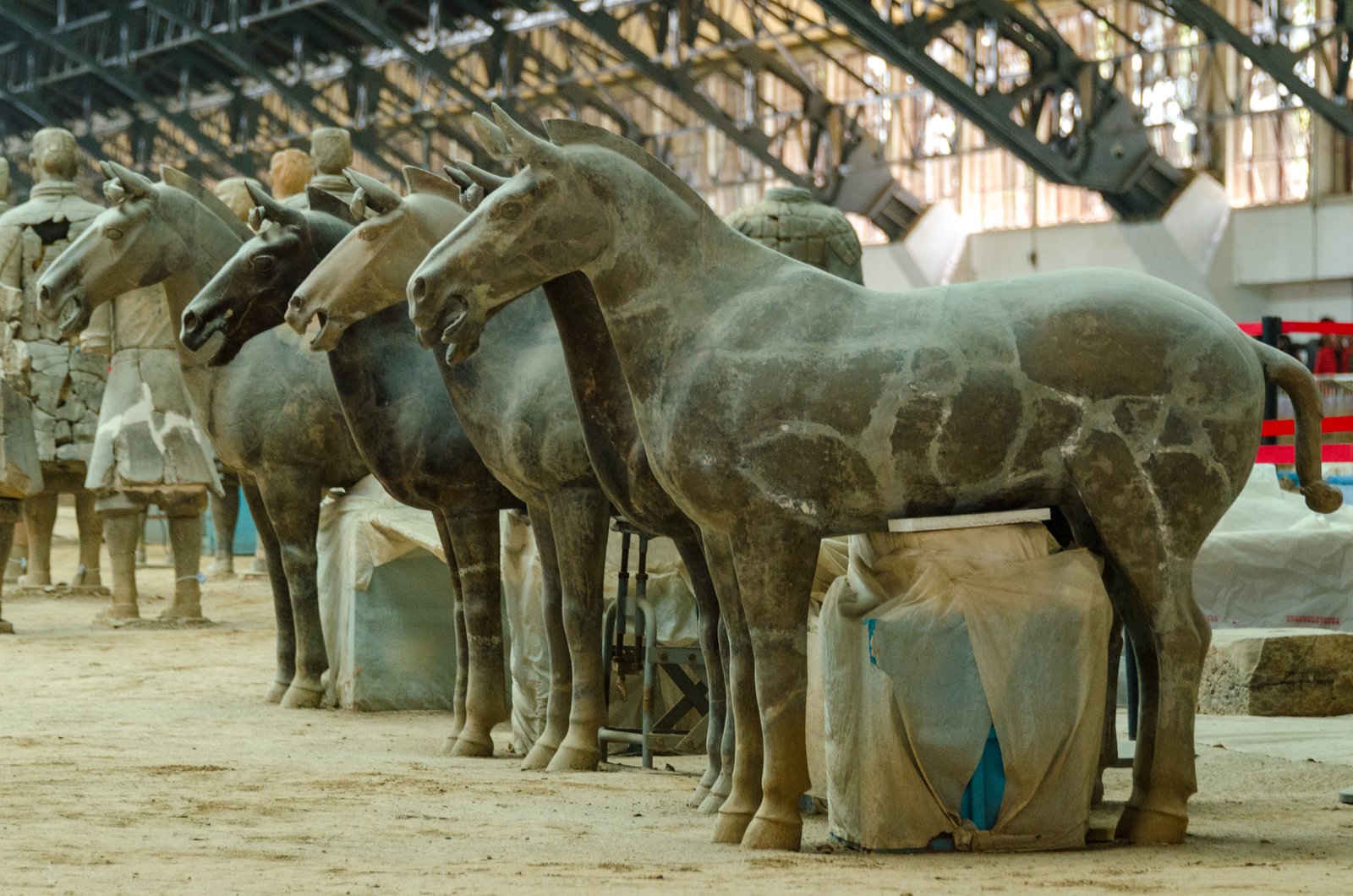
Construction began in 246 BCE the moment Emperor Qin Shi Huang — who would go on to unify China in 221 BCE — ascended the throne at age thirteen. The mausoleum took roughly 38 years and a reported 700,000 workers to build, according to the historian Sima Qian. The complex is vast: the outer city wall stretches 6.3 kilometres in circumference, while the central burial mound rises 76 metres above the surrounding plain. The tomb chamber at its heart remains sealed and unexcavated. What visitors see today — the Terracotta Army, discovered only in 1974 by local farmers digging a well — occupies a zone roughly 1.5 kilometres east of the mound. Approximately 7,000 life-size terracotta warriors, cavalry horses, and wooden chariots were arranged in precise military formation to guard the emperor in the afterlife. Each warrior’s face is individually modelled. Standing at the edge of Pit 1, the scale of the trench — 230 metres long, 62 metres wide — is felt as much as seen. UNESCO inscribed the site in 1987.
Getting there: Bus 306 departs Xi’an Railway Station (east plaza) every 20 minutes; journey approximately 1 hour. Last return bus 18:00. Allow: 3–4 hours. Best for: Ancient military history, imperial archaeology, and anyone wanting to understand the scale of early Chinese statecraft.
Silk Roads: Big Wild Goose Pagoda City centre — Metro line 3
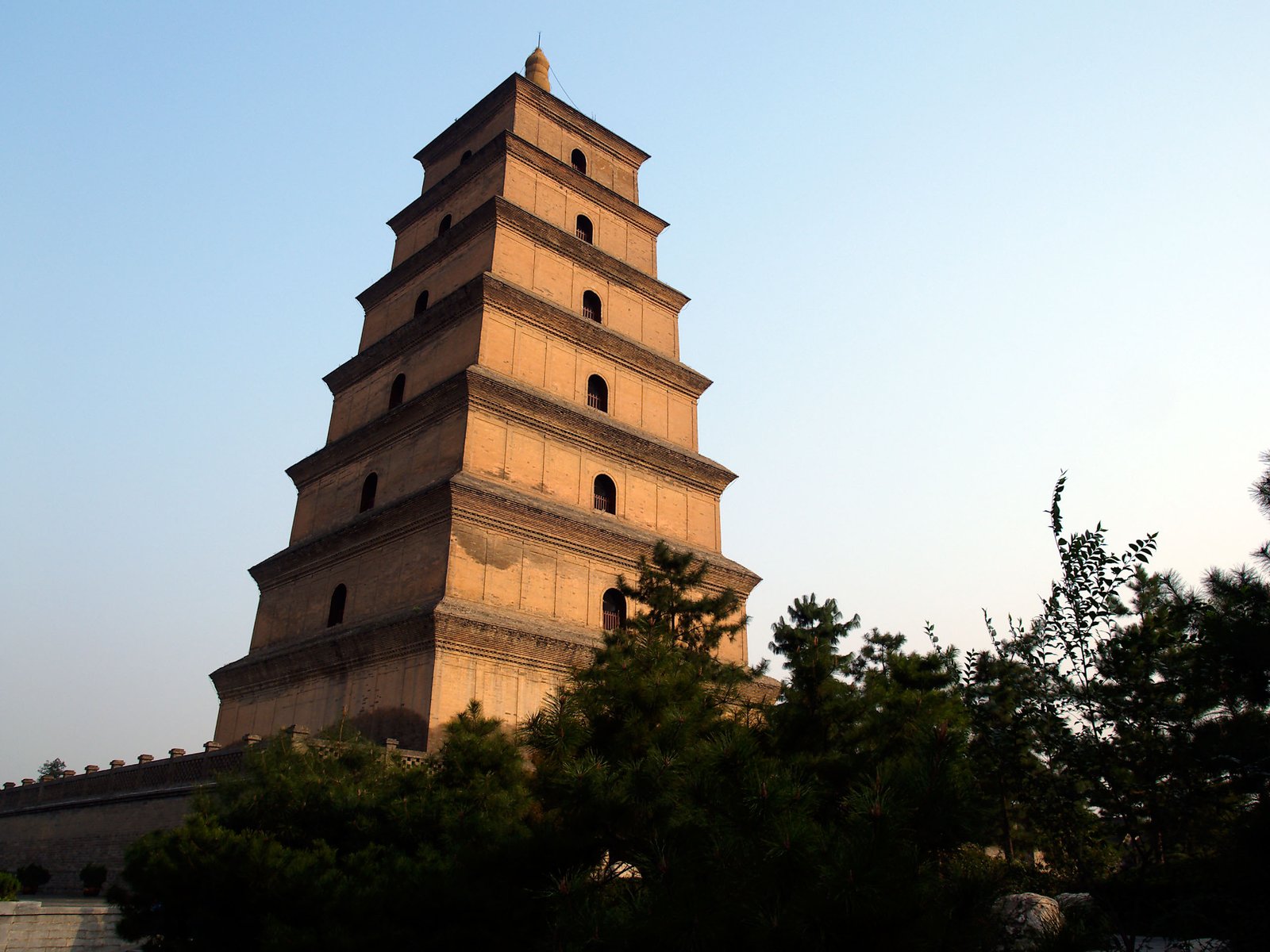
The monk Xuanzang returned to Tang-dynasty Chang’an in 645 CE after seventeen years travelling through Central Asia and India, carrying 657 Buddhist scriptures he had collected along the route. To house them — and the Buddha figurines he brought back — a five-storey brick pagoda was raised in 652 CE on the orders of Emperor Gaozong of Tang. Empress Wu Zetian ordered it enlarged to ten storeys in 704 CE. Earthquake damage reduced it over the centuries; the seven-storey structure standing today, 64.1 metres tall, is the result of repairs carried out under the Ming dynasty (1368–1644), who clad the exterior in the dark grey brick still visible now. Inside, 248 steps climb past stone doorways carved with Heavenly Kings and delicate celestial figures. In 2014, the pagoda became part of the UNESCO Silk Roads inscription — formally titled the “Silk Roads: the Routes Network of Chang’an-Tianshan Corridor” — recognising Xi’an’s position as the eastern anchor of the overland trade and pilgrimage network that stretched to the Mediterranean.
Getting there: Metro Line 3 to Xiaozhaixi station, then a short walk north through the Tang Paradise park zone. Allow: 1–2 hours including the surrounding Da Ci’en Temple complex. Best for: Silk Roads history, Tang-dynasty Buddhist art, and skyline views from the upper terrace.
Longmen Grottoes 2 hrs by high-speed rail
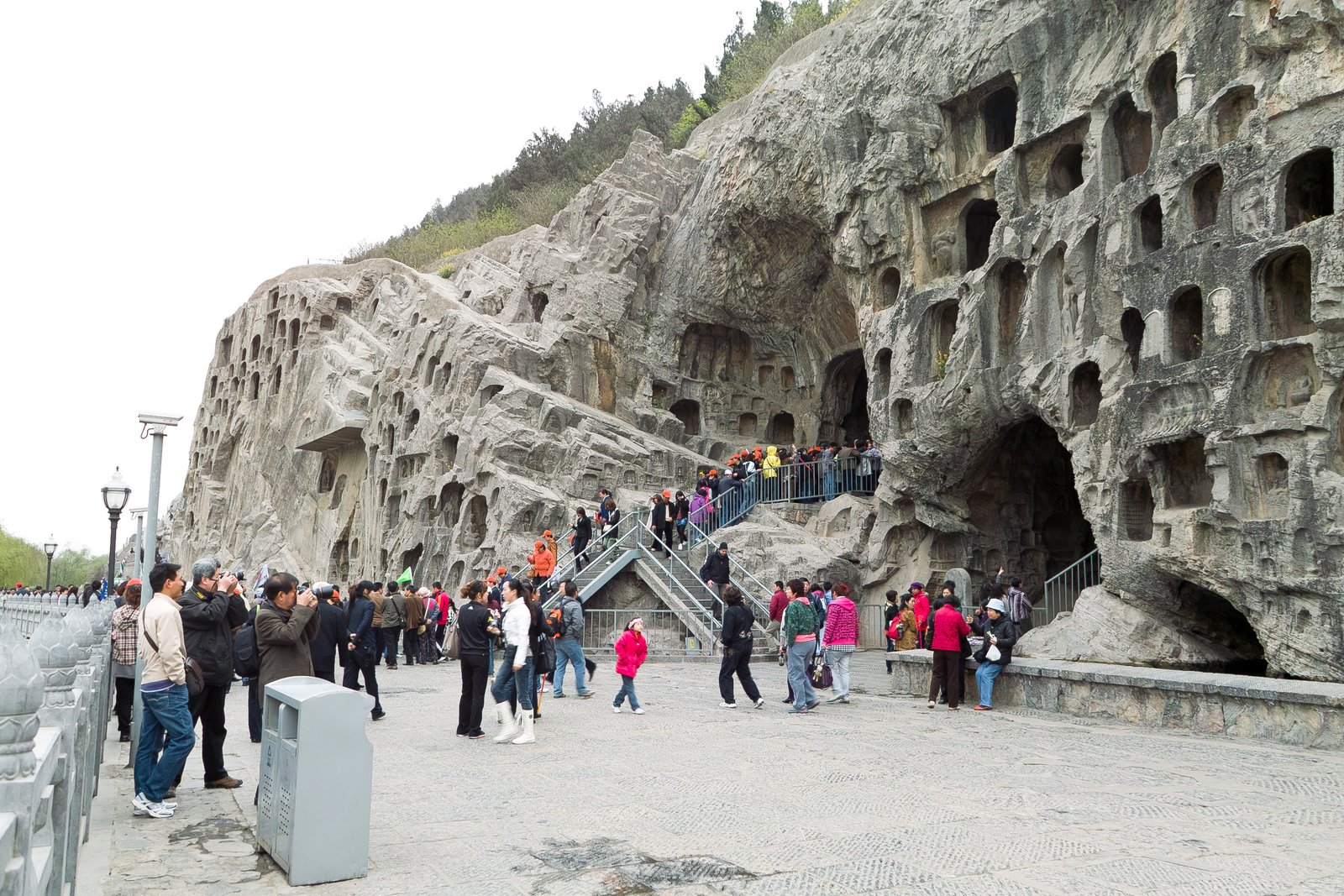
In 493 CE, Emperor Xiaowen of the Northern Wei dynasty moved his capital south toward Luoyang and ordered work to begin on a new series of Buddhist cave-temples in the limestone cliffs flanking the Yi River. What followed was nearly seven centuries of carving, interrupted by dynastic changes and resumed each time a new ruling house sought to demonstrate piety through patronage. The result is one of the greatest concentrations of Buddhist stone sculpture anywhere in the world: approximately 2,345 caves containing around 100,000 individual figures, carved across 1 kilometre of cliff face on both banks. The most celebrated is the Fengxian Cave, commissioned by Empress Wu Zetian and completed between 672 and 676 CE. Its central Vairocana Buddha stands 17.14 metres high, the ears alone measuring 2 metres. Up close, the surface of the limestone — worn smooth by centuries of weather and touch — catches the afternoon light differently from every angle. About 60% of the surviving carvings date to the Tang dynasty; 30% to the earlier Northern Wei period. UNESCO inscribed the site in 2000.
Getting there: CRH high-speed rail from Xi’an North station to Luoyang Longmen station; journey approximately 2 hours. The grottoes entrance is a 5-minute taxi ride from the station. Allow: 2–3 hours. Best for: Buddhist sculpture at monumental scale, Northern Wei and Tang imperial history, and photography along the river-facing cliff walk.
Frequently Asked Questions
How many UNESCO World Heritage Sites are there near Xi’an?
Xi’an and its wider region contain three UNESCO inscriptions covered in this guide: the Mausoleum of the First Qin Emperor (inscribed 1987), the Big Wild Goose Pagoda as part of the Silk Roads corridor inscription (2014), and the Longmen Grottoes near Luoyang (2000). The Longmen site requires a separate day trip by high-speed rail, approximately 360 kilometres east of Xi’an.
Which UNESCO site is closest to Xi’an city centre?
The Big Wild Goose Pagoda is the closest, sitting within Xi’an’s urban area and reachable by Metro Line 3. The Terracotta Army site is 30 kilometres east of the city, about one hour by Bus 306. Longmen Grottoes are the furthest, requiring a 2-hour high-speed rail journey to Luoyang.
Do visitors need a visa to travel to Xi’an, and what is the best season to visit?
Most international travellers require a Chinese tourist visa, though China has expanded its unilateral visa-free policies for a growing number of countries — check the current list with the Chinese embassy in your country before travelling. The best seasons are spring (April to May) and autumn (September to October), when temperatures in Shaanxi are mild and the sites are not at peak summer capacity. Summer can be hot and crowded; winter is cold but viable for the indoor Terracotta Army museum.
Is there a transport card or pass that simplifies getting around Xi’an and to these sites?
Xi’an’s Metro accepts both local transit cards and mobile payment apps (Alipay and WeChat Pay). A local transit card (交通一卡通) can be purchased and topped up at Metro stations and covers bus routes including Bus 306 to the Terracotta Army. For the Longmen Grottoes, high-speed rail tickets can be purchased at Xi’an North station or via the official 12306 app, which accepts foreign credit cards with a registration step.
Sources
- S1 — Portal, Jane. The First Emperor: China's Terracotta Army. Harvard University Press, 2007. ISBN 978-0-674-02697-1.
- S2 — Hansen, Valerie. The Silk Road: A New History. Oxford University Press, 2012. ISBN 978-0-19-515931-8.
Spotted an error? Write to editorial@culturalheritageonline.com and we correct it the same day.


.jpg)


.jpg)