India has 44 UNESCO World Heritage Sites — a list that spans the carved stone temples of the medieval Deccan, Mughal garden cities, Himalayan wildlife corridors, Bronze Age urban ruins, and a shared slice of Le Corbusier’s modernist legacy. Few countries compress so many layers of civilisation, geology, and ecology into a single UNESCO portfolio. From Cultural Heritage Online.
Why India’s list looks the way it does
India’s 44 inscriptions — 36 cultural, 7 natural, and 1 mixed — reflect a subcontinent that hosted several of the ancient world’s most sophisticated civilisations while remaining a crossroads for Buddhism, Hinduism, Islam, and colonial-era modernity. The cultural entries dominate because the built record is unusually dense: cave monasteries, temple complexes, Mughal fortresses, and British-engineered railways all competed for inscription across four decades of nominations.
The natural sites cluster in the northeast and along the Western Ghats biodiversity hotspot, where the pressure to protect endemic species long predates UNESCO’s involvement. The single mixed site — Khangchendzonga National Park, inscribed in 2016 — acknowledges that Sikkim’s sacred peaks sit at the intersection of ecological rarity and living spiritual belief, a combination the criteria for mixed inscription were designed to capture.
The first inscriptions
India’s engagement with the World Heritage programme began emphatically. At the 1983 session of the World Heritage Committee, four sites were inscribed simultaneously — a signal that the country intended to nominate the full breadth of its patrimony from the start:
- Ajanta Caves — Buddhist rock-cut monasteries decorated with paintings dating from the 2nd century BCE
- Ellora Caves — a multi-faith complex of 34 monasteries and temples cut from a single basalt escarpment
- Agra Fort — the red-sandstone Mughal imperial citadel on the Yamuna
- Taj Mahal — the 17th-century marble mausoleum that became India’s most recognised landmark
The choice was deliberate: two ancient sacred sites and two Mughal-era monuments, together staking a claim across religious traditions and historical periods. The pairing of Ellora and Ajanta — which pre-date the Mughal inscriptions by more than a millennium — immediately established that India’s heritage list would not be centred on the Islamic architectural tradition alone.
The most visited — and the alternatives
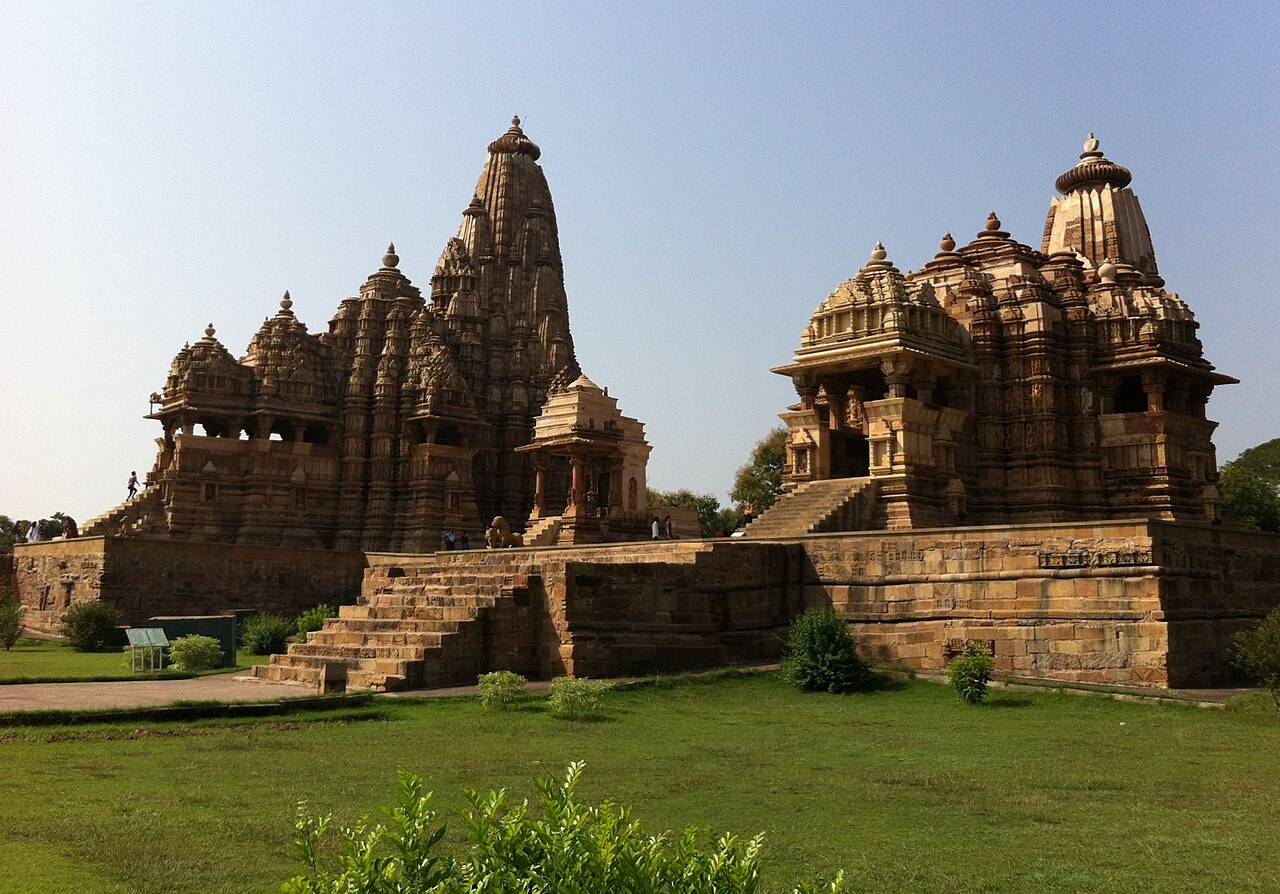
The Taj Mahal, the Red Fort in Delhi, Qutb Minar, and the Sun Temple at Konark draw the largest international visitor numbers and require little introduction. Slightly further down the awareness curve, the Khajuraho Group of Monuments — a cluster of medieval Hindu and Jain temples in Madhya Pradesh, celebrated for their intricate figurative sculpture — remains one of the most photographed but also most misunderstood inscriptions on the list.
Several inscriptions repay the detour precisely because they see fewer visitors. Dholavira, inscribed in 2021, is one of the largest and best-preserved cities of the Harappan Bronze Age, with sophisticated water management infrastructure laid bare on the arid Rann of Kutch. Ramappa Temple, also inscribed in 2021, is a 13th-century Kakatiya-dynasty shrine in Telangana whose granite and dolerite carvings document regional dance traditions with unusual specificity. And Moidams — the tumuli burial mounds of Ahom royalty in Assam, added in 2024 — represent a funerary tradition that survived intact for six centuries in the upper Brahmaputra valley.
Natural and shared sites
India’s seven natural sites trace the country’s major biodiversity zones. Kaziranga and Manas in Assam protect one-horned rhinoceros and Bengal tiger habitat in the northeastern floodplains. Keoladeo National Park in Rajasthan is a critical wintering ground for migratory waterbirds. The Sundarbans — shared with Bangladesh as separate nominations — cover the world’s largest contiguous mangrove forest. Nanda Devi and Valley of Flowers protect high-altitude Himalayan ecosystems, while the Great Himalayan National Park adds an additional corridor for western Himalayan wildlife. The Western Ghats inscription, covering a fragmented chain of biodiversity-rich forest across six states, is among the largest natural listings in Asia.
India also participates in two transnational serial inscriptions. The Architectural Work of Le Corbusier, inscribed in 2016 across seven countries, includes the Chandigarh Capitol Complex — the administrative heart of Punjab and Haryana, designed when India was less than a decade old and still defining what post-independence modernity might look like. The Mountain Railways of India, inscribed in stages between 1999 and 2008, groups three colonial-era narrow-gauge lines: the Darjeeling Himalayan Railway in West Bengal, the Nilgiri Mountain Railway in Tamil Nadu, and the Kalka–Shimla Railway in Himachal Pradesh.
How to find them
India’s World Heritage sites sit alongside thousands of other places on CHO’s interactive map, with GPS and sourced editorial history for each. See also our guides to Italy’s and France’s UNESCO sites, and our piece on cultural travel beyond mass tourism.
Frequently Asked Questions
How many UNESCO World Heritage Sites does India have?
India has 44 UNESCO World Heritage Sites, comprising 36 cultural, 7 natural, and 1 mixed site. The mixed designation belongs to Khangchendzonga National Park in Sikkim, which holds both outstanding ecological and sacred cultural significance.
What was India’s first UNESCO World Heritage Site?
India had four sites inscribed simultaneously in 1983 — the Ajanta Caves, the Ellora Caves, Agra Fort, and the Taj Mahal — making it impossible to name a single “first.” All four were accepted at the same session of the World Heritage Committee.
What is India’s most recently inscribed UNESCO World Heritage Site?
The Maratha Military Landscapes of India, a serial inscription encompassing twelve forts in Maharashtra and Tamil Nadu, was inscribed in 2025. The forts reflect the military and administrative genius of the Maratha Empire, which controlled large parts of the subcontinent in the 17th and 18th centuries.
Does India have any UNESCO natural World Heritage Sites?
India has seven natural World Heritage Sites, including Kaziranga National Park, the Sundarbans mangrove forest, the Western Ghats biodiversity corridor, and Nanda Devi and Valley of Flowers National Parks. Together they protect habitats ranging from high-altitude Himalayan meadows to coastal mangroves and northeastern floodplains.
Sources used in this article
- UNESCO — State Party India — World Heritage list.
- UNESCO — India: World Heritage Sites.
- CHO magazine — What is a World Heritage Site?
- CHO — Interactive map of heritage sites.
Sources
- S1 — Thapar, Romila. Early India: From the Origins to AD 1300. University of California Press, 2004. ISBN 978-0-520-24225-8.
- S2 — Michell, George. The Hindu Temple: An Introduction to Its Meaning and Forms. University of Chicago Press, 1988. ISBN 978-0-226-53230-1.
Spotted an error? Write to editorial@culturalheritageonline.com and we correct it the same day.