The United Kingdom has 35 UNESCO World Heritage Sites (as of 2024), a list that spans prehistoric stone circles, industrial-era engineering, remote Atlantic archipelagos, and one of the best-preserved Roman frontiers in the world. From the basalt columns of the Giant’s Causeway to the peatlands of Caithness and Sutherland, the range is extraordinary. From Cultural Heritage Online.
Why the United Kingdom’s list looks the way it does
The United Kingdom’s World Heritage list reflects the unusual depth of its layered history. With 29 cultural sites, 5 natural sites, and 1 mixed designation, the list leans heavily toward the built and the commemorated — places where human ingenuity left a mark deep enough to endure millennia. Britain was an early and enthusiastic participant in the UNESCO process, achieving six inscriptions in the very first year it submitted nominations.
The list also reaches far beyond the British Isles. The UK’s Overseas Territories contribute several entries, including Henderson Island in the South Pacific and Gough and Inaccessible Islands in the South Atlantic, both recognised for their ecological significance. This global footprint means the UK’s heritage portfolio is genuinely planetary in scope, not merely national.
The first inscriptions
In 1986 — the first year the United Kingdom submitted nominations — six sites received World Heritage status simultaneously, establishing the breadth of approach that would define the country’s list for decades:
- Giant’s Causeway and Causeway Coast (Northern Ireland)
- Durham Castle and Cathedral (England)
- Ironbridge Gorge (England)
- Studley Royal Park including the Ruins of Fountains Abbey (England)
- Stonehenge, Avebury and Associated Sites (England)
- Castles and Town Walls of King Edward in Gwynedd (Wales)
The range was deliberate: prehistoric ceremonial landscape, medieval castle-building campaign, industrial birthplace, Cistercian ruin, volcanic coastal wonder. From the outset, the UK signalled that its list would not be confined to any single era or region.
The most visited — and the alternatives
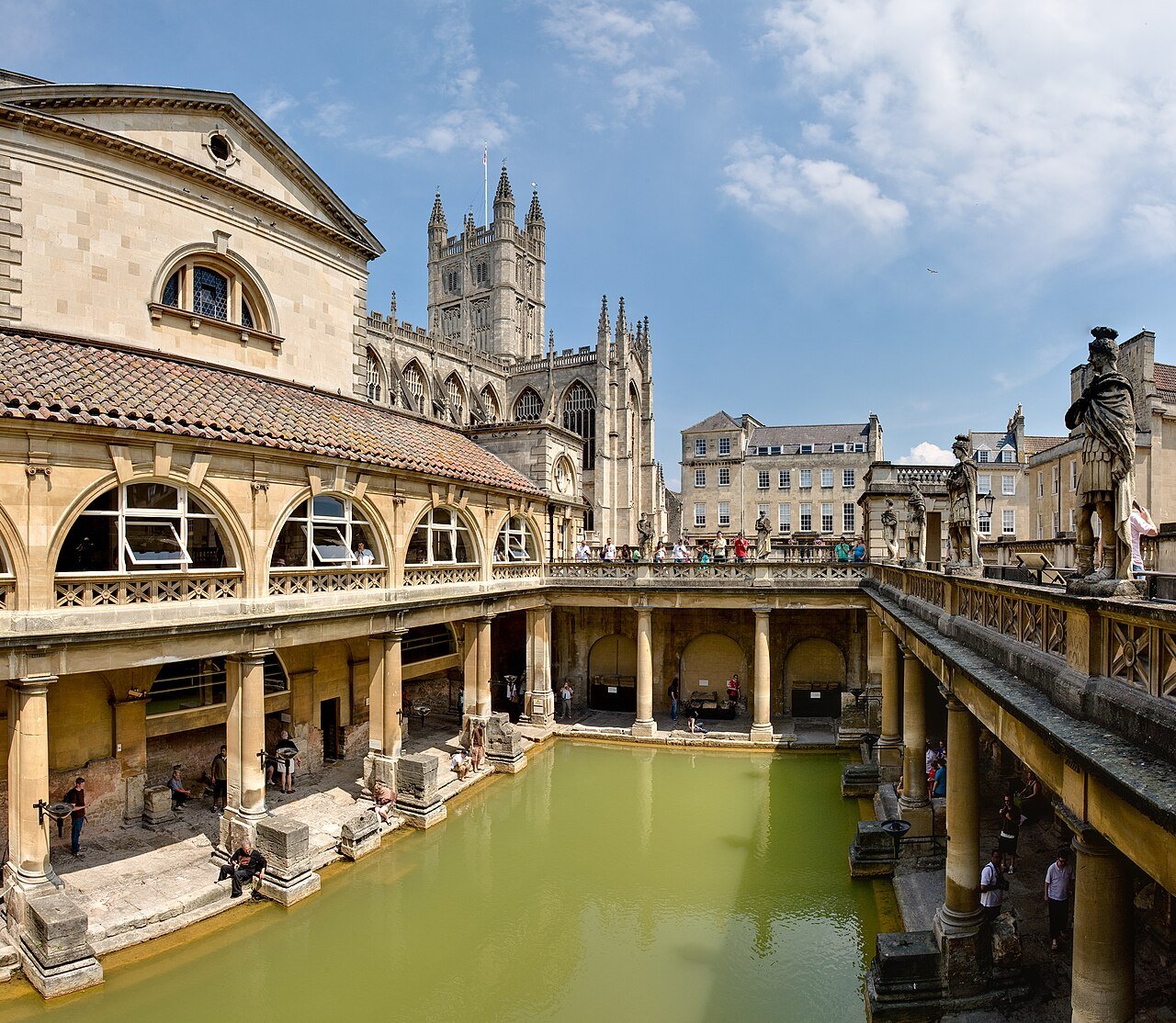
Stonehenge draws over a million visitors a year and is probably the UK’s single most recognisable World Heritage landmark. The Tower of London, Westminster Palace with Westminster Abbey and Saint Margaret’s Church, and Bath’s Roman Baths (now also part of the Great Spa Towns of Europe transnational inscription) pull similarly large crowds. Edinburgh’s Old and New Towns together form one of Europe’s most photographed skylines.
Beyond the headline sites, the list rewards curiosity. Gorham’s Cave Complex on Gibraltar holds evidence of Neanderthal occupation spanning more than 100,000 years, making it one of the most significant Neanderthal sites anywhere. Pontcysyllte Aqueduct and Canal in Wales, completed in 1805 to Thomas Telford’s design, carries boats across the River Dee at 38 metres above the valley floor — an engineering feat that still operates today. Jodrell Bank Observatory in Cheshire, inscribed in 2019, represents the dawn of radio astronomy; the Lovell Telescope, built in 1957, remains the third-largest steerable radio telescope on Earth. And New Lanark in Scotland, a mill village founded in 1785 and associated with the social reformer Robert Owen, is among the most complete surviving examples of utopian industrial planning.
Natural and shared sites
The United Kingdom’s five natural sites include two with strong claims to being among the most ecologically distinctive places on the planet. Gough and Inaccessible Islands in the South Atlantic host one of the most important seabird colonies in the world, while Henderson Island in the Pacific — despite its remoteness — has become a case study in the global reach of plastic pollution, making its inscription both a scientific and a cautionary designation. The Dorset and East Devon Coast, known informally as the Jurassic Coast, exposes 185 million years of Earth history along 95 miles of shoreline. The Flow Country, inscribed in 2024, is the world’s largest blanket bog system, a carbon sink spanning Caithness and Sutherland in the far north of Scotland. The mixed designation — cultural and natural simultaneously — belongs to St Kilda, the remote archipelago in the Outer Hebrides evacuated in 1930 and now a site of exceptional geological, ecological, and vernacular architectural importance.
On the transnational side, the UK shares the Frontiers of the Roman Empire inscription with Germany, encompassing Hadrian’s Wall and the Antonine Wall alongside the Upper Germanic-Rhaetian Limes. The Great Spa Towns of Europe, a serial inscription shared with six other European countries, includes Bath. And in 2024 the Moravian Church Settlements inscription, shared with Denmark, Germany, and the United States, was added — recognising the distinctive planned communities built by the Moravian Brethren from the eighteenth century onward.
How to find them
The United Kingdom’s World Heritage sites sit alongside thousands of other places on CHO’s interactive map, with GPS and sourced editorial history for each. See also our guides to Italy’s and France’s UNESCO sites, and our piece on cultural travel beyond mass tourism.
Frequently Asked Questions
How many UNESCO World Heritage Sites does the United Kingdom have?
As of 2024, the United Kingdom has 35 UNESCO World Heritage Sites, including sites in its Overseas Territories. The list comprises 29 cultural sites, 5 natural sites, and 1 mixed site (St Kilda), making the UK one of the more richly represented countries in the World Heritage system.
What was the United Kingdom’s first UNESCO World Heritage Site?
The United Kingdom achieved six inscriptions simultaneously in 1986, the first year it submitted nominations. Among them were Stonehenge and Avebury, Durham Castle and Cathedral, Ironbridge Gorge, and the Giant’s Causeway — a sweep of prehistoric, medieval, industrial, and natural heritage inscribed in a single year.
What is the most recently inscribed World Heritage Site in the United Kingdom?
Two sites were inscribed in 2024: The Flow Country, a vast blanket bog system in northern Scotland recognised as the largest of its kind in the world, and the Moravian Church Settlements, a transnational cultural inscription shared with Denmark, Germany, and the United States.
Does the United Kingdom have any natural UNESCO World Heritage Sites?
Yes — the UK has five natural sites: Giant’s Causeway and Causeway Coast, Henderson Island, Gough and Inaccessible Islands, the Dorset and East Devon Coast (Jurassic Coast), and The Flow Country. St Kilda holds a mixed designation, recognised for both its natural and cultural values.
Sources used in this article
- UNESCO — State Party the United Kingdom — World Heritage list.
- UNESCO — the United Kingdom: World Heritage Sites.
- CHO magazine — What is a World Heritage Site?
- CHO — Interactive map of heritage sites.
Sources
- S1 — Schama, Simon. A History of Britain: At the Edge of the World? BBC Worldwide, 2000. ISBN 978-0-563-48714-2.
- S2 — Breeze, David J. Roman Frontiers in Britain. Bloomsbury Academic, 2007. ISBN 978-1-85399-698-6.
Spotted an error? Write to editorial@culturalheritageonline.com and we correct it the same day.