Gabon has 2 UNESCO World Heritage Sites, both located in the country’s vast equatorial interior and both recognised for the exceptional ecological integrity that sets Central Africa’s rainforest belt apart. One spans a mosaic of ancient human landscapes and living forest; the other protects a river wilderness where blackwater channels cut through nearly 300,000 hectares of intact canopy. Together they represent a national list that is small in number but striking in ambition. From Cultural Heritage Online.
Why Gabon’s list looks the way it does
Gabon submitted its first nomination only in 2007, relatively late by African standards, in part because the country’s protected-area network had long been managed through national legislation alone. The establishment of thirteen national parks in 2002 created the institutional framework that made credible UNESCO nominations possible, and both World Heritage inscriptions flow directly from that reform. The result is a short list built on sites where the scientific case for Outstanding Universal Value was already exceptionally well documented before nomination.
With six properties on its tentative list as of 2022, Gabon’s total is likely to grow over the coming decade. The tentative entries span coastal lagoon systems, iron-smelting cultural landscapes, and further stretches of equatorial forest, suggesting the country is pursuing a deliberately phased strategy rather than a single large nomination wave.
The first inscriptions
Gabon’s inaugural entry onto the World Heritage List came in 2007, when the UNESCO World Heritage Committee inscribed a site that combined ecological and cultural significance in an unusual pairing:
- Ecosystem and Relict Cultural Landscape of Lopé-Okanda (2007, mixed) — a landscape that holds both dense equatorial rainforest and open relict savannah, along with more than 1,800 petroglyphs and Neolithic and Iron Age archaeological remains that document Bantu migration routes across Central Africa.
The mixed designation — awarded to sites meeting both cultural and natural criteria — placed Lopé-Okanda in a small global category. Only a fraction of World Heritage Sites hold this classification, and in Gabon’s case the distinction reflects an environment where ecological continuity and human occupation over millennia have shaped the same terrain simultaneously.
The most visited — and the alternatives
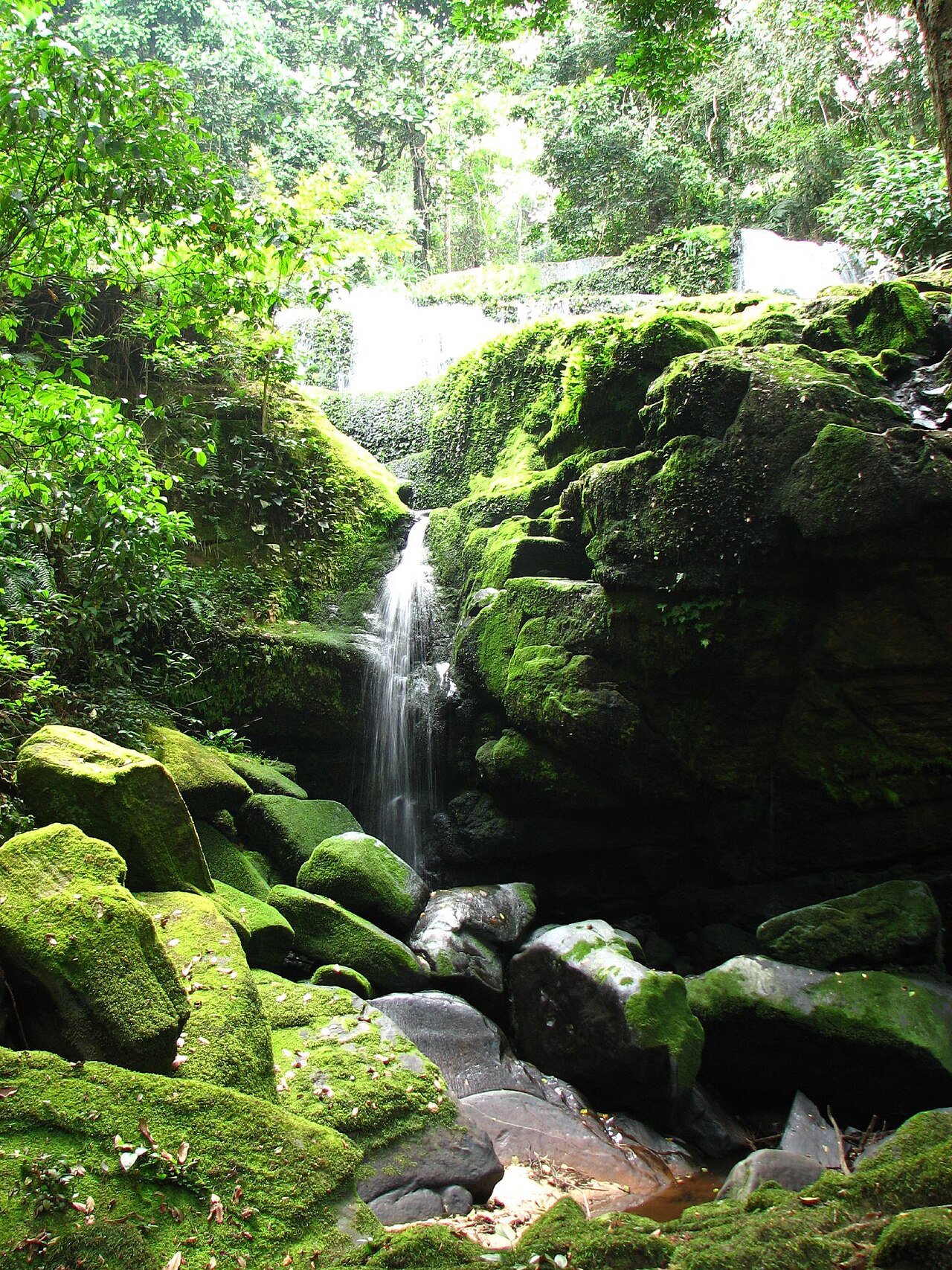
Ivindo National Park, inscribed in 2021 as Gabon’s second site and its only purely natural listing, draws the most international attention. Its blackwater rivers, most notably the Ivindo River itself, and the Kongou and Mingouli waterfalls have made it one of the more photographed landscapes in Gabon’s park system. The site shelters forest elephants, western lowland gorillas, and slender-snouted crocodiles, along with endemic freshwater fish species found nowhere else on Earth.
For those who prefer the intersection of human history and natural landscape, Lopé-Okanda offers a different kind of encounter. The petroglyphs scattered across its rocky outcrops represent one of the largest concentrations of prehistoric rock art in Central Africa, yet they remain far less discussed in the broader heritage literature than comparable sites in West or Southern Africa. The relict savannah patches within the park — ecological survivors from an earlier, drier climate — add a layer of scientific interest that the Ivindo landscape, extraordinary as it is, does not replicate.
Natural and shared sites
Both of Gabon’s World Heritage Sites hold natural values of global significance. Lopé-Okanda’s forest-savannah interface is considered a relic of climatic shifts dating back thousands of years, making it a reference point for understanding how Central African ecosystems responded to past climate change. Ivindo National Park’s intact hydrological system, essentially undisturbed by dams or large-scale extraction, supports biodiversity that scientists use to establish baseline data for the Congo Basin as a whole.
Neither site is part of a transnational serial inscription, though Gabon’s forests are ecologically contiguous with those of Cameroon, Republic of Congo, and the Central African Republic. Regional conservation bodies have discussed extending protection frameworks across borders, and future nominations from Gabon’s tentative list may eventually include transboundary components. For now, both inscribed sites are managed as discrete national properties under Gabon’s Agency for National Parks.
How to find them
Lopé-Okanda lies roughly in the geographic centre of Gabon and is accessible by the Transgabonais railway, which stops at Lopé village. Ivindo National Park sits in the northeast of the country, with the town of Makokou serving as the nearest gateway. Road infrastructure in both areas is limited, and most visits are arranged through guided expeditions. Both parks permit research stays and conservation-linked tourism, though neither operates large-scale visitor infrastructure by international comparison.
Gabon’s World Heritage sites sit alongside thousands of other places on CHO’s interactive map, with GPS and sourced editorial history for each. See also our guides to Italy’s and France’s UNESCO sites, and our piece on cultural travel beyond mass tourism.
Frequently Asked Questions
How many UNESCO World Heritage Sites does Gabon have?
Gabon has 2 UNESCO World Heritage Sites as of 2023: the Ecosystem and Relict Cultural Landscape of Lopé-Okanda, inscribed in 2007 as a mixed site, and Ivindo National Park, inscribed in 2021 as a natural site. Six additional properties appear on the country’s tentative list.
What was Gabon’s first UNESCO World Heritage Site?
The Ecosystem and Relict Cultural Landscape of Lopé-Okanda was Gabon’s first UNESCO World Heritage Site, inscribed in 2007. It received a mixed designation, meaning it satisfies both cultural and natural criteria, for its ancient petroglyphs, Iron Age remains, and exceptional forest-savannah interface.
What endangered species live in Gabon’s World Heritage Sites?
Ivindo National Park shelters critically endangered forest elephants, western lowland gorillas, and slender-snouted crocodiles, as well as endemic freshwater fish species unique to its blackwater river system. Lopé-Okanda also supports endangered wildlife within its well-conserved tropical rainforest and savannah habitats.
What are the petroglyphs at Lopé-Okanda?
Lopé-Okanda contains approximately 1,800 petroglyphs — images carved into rock surfaces — representing one of the largest concentrations of prehistoric rock art in Central Africa. They are associated with Neolithic and Iron Age occupation and are considered evidence of Bantu migration patterns across the region.
Sources used in this article
- UNESCO — State Party Gabon — World Heritage list.
- UNESCO — Gabon: World Heritage Sites.
- CHO magazine — What is a World Heritage Site?
- CHO — Interactive map of heritage sites.
Sources
- S1 — Barnes, James F. Gabon: Beyond the Colonial Legacy. Westview Press, 1992. ISBN 978-0-8133-0430-4.
- S2 — Wilks, Chris. La conservation des écosystèmes forestiers du Gabon. UICN, 1990. ISBN 978-2-88032-988-4.
Spotted an error? Write to editorial@culturalheritageonline.com and we correct it the same day.