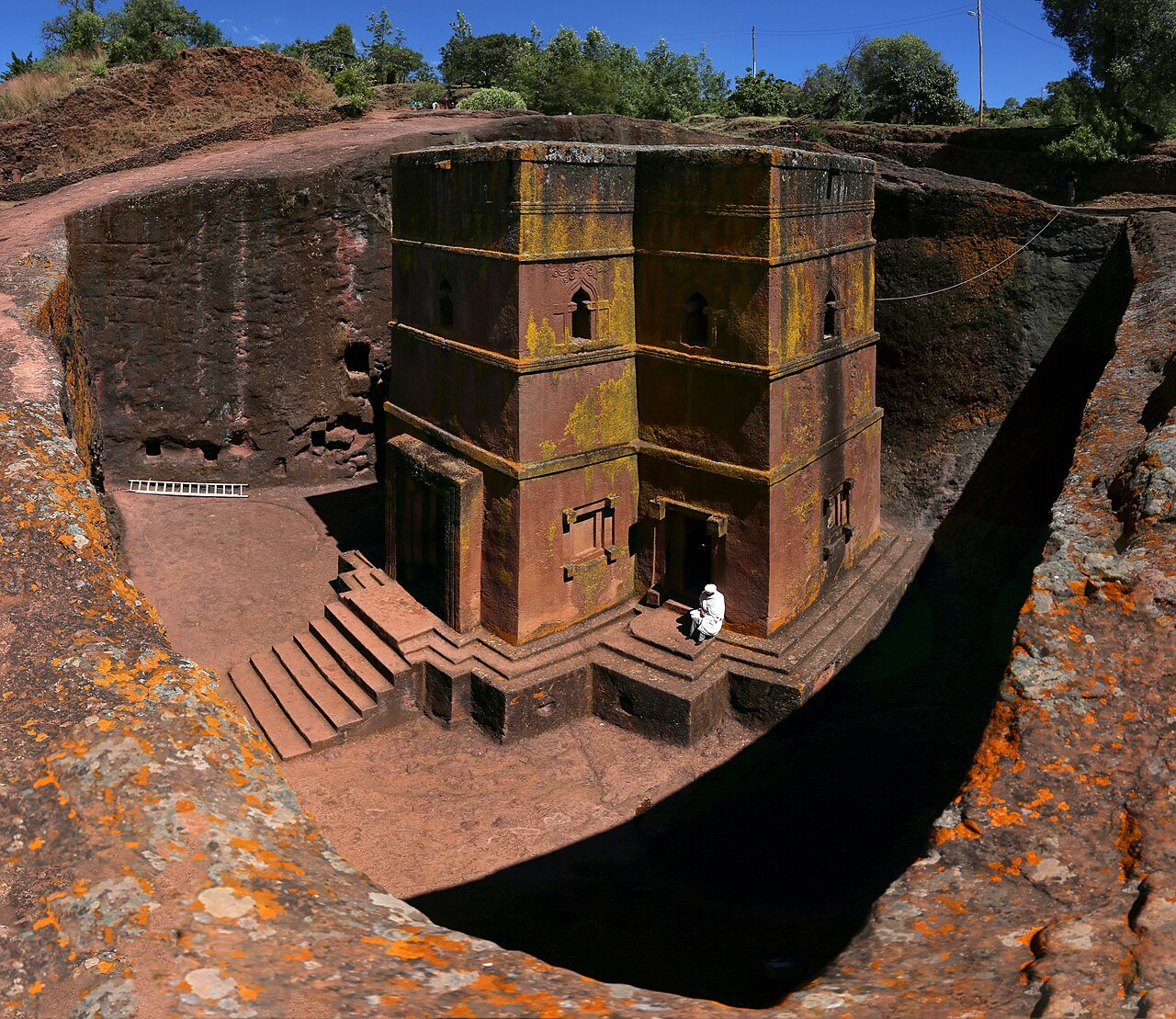
Ethiopia has 12 UNESCO World Heritage Sites, a number that spans prehistoric fossil beds, medieval rock churches, walled Islamic cities, and high-altitude wilderness that shelters species found nowhere else on earth. Few countries compress so much of humanity’s deep past — and so many distinct ecosystems — into a single heritage list. From Cultural Heritage Online.
Why Ethiopia’s list looks the way it does
Ethiopia’s World Heritage portfolio reflects the country’s unusual position in human and natural history. It sits at the junction of the African Rift Valley, one of the most significant geological and paleoanthropological corridors on the planet, and was the seat of one of the ancient world’s major civilisations, the Aksumite Empire, whose monuments still stand in the northern highlands. That dual weight — deep prehistory and living urban tradition — gives the list a range that few other African states can match.
Of the 12 inscribed sites, 10 are cultural and 2 are natural. That ratio is partly an artifact of history: Ethiopia’s monumental and urban heritage was among the first on the continent to attract international scholarly attention, while its natural landscapes, though exceptional, were inscribed more gradually over the following decades.
The first inscriptions
Ethiopia entered the World Heritage list in 1978, at the Second Session of the World Heritage Committee held in Washington, D.C. Two sites were inscribed simultaneously that year:
- Rock-Hewn Churches, Lalibela — a complex of eleven monolithic churches carved directly from red volcanic rock in the Lasta highlands, constructed under the Zagwe dynasty around the twelfth and thirteenth centuries.
- Simien National Park — a high-altitude landscape in the Simien Mountains that shelters the endangered Walia ibex and the Ethiopian wolf, two of the country’s most emblematic endemic species.
The pairing of a sacred architectural ensemble and a national park on the very first inscription reflects the breadth that would come to define Ethiopia’s full list. Both sites remain among the most visited in the country today.
The most visited — and the alternatives
Lalibela draws by far the largest number of heritage-focused visitors, particularly during the Timkat festival in January, when its subterranean courtyards fill with processions. The Aksum obelisks — part of the Aksum inscription (1980), covering the ruins of the Aksumite capital including giant stelae, ancient tombs, and a palace complex — form the other pole of what most itineraries call the “Historic Route.” The walled city of Harar Jugol (2006), with its 82 mosques and distinctive painted façades, is a third anchor site that tourism infrastructure has grown to support.
Beyond those three, the list holds sites that receive far less international attention yet carry considerable historical and scientific weight:
- Tiya (1980) — a field of 36 megalithic stelae, 33 of them aligned along a 45-metre axis, associated with funerary rites and still not fully interpreted.
- Konso Cultural Landscape (2011) — a system of stone-terraced hillside settlements built by the Konso people, whose tradition of erecting wooden anthropomorphic grave markers, called waka, remains a living practice.
- Gedeo Cultural Landscape (2023) — a densely populated agroforestry landscape in southern Ethiopia containing megalithic ritual monuments, including stelae and phallic stone forms, integrated into still-active agricultural land.
Natural and shared sites
Ethiopia’s two natural World Heritage Sites anchor its biodiversity heritage at opposite ends of the ecological spectrum. Simien National Park, inscribed in 1978, occupies a dramatically eroded plateau above 3,000 metres, its cliff edges and alpine meadows providing habitat for the gelada, a primate found only in the Ethiopian highlands. Bale Mountains National Park, inscribed in 2023, covers the largest expanse of Afroalpine habitat in Africa and is the stronghold of the critically endangered Ethiopian wolf — the world’s rarest canid.
The most recently added site to the list is Melka Kunture and Balchit, inscribed in 2024. Located along the Awash River south of Addis Ababa, Melka Kunture is a paleoanthropological site where stone tools and fossils document human presence across more than a million years; Balchit is a related site preserving early Acheulean occupation layers. The inscription extends the country’s already strong representation in the Lower Awash Valley — where the Lower Valley of the Omo (1980) contains fossils spanning between roughly 3.5 million and one million years ago — making Ethiopia one of the world’s most significant nations for the study of early human evolution.
How to find them
Ethiopia’s World Heritage sites are geographically dispersed across a large country with varied infrastructure. The northern historic circuit — Aksum, Lalibela, and the rock-hewn churches of Tigray (part of a broader cluster) — is served by domestic flights and a developing road network. Southern sites such as Tiya, Konso, and the Gedeo landscape require more logistical planning, while Bale Mountains is most accessible from the town of Goba. Melka Kunture, being close to Addis Ababa, can be reached as a day trip.
Ethiopia’s World Heritage sites sit alongside thousands of other places on CHO’s interactive map, with GPS and sourced editorial history for each. See also our guides to Italy’s and France’s UNESCO sites, and our piece on cultural travel beyond mass tourism.
Frequently Asked Questions
How many UNESCO World Heritage Sites does Ethiopia have?
Ethiopia has 12 UNESCO World Heritage Sites as of 2026, comprising 10 cultural and 2 natural sites. A further six properties appear on the country’s tentative list and may be submitted for future inscription.
What was Ethiopia’s first UNESCO World Heritage Site?
Two sites were inscribed simultaneously in 1978, at the Second Session of the World Heritage Committee: the Rock-Hewn Churches of Lalibela and Simien National Park. Both were added at the same meeting held in Washington, D.C., making them joint first inscriptions.
What is the most recently inscribed UNESCO site in Ethiopia?
Melka Kunture and Balchit was inscribed in 2024, becoming Ethiopia’s twelfth World Heritage Site. Located along the Awash River near Addis Ababa, the site preserves paleoanthropological evidence of human activity spanning more than one million years.
Does Ethiopia have any natural UNESCO World Heritage Sites?
Ethiopia has two natural World Heritage Sites: Simien National Park (1978), home to the endangered Walia ibex and the gelada primate, and Bale Mountains National Park (2023), the largest Afroalpine habitat in Africa and the primary stronghold of the Ethiopian wolf.
Sources used in this article
- UNESCO — State Party Ethiopia — World Heritage list.
- UNESCO — Ethiopia: World Heritage Sites.
- CHO magazine — What is a World Heritage Site?
- CHO — Interactive map of heritage sites.
Sources
- S1 — Phillipson, David W. Ancient Churches of Ethiopia. Yale University Press, 2009. ISBN 978-0-300-14156-6.
- S2 — Munro-Hay, Stuart. Aksum: An African Civilisation of Late Antiquity. Edinburgh University Press, 1991. ISBN 978-0-7486-0106-6.
Spotted an error? Write to editorial@culturalheritageonline.com and we correct it the same day.