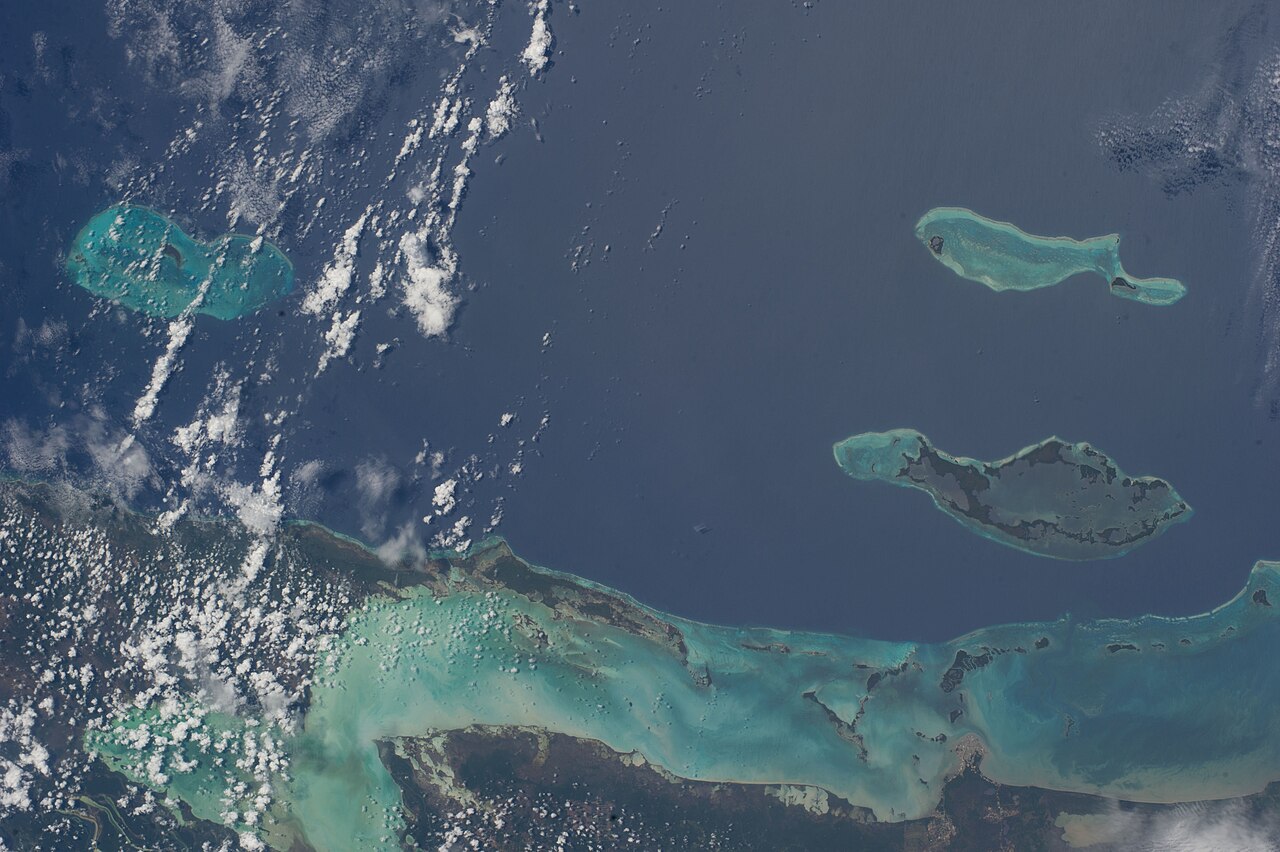
The Belize Barrier Reef Reserve System — the largest barrier reef in the Northern Hemisphere, home to the Great Blue Hole, whale shark aggregations, and the densest population of manatees in Central America — is accessible from Belmopan, Belize’s inland capital, within two hours. From Cultural Heritage Online.
Belize Barrier Reef Reserve System 100 km east to Belize City, then boat to the reef — 2 hr
The barrier reef extends 225 km along the entire Caribbean coast of Belize, making it the largest in the Northern Hemisphere and the second longest in the world after Australia’s Great Barrier Reef. UNESCO inscribed the system in 1996 as a serial site comprising seven protected areas: Bacalar Chico National Park and Marine Reserve in the north, the South Water Caye and Gladden Spit marine reserves in the centre, Laughing Bird Caye National Park and the Sapodilla Cayes in the south, plus the Half Moon Caye Natural Monument and the Blue Hole Natural Monument offshore.
The Great Blue Hole — the Blue Hole Natural Monument — is the element of the inscription most familiar to non-specialists. The circular sinkhole, 300 metres in diameter and 125 metres deep, was formed as a limestone cave system during periods of lower sea level in the Pleistocene and subsequently flooded as the Caribbean rose after the last glaciation. Jacques Cousteau named it one of the top ten dive sites in the world after his 1971 visit. The walls of the hole are hung with stalactites in their original orientations — evidence that the ceiling of the former cave has collapsed downward — and several species of reef shark are reliably encountered at depth. The hole is located approximately 70 km east of Belize City and reached by liveaboard or organised day trip from San Pedro on Ambergris Caye.
The reef was placed on UNESCO’s List of World Heritage in Danger in 2009 over concerns about oil exploration permitted within the inscribed zone and inadequate management. Belize responded by banning offshore oil exploration across the entire country in 2018, after which the site was removed from the Danger List — a process widely cited as a model for UNESCO heritage conservation advocacy. The reef system supports over 500 fish species, 350 molluscs, and 70 hard coral species.
Gladden Spit, in the southern reef, attracts whale sharks between March and June each year, drawn by the mass spawning of cubera and mutton snappers. The aggregations are predictable enough to support regulated dive tourism; this is one of the most reliably accessible whale shark sites in the world outside the open ocean. Manatees inhabit the coastal lagoons behind the reef and are encountered regularly on tours from Belize City.
Getting there: Belmopan to Belize City by road (50 km, 45 min), then boat transfers to Ambergris Caye (San Pedro) or Caye Caulker — the primary reef access points. Water taxi from Belize City docks to San Pedro takes 75 min. The Great Blue Hole requires a liveaboard or organised day charter. Allow: Minimum 2 nights on the cayes for reef access; 3–4 days to cover multiple sites. Best for: Divers, snorkellers, and marine wildlife observers.
Frequently Asked Questions
How many UNESCO World Heritage Sites does Belize have?
One: the Belize Barrier Reef Reserve System, inscribed in 1996. It is a serial inscription comprising seven protected marine areas along the entire 225-km Caribbean coast of Belize. The site was on the UNESCO List of World Heritage in Danger from 2009 to 2018, when it was removed following Belize’s decision to ban offshore oil exploration across the country.
What is the Great Blue Hole and how do you get there?
The Great Blue Hole is a circular underwater sinkhole 300 metres in diameter and 125 metres deep, located approximately 70 km east of Belize City. It is most commonly accessed by liveaboard dive trips departing from Belize City or San Pedro on Ambergris Caye; some operators run day trips, though the distance means limited bottom time. The dive descends to 40 metres along walls hung with Pleistocene stalactites; Caribbean reef sharks and bull sharks are encountered at depth.
When is the best time to see whale sharks at Gladden Spit?
Whale sharks aggregate at Gladden Spit between March and June each year, peaking in April and May, coinciding with the mass spawning of cubera snapper and other reef fish during the full moon periods. Dive operators based in Placencia (the closest town) offer organised whale shark dives; numbers are regulated by the Belize Fisheries Department to limit disturbance to the animals.
Is the Belize Barrier Reef accessible from Belmopan?
Yes, though Belmopan is 50 km inland. The standard approach is to drive or take a bus to Belize City (45 min), then take the water taxi to Ambergris Caye (San Pedro) or Caye Caulker — the two main caye destinations with reef access. From San Pedro, the reef and most dive sites are a short boat ride away. The Great Blue Hole and Gladden Spit require longer boat journeys or organised day trips from Belize City.
Sources
- S1 — Macpherson, Anne S. From Colony to Nation: Women Activists and the Struggle in Belize. University of Nebraska Press, 2007. ISBN 978-0-8032-3242-6.
- S2 — Sharer, Robert J., and Loa P. Traxler. The Ancient Maya. Stanford University Press, 2006. ISBN 978-0-8047-4817-9.
Spotted an error? Write to editorial@culturalheritageonline.com and we correct it the same day.