Cyprus has three UNESCO World Heritage Sites, a compact but consequential list that spans ten thousand years of human settlement — from a Neolithic village whose circular stone-and-mudbrick houses predate the Bronze Age, to medieval frescoes that chart the full arc of Byzantine art, to a coastal city whose Roman mosaic floors remain among the finest in the eastern Mediterranean. All three are cultural designations, a reflection of an island whose geological drama runs deep but whose heritage record centres firmly on the layered civilisations that came and stayed. From Cultural Heritage Online.
Why Cyprus’s list looks the way it does
Cyprus ratified the World Heritage Convention on 14 August 1975, among the earlier signatories in the region, and its first inscription followed just five years later. With only three sites on the list as of 2021, Cyprus is not a country that has pushed hard for volume. The eleven entries on its tentative list — six of them linked to the Troodos Ophiolite geological formation — suggest that future nominations may tilt toward natural and mixed designations, but no new site has been inscribed since 1998.
The current list is exclusively cultural, and it spans an unusually long chronological sweep: from the seventh millennium BCE at Choirokoitia, through the Roman imperial period at Paphos, to post-Byzantine painting traditions that continued into the sixteenth century in the Troodos uplands. That breadth in just three inscriptions is part of what makes the Cypriot list disproportionately rich relative to its size.
The first inscriptions
Cyprus’s entry into the World Heritage system began with a single inscription in 1980, followed by a second five years later. Both remain on the list today without significant alteration to their core designation.
- Paphos (1980) — the coastal city and its surrounding archaeological zone, inscribed for its exceptional concentration of Hellenistic to Byzantine material culture.
- Painted Churches in the Troodos Region (1985, extended 2001) — originally nine rural churches and monasteries; a tenth was added in 2001, bringing the group to its current form.
The pairing already signalled something about how Cyprus would approach World Heritage: a major urban archaeological site on one hand, and a dispersed rural ensemble on the other — monument and landscape, coast and mountain interior.
The most visited — and the alternatives
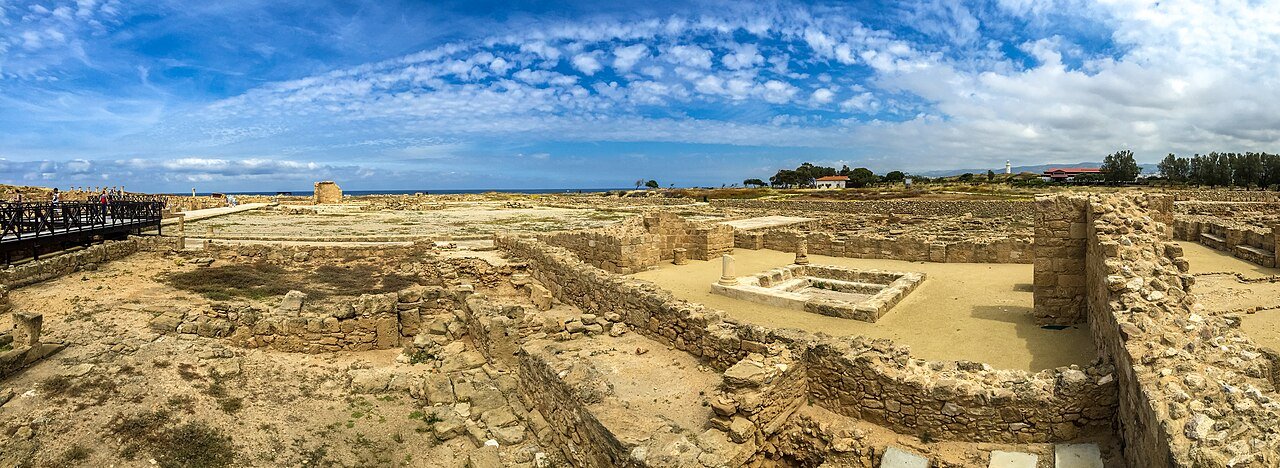
Paphos draws the largest share of visitors, partly because it sits within an established tourist corridor on the southwestern coast. The Paphos Archaeological Park contains mosaic floors from the Houses of Dionysus, Theseus, Aion, and Orpheus — room-scale compositions depicting mythological scenes with a precision and chromatic range that rank them among the most important Roman-period mosaics anywhere in the Mediterranean world. The adjacent Tombs of the Kings, rock-cut burial chambers from the Hellenistic era, extend the site’s scope further.
The Troodos churches and Choirokoitia reward visitors willing to move off the coast. The ten churches of the Troodos ensemble — small, steep-roofed structures fitted with timber frames designed to shed snow at altitude — contain paintings spanning from the eleventh to the sixteenth century, a continuous documentary record of Byzantine and post-Byzantine iconographic traditions rarely found in such density in a single region. Choirokoitia, for its part, is a Neolithic settlement occupied between the seventh and fourth millennia BCE; its circular stone-and-mudbrick dwelling units and the analytical framework archaeologists have built around the site make it one of the most informative prehistoric sites in the eastern Mediterranean.
Natural and shared sites
As of 2021, Cyprus has no inscribed natural or mixed World Heritage Sites. The island’s geology is, however, scientifically significant: the Troodos Ophiolite is one of the world’s best-exposed and best-preserved examples of ancient oceanic crust thrust above sea level, and it has been the subject of sustained geological study since the twentieth century. Six of Cyprus’s eleven tentative-list entries relate to this formation, which may eventually form the basis of a natural or mixed nomination.
Cyprus does not currently participate in any transnational or serial World Heritage inscription. Its three sites are each nationally inscribed and administered independently. The tentative list entries associated with the Ophiolite, if pursued jointly with other countries sharing comparable geological formations, could in principle become a transnational serial nomination, but no formal process of that kind is underway as of the available record.
How to find them
All three sites are accessible by road and are signposted within Cyprus’s national heritage infrastructure. Paphos Archaeological Park operates with ticketed entry; the Troodos churches vary in access conditions, with some requiring advance contact with local ecclesiastical authorities. Choirokoitia, on the main Nicosia-Limassol motorway corridor, has visitor facilities managed by the Cyprus Department of Antiquities.
Cyprus’s World Heritage sites sit alongside thousands of other places on CHO’s interactive map, with GPS and sourced editorial history for each. See also our guides to Italy’s and France’s UNESCO sites, and our piece on cultural travel beyond mass tourism.
Frequently Asked Questions
How many UNESCO World Heritage Sites does Cyprus have?
Cyprus has three UNESCO World Heritage Sites as of 2021, all classified as cultural heritage. They are Paphos, the Painted Churches in the Troodos Region, and Choirokoitia.
What was Cyprus’s first UNESCO World Heritage Site?
Paphos was Cyprus’s first UNESCO World Heritage Site, inscribed in 1980. The site encompasses the Paphos Archaeological Park and its remarkable collection of Roman-era mosaic floors, along with the Hellenistic rock-cut Tombs of the Kings.
What are the Painted Churches in the Troodos Region?
The Painted Churches in the Troodos Region is a group of ten rural Byzantine churches and monasteries located in the Troodos Mountains, inscribed in 1985 with a tenth church added in 2001. Their interiors preserve a continuous sequence of Byzantine and post-Byzantine fresco painting spanning from the eleventh to the sixteenth century.
How old is the Choirokoitia settlement?
Choirokoitia is a Neolithic settlement occupied between the seventh and fourth millennia BCE, making it one of the oldest and best-preserved prehistoric sites in the eastern Mediterranean. It was inscribed on the World Heritage List in 1998 and is notable for its distinctive circular dwelling structures built from stone and mudbrick.
Sources used in this article
- UNESCO — State Party Cyprus — World Heritage list.
- UNESCO — Cyprus: World Heritage Sites.
- CHO magazine — What is a World Heritage Site?
- CHO — Interactive map of heritage sites.