Armenia’s three UNESCO World Heritage Sites — Etchmiadzin’s cathedral complex, the cliff-carved monastery of Geghard, and the medieval ensemble of Haghpat — span seventeen centuries of unbroken Christian heritage and are all reachable as day trips from Yerevan. Each rewards the journey with architecture shaped by a singular civilisation that absorbed Persian, Byzantine, and Central Asian influence without losing itself. From Cultural Heritage Online.
Cathedral and Churches of Etchmiadzin & Zvartnots 20 km west · 30 min by taxi or bus
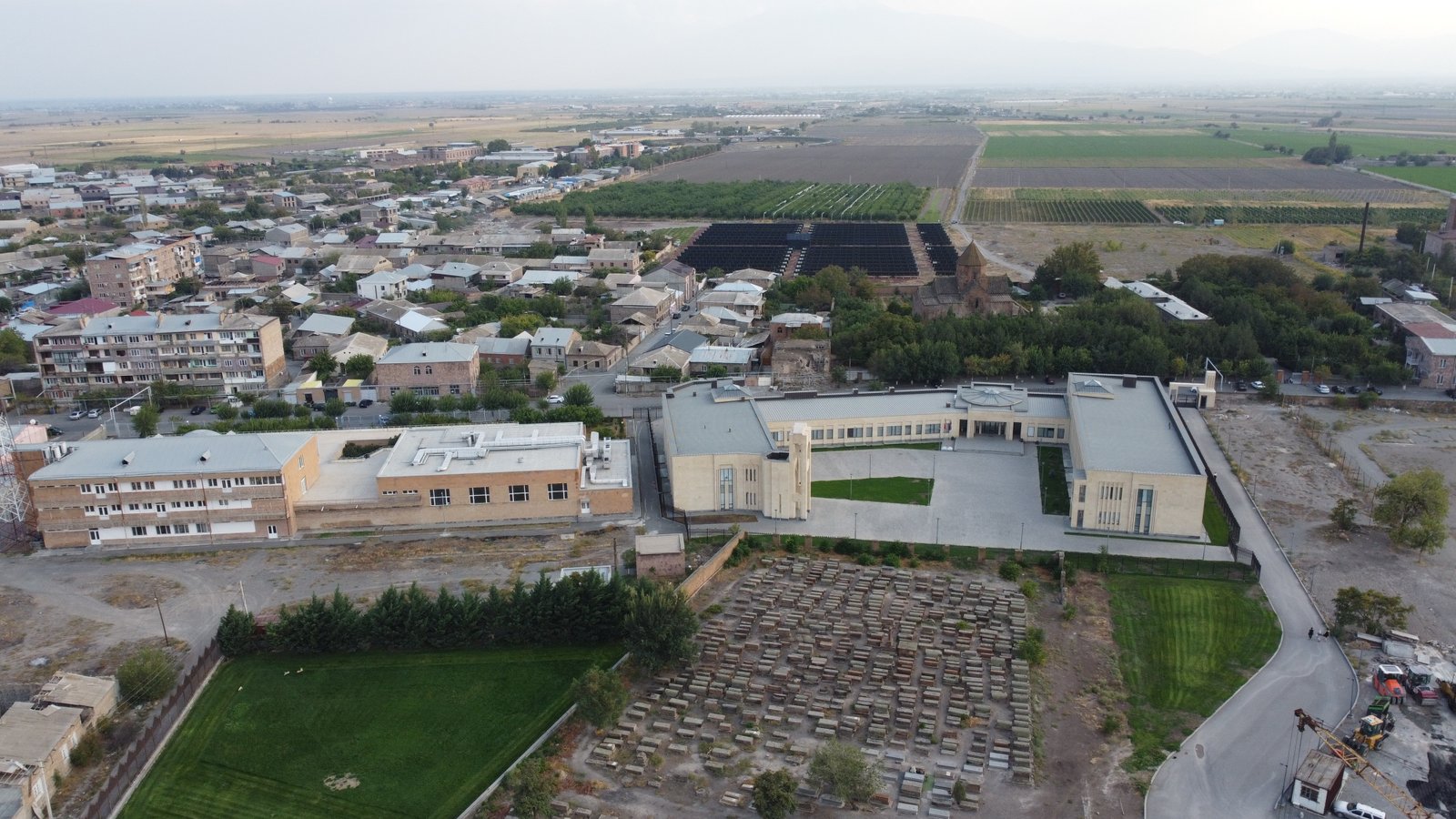
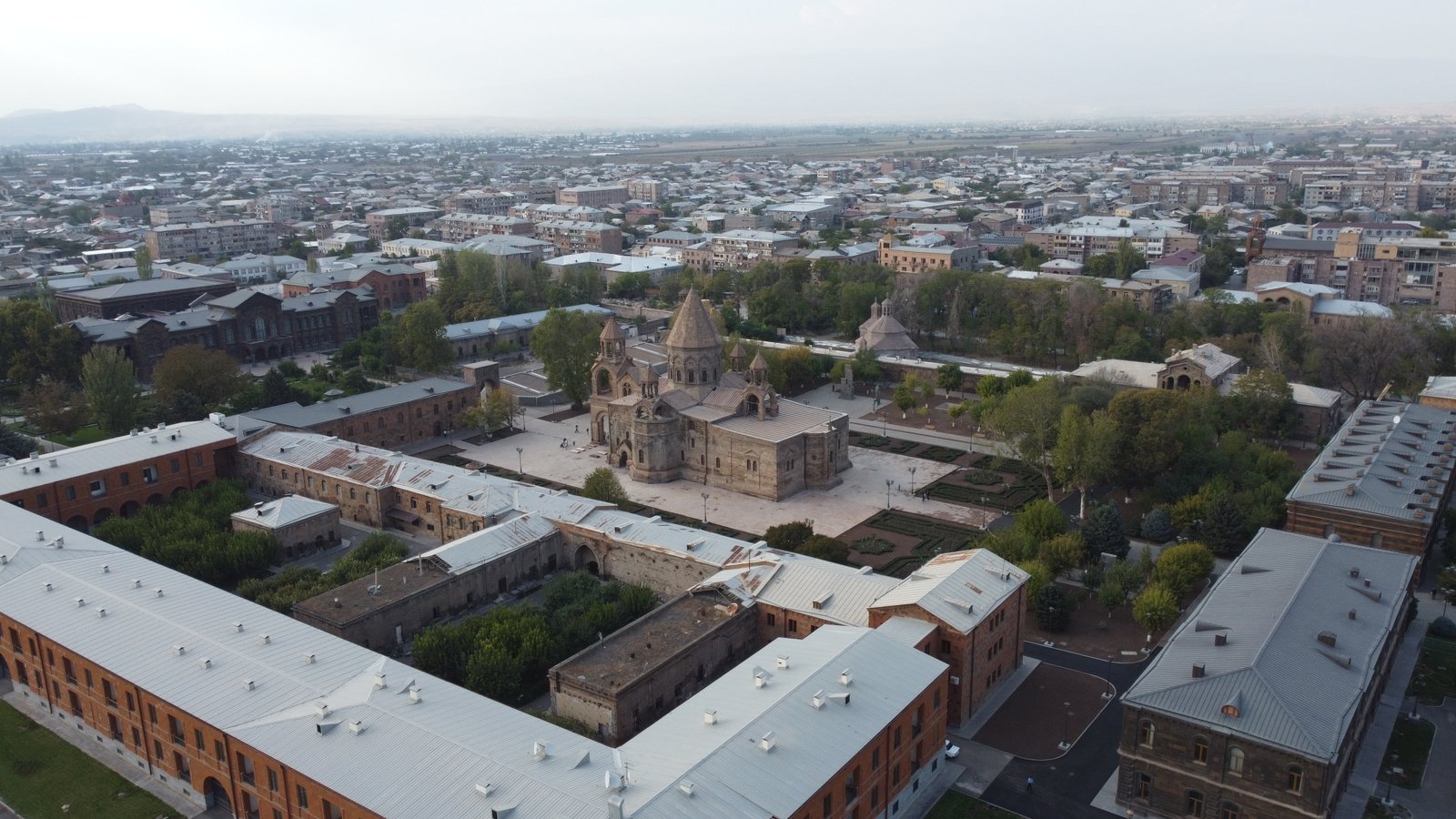
Etchmiadzin Cathedral, consecrated in 301 AD, is among the oldest functioning cathedrals in the world — and the spiritual headquarters of the Armenian Apostolic Church, whose 170 million global faithful regard this building as their mother church. The name translates as “the descent of the Only-Begotten,” commemorating a vision in which Gregory the Illuminator claimed to witness Christ strike the ground at this precise spot, marking where the altar should stand. What you see today is the accumulated labour of centuries: a core dating to the early fourth century, with substantial reconstruction under Catholicos Sahak in the fifth, an exterior reclad in dark volcanic tuff in the seventeenth, and bell towers added later still. The building’s cross-shaped plan with a central dome became the prototype from which Armenian ecclesiastical architecture spread across the Caucasus.
Inside, the air smells faintly of incense and old stone. A section of the original mosaic floor is preserved beneath glass at the crossing, worn smooth by a millennium and a half of pilgrims. Three other early Christian churches stand within the walled compound — Saints Hripsime, Gayane, and Shoghakat — each smaller but remarkably intact, their interiors lit by narrow windows whose deep reveals cast precise bands of light across bare stone walls. The site was inscribed by UNESCO in 2000 for its exceptional testimony to the early adoption of Christianity as a state religion and the architectural innovations that followed.
Ten kilometres further west, the ruins of Zvartnots Cathedral reward the detour. Built between 641 and 661 AD under Catholicos Nerses III and destroyed by earthquake in the tenth century, the circular design was so unusual that scholars long debated its reconstruction. A small on-site museum displays carved capitals and column fragments that confirm its ambition: a four-storey rotunda approximately 35 metres across, clad in finely dressed basalt. Only the foundations and scattered carved stones remain, but their scale makes the absence feel like a presence.
Getting there: Marshrutka minibuses depart Yerevan’s Kilikia station frequently; journey 30–40 minutes. Taxis from Republic Square cost around 2,500–3,500 AMD one way. Zvartnots ruins are a further 10-minute drive or taxi from Etchmiadzin. Allow: Half a day for both sites combined. Best for: Travellers interested in early Christian history, sacred architecture, and Armenian national identity.
Monastery of Geghard and the Upper Azat Valley 40 km southeast · 1 hr by car or tour bus
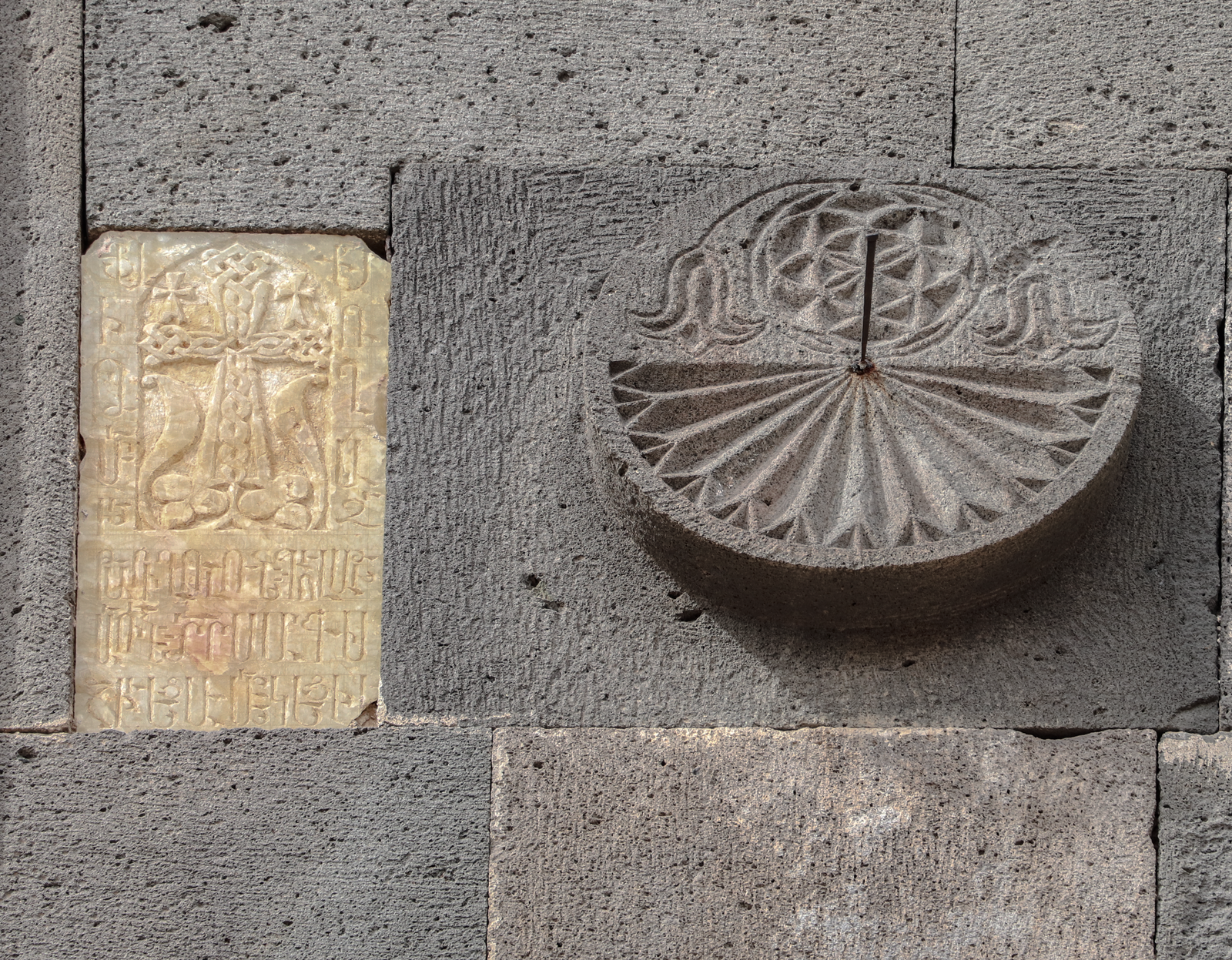
The road into the Upper Azat Valley narrows as the gorge tightens, basalt walls rising sheer on either side until the monastery appears ahead: part free-standing stone, part mountain. Geghard takes its name from the spear said to have pierced Christ’s side at the crucifixion — a relic brought here in the fourth century by the Apostle Thaddeus and preserved in the main church treasury. The founding tradition reaches back that far, though the surviving structures date primarily from the twelfth and thirteenth centuries, built and expanded by the Proshian dynasty of Armenian princes.
What makes Geghard exceptional, and what earned its UNESCO inscription in 2000, is the seamless integration of built and rock-cut architecture. The main Cathedral of the Mother of God, completed in 1215, is a conventional if superbly executed hall church in volcanic tuff. Step through the door carved into the cliff behind it and the acoustic changes immediately: the rock-hewn gavit, or antechamber, absorbs sound differently from any built space, the stone so close around you that whispers travel oddly and the drip of water somewhere deep in the rock carries clearly. Further chambers are carved yet deeper into the cliff — burial chambers for Proshian nobles, their walls studded with khachkars, the intricately latticed stone crosses that are Armenia’s most distinctive artistic contribution. Natural light enters through small oculi cut through metres of solid rock, producing shafts that shift across the carved surfaces with the hour.
Most visitors combine Geghard with the Hellenistic temple of Garni, 7 km back along the valley road — a first-century AD porticoed structure that survived because a medieval Armenian king converted it into his summer residence. Neither site requires more than two hours; together they form the most complete single day out from Yerevan.
Getting there: No direct public transport; shared taxis from Yerevan’s Gai minibus station depart when full (roughly 600 AMD per seat). Most visitors take a guided tour or hire a private taxi for 8,000–12,000 AMD return including waiting time. Allow: Half a day; a full day if combining with Garni Temple. Best for: Architecture enthusiasts, travellers interested in medieval Armenian history, and anyone drawn to landscapes where human construction and natural rock are indistinguishable.
Monasteries of Haghpat and Sanahin 170 km north · 2.5 hr by car
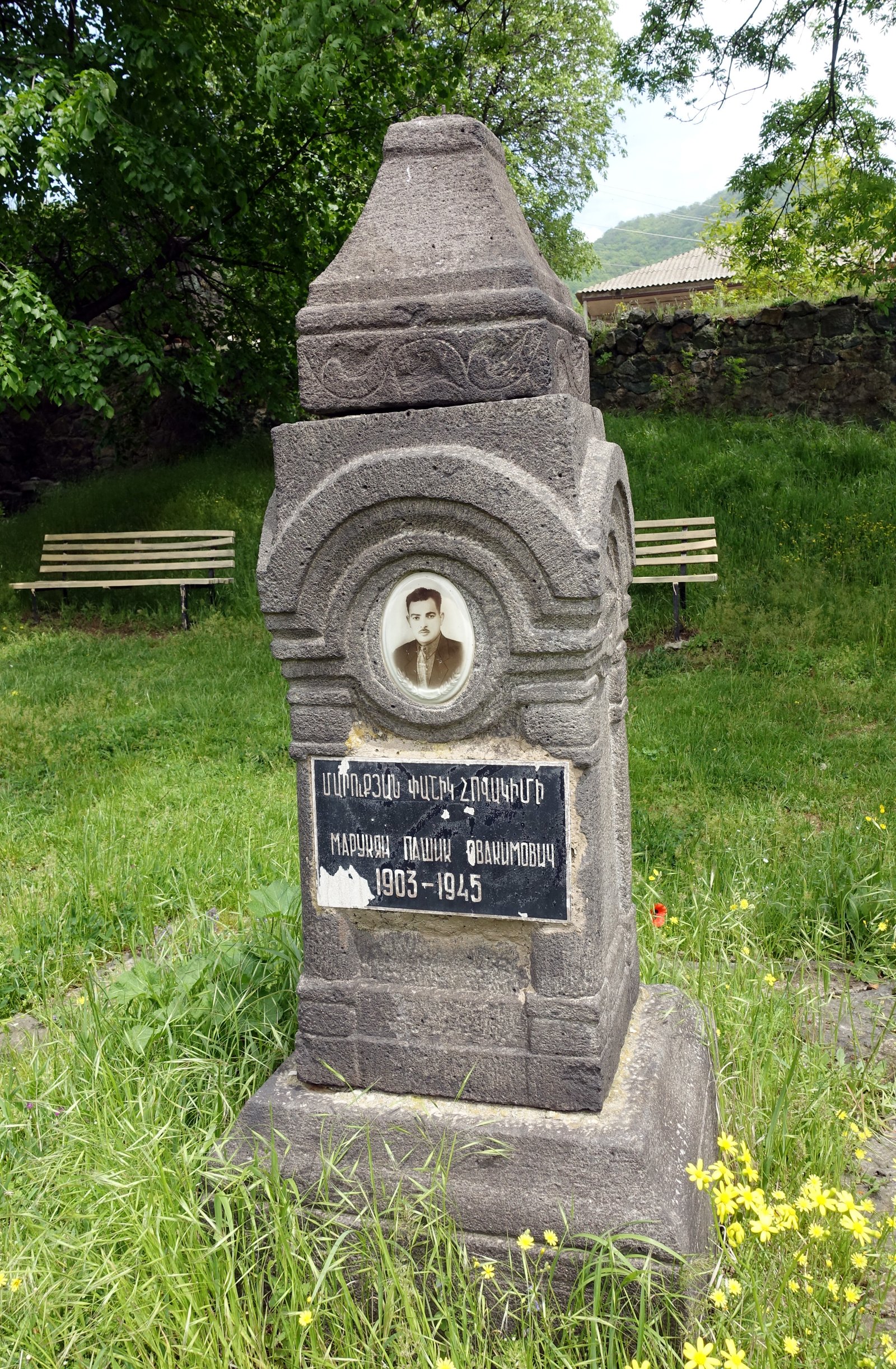
The drive north from Yerevan crosses the Debed River canyon — steep gorge walls clad in oak and hornbeam — before climbing to the village of Haghpat, where the monastery sits on a promontory looking across to the matching ensemble of Sanahin on the ridge opposite. Both complexes were founded in the tenth century under the Bagratid dynasty, when the region was the cultural and political heart of a briefly reunified Armenian kingdom. UNESCO inscribed them together in 1996, extended to the current boundary in 2000, for their outstanding demonstration of medieval Armenian religious architecture across three centuries of continuous development.
Haghpat’s Church of St Nishan, built in 976–991, establishes the ensemble’s tone: a basilica of deep-red tuff whose interior is larger than it appears from outside, the nave spanned by pendentives carrying a drum and dome that lift the eye upward despite the building’s modest outer profile. The gavit attached to its western facade was added in the thirteenth century; its ceiling is a tour de force of interlocking stone ribs forming a pointed star, all cut and fitted without mortar by craftsmen whose names are recorded in the building’s foundation inscriptions. The library building, a rare secular survival, contains the stone where manuscripts were chained to prevent theft. Stand in the refectory at the right hour and the afternoon light through the oculus above the altar falls directly onto the carved stone table below.
Sanahin, a fifteen-minute drive away, is quieter and less visited. Its Academy building — one of the earliest freestanding educational institutions in Armenian history — still stands beside the main church, its carved portal worn but legible. The two monasteries together form a compelling argument for the full-day northern route, which passes through the Debed Canyon and can include the nearby town of Alaverdi.
Getting there: Marshrutkas run from Yerevan’s Kilikia station to Alaverdi (nearest town, 10 km from Haghpat) in around 2.5 hours; onward taxi to either monastery costs 1,500–2,500 AMD. A private car hire from Yerevan typically runs 20,000–30,000 AMD for a full-day northern circuit. Allow: Full day; ideally both monasteries plus Debed Canyon. Best for: Medieval architecture, Byzantine-influenced art history, and travellers who prefer UNESCO sites well away from tour-group crowds.
Frequently Asked Questions
How many UNESCO World Heritage Sites are near Yerevan?
Armenia has three UNESCO World Heritage Sites, all accessible as day trips from Yerevan. They are: the Cathedral and Churches of Etchmiadzin and the Archaeological Site of Zvartnots (inscribed 2000), the Monastery of Geghard and the Upper Azat Valley (inscribed 2000), and the Monasteries of Haghpat and Sanahin (inscribed 1996, boundary modified 2000).
What can you see inside Geghard Monastery, and how do you get there?
Geghard contains both a free-standing cathedral (completed 1215) and a series of chambers carved directly into the cliff behind it — antechambers, burial halls, and chapels whose vaulted ceilings were cut from solid basalt by Proshian-era craftsmen. The rock-hewn spaces are dimly lit by oculi bored through metres of stone, and the acoustic in the deepest chambers is unlike any built interior. There is no direct public transport; the standard approach is a shared taxi from Yerevan’s Gai station (roughly 600 AMD per seat) or a private taxi return for 8,000–12,000 AMD. Most visitors combine the monastery with the nearby Garni Temple in a half-day trip.
Can you visit Etchmiadzin and Geghard in the same day?
In theory yes, but the experience is rushed. Etchmiadzin lies 20 km west of Yerevan and Geghard 40 km southeast — they are in opposite directions. A practical itinerary pairs Etchmiadzin and Zvartnots on one morning (both sites are within 10 km of each other), and reserves Geghard, combined with Garni, for a separate half-day. Haghpat and Sanahin are far enough north to constitute a full day on their own. Autumn and spring offer the best light and manageable temperatures; summer weekends bring the largest crowds at Geghard.
What is unique about the architecture of Haghpat and Sanahin?
Both monasteries exemplify the distinctly Armenian approach to sacred building: exterior profiles that read as compact and austere, with interior volumes that open unexpectedly through the use of pendentives, blind arcades, and interlocking stone-rib vaulting requiring no mortar. The thirteenth-century gavit at Haghpat is particularly remarkable — its ceiling, a geometric lattice of carved ribs converging at a central lantern, was achieved without the metal armatures or centering that contemporary European builders relied on. Foundation inscriptions name specific architects and donors, making these structures unusually well-documented for their period.
Sources
- S1 — Maranci, Christina. Vigilant Powers: Three Churches of Early Medieval Armenia. Brepols Publishers, 2015. ISBN 978-2-503-54900-2.
- S2 — Redgate, Anne Elizabeth. The Armenians. Wiley-Blackwell, 2000. ISBN 978-0-631-22037-4.
Spotted an error? Write to editorial@culturalheritageonline.com and we correct it the same day.