Burkina Faso has four UNESCO World Heritage Sites — three cultural and one natural — spanning medieval stone fortresses, iron-smelting traditions that predate many European metallurgical traditions by centuries, a royal court painted by generations of women, and a vast savanna shared with two neighbouring nations. Each site opens a distinct window into West African history and ecology. From Cultural Heritage Online.
Why Burkina Faso’s list looks the way it does
Four inscriptions across fifteen years give Burkina Faso one of the more focused UNESCO portfolios in West Africa. The country joined the World Heritage Convention later than many of its neighbours, and its nominations have reflected a deliberate curatorial approach: each site added represents a category of heritage — fortified settlement, metallurgical knowledge, intangible craft tradition, and biodiversity corridor — rather than a drive for volume.
The resulting list rewards travellers willing to venture beyond the better-publicised heritage circuits of North and East Africa. The sites are geographically dispersed across the country’s south and southwest, and most receive only modest international visitor numbers, which preserves a directness of encounter that more crowded destinations rarely offer.
The first inscriptions
Burkina Faso’s first — and for a decade, only — UNESCO inscription came in 2009, when a single site joined the World Heritage List:
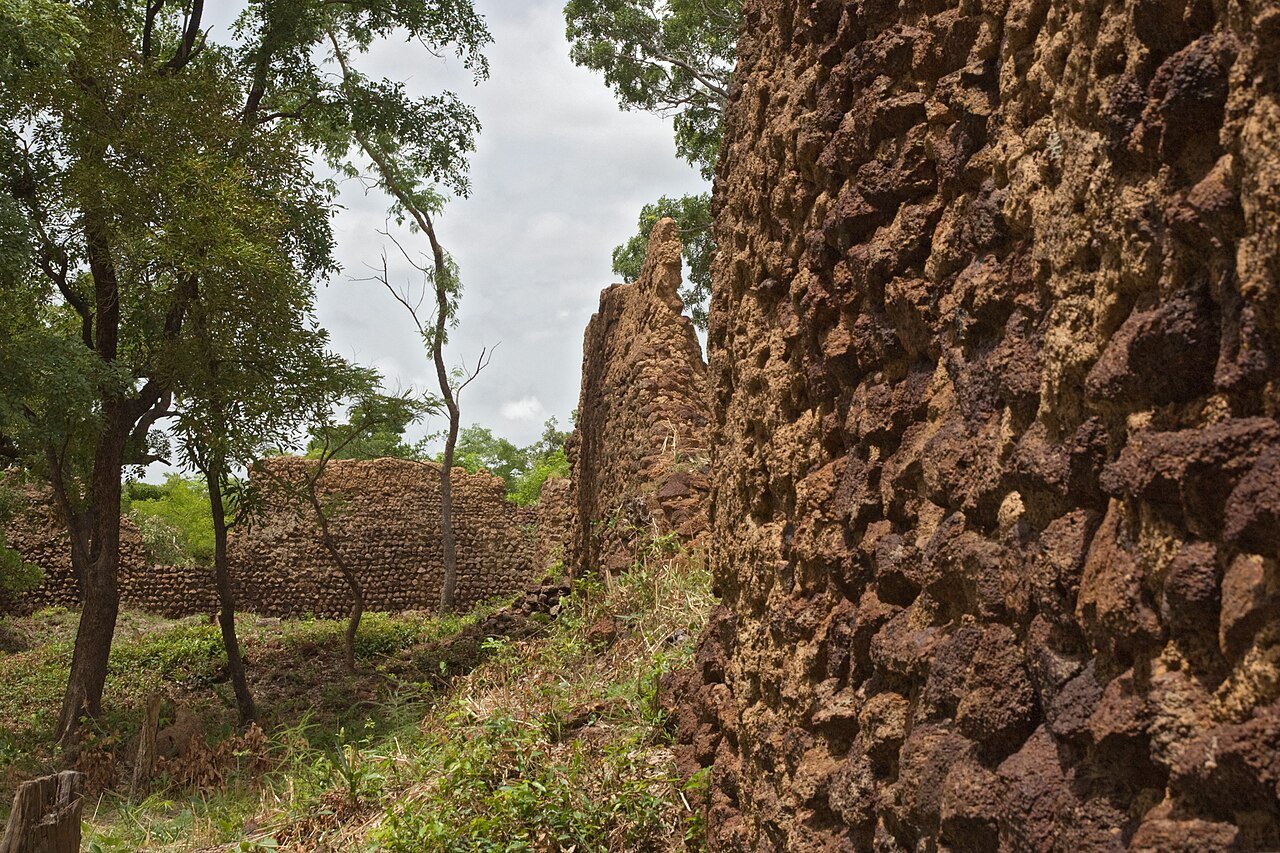
- Ruins of Loropéni (2009) — described by UNESCO as the best-preserved example of a medieval fortified settlement in West Africa, the site flourished between the fourteenth and seventeenth centuries during the successive dominance of the Ghana, Mali, and Songhai empires.
The stone walls of Loropéni, constructed without mortar, enclosed a trading centre that grew wealthy on the trans-Saharan gold trade. A decade passed before Burkina Faso added a second inscription, a gap that reflects both the complexity of nomination dossiers and the country’s limited heritage-administration capacity during periods of political instability.
The most visited — and the alternatives
Loropéni remains the site most familiar to international visitors and researchers, partly because of its age on the list and partly because its dramatic stone enclosures photograph well. The Royal Court of Tiébélé, inscribed in 2024, is rapidly drawing attention for a different reason: the entire adobe architecture of the royal compound is decorated with intricate geometric murals produced exclusively by women, a living tradition maintained across generations in the Kassena community.
Two sites reward closer attention from travellers interested in less-conventional heritage:
- Ancient Ferrous Metallurgy Sites of Burkina Faso (2019) — five properties distributed across the country document iron-smelting technology with evidence dating to the eighth century BCE, placing Burkina Faso among the earliest centres of iron production anywhere in the world. The oldest furnaces are at Douroula, in the west of the country.
- Ruins of Loropéni, for all its fame within Burkina Faso, receives few international visitors in absolute terms — the site sits in the far southwest near the borders of Ghana and Côte d’Ivoire, and travel infrastructure remains thin.
Natural and shared sites
Burkina Faso’s sole natural World Heritage Site is also its most geographically expansive: the W-Arly-Pendjari Complex, inscribed as a transnational property in 2017. The complex links three protected areas — Burkina Faso’s Arli National Park, Niger’s W National Park, and Benin’s Pendjari National Park — across a continuous block of Sudano-Sahelian savanna that supports one of West Africa’s most significant populations of African elephants, alongside lions, cheetahs, and wild dogs.
The transnational structure of the inscription reflects a broader UNESCO strategy for large-scale ecosystems that do not respect national borders. Management coordination between the three countries has been uneven in practice, and parts of the complex have faced security pressures in recent years, but the ecological integrity of the core zones remains notable. Visitors approaching from Benin — where Pendjari is the most developed for tourism — generally have the most accessible entry point.
How to find them
Reaching Burkina Faso’s World Heritage Sites requires planning. The capital, Ouagadougou, serves as the main gateway, but each site involves further overland travel on roads of variable quality. Loropéni and Tiébélé are both in the country’s south; the Ancient Ferrous Metallurgy Sites are distributed across multiple provinces; and Arli National Park lies in the southeast. Dry-season travel (November to February) is generally preferable for road access and wildlife visibility in the W-Arly-Pendjari Complex.
Burkina Faso’s World Heritage sites sit alongside thousands of other places on CHO’s interactive map, with GPS and sourced editorial history for each. See also our guides to Italy’s and France’s UNESCO sites, and our piece on cultural travel beyond mass tourism.
Frequently Asked Questions
How many UNESCO World Heritage Sites does Burkina Faso have?
Burkina Faso has four UNESCO World Heritage Sites. Three are designated as cultural sites and one — the W-Arly-Pendjari Complex — is a natural site shared with Benin and Niger.
What was Burkina Faso’s first UNESCO World Heritage Site?
The Ruins of Loropéni, inscribed in 2009, were Burkina Faso’s first UNESCO World Heritage Site. The stone-walled medieval settlement in the country’s southwest was recognised as the best-preserved fortified site of its type in West Africa.
What is the most recently inscribed UNESCO site in Burkina Faso?
The Royal Court of Tiébélé was inscribed in 2024, making it the country’s newest World Heritage Site. The property is remarkable for its adobe architecture decorated entirely with traditional geometric murals, a craft practised exclusively by women of the Kassena community.
Does Burkina Faso have any transnational UNESCO World Heritage Sites?
Yes. The W-Arly-Pendjari Complex, inscribed in 2017, is a transnational natural site shared by Burkina Faso, Niger, and Benin. It protects a large block of West African savanna and is home to populations of elephants, lions, cheetahs, and wild dogs.
Sources used in this article
- UNESCO — State Party Burkina Faso — World Heritage list.
- UNESCO — Burkina Faso: World Heritage Sites.
- CHO magazine — What is a World Heritage Site?
- CHO — Interactive map of heritage sites.
Sources
- S1 — Englebert, Pierre. Burkina Faso: Unsteady Statehood in West Africa. Westview Press, 1996. ISBN 978-0-8133-3680-0.
- S2 — Frank, Barbara E. Mande Potters and Leatherworkers: Art and Heritage in West Africa. Smithsonian Institution Press, 1998. ISBN 978-1-56098-794-9.
Spotted an error? Write to editorial@culturalheritageonline.com and we correct it the same day.